the city of heritage

by Anna Blake Mezquida

Down where the swift Passaic
        Flows on to the placid bay,
Where the marshes stretch to the restless sea,
And the green hills cling in the mountain’s lee,
There the sad-eyed Lenni-Lenape
        Unchallenged held their sway.

Gentlest of all their neighbors,
        Proud race of the Delaware,
They lived in the land where their fathers dwelt,
They killed the game and they cured the pelt,
And marked the blue in the wampum belt—
        The purple and blue so rare.

When day tripped over the meadows
        Fresh as a maiden trim,
They skirted the trails where the black swamps lie,
They notched the cedars to guide them by,
And wandered free as the birds that fly
        Beyond the river’s rim.

But few were the moons that silvered
        The mountain’s hoary side,
When over the banks where the waters foam,
Over the fields where they loved to roam,
Into the heart of their forest home
        They watched the pale-face stride.

Unconquered, and loath to conquer,
        They hid the arrow and bow;
The mat was spread for the honored guest;
They hung bright beads on the stranger’s breast,
And mutely signing, they bade him rest
        Before the camp-fire’s glow.

The suns of a hundred noondays
        Blazed down on river and hill,
And the pale-face walked in the red-man’s land;
A pious, fearless and strong-souled band,
For home and for country they took their stand,
        And served God with a will.

Where the waters gleamed in splendor,
        And the meadows glistened green,
They founded a town with an English name;
Their sternness shielded it like a flame,
And woe to the creature of sloth or shame
        Who dared let himself be seen!

They founded the house of learning;
        They built them the place of trade;
They guarded their laws by the force of might—
The laws that they held as a free man’s right;
And first to pray, they were first to fight
        When foemen stood arrayed.

And staunch were their children’s children,
        Brave men of a stalwart breed,
Who fought for the land where their fathers fought,
And kept the faith that was dearly bought,
That a brother-man, in the shackles caught,
        Forever might he freed.

And into the growing city
        Poured German and Celt and Scot
All seeking the land of the sore-oppressed—
The land that all free-born souls had blest,
And put of their manhood’s brawny best
        Into the melting pot.
        .         .         .         .         .         .         . 

The moccasined feet have padded
        Into the silence vast,
And the smoke-stacks belch where the camp-fires glowed,
Yet the white man reaps what the red man sowed,
For the friendliness to the stranger showed
        Shall live while the town shall last.

Unfearing, true and sturdy,
        The Puritan left his mark;
Though he sleeps beneath the grassy sod,
Though a million feet o’er his bones have trod
Yet he leaves his faith and his love of God
        To light men through the dark.

The soldier’s battles are over;
        His deeds but a written page!
Now the living pass by his low green tent,
But the patriot fires of a young life spent,
And a country whole from a country rent
        He leaves to a future age.

The toiler that strove and builded,
        And into the furnace hurled
Not coals alone, but his hopes and dreams,
Has lighted a beacon that ever gleams,—
While ships that sail on a hundred streams
        Shall bear his gifts to the world.

Then rise to your heritage, Newark!
        It cannot be swept away
Like chaff by the sullen north winds blown,
Or barren seed that is lightly sown,
For out of the past has the present grown—
        The city men love today!

Image: Joseph Atkinson, The history of Newark, New Jersey (1878)

Anna Blake Mezquida produced poetry, short stories, plays, film scenarios, and newspaper and magazine pieces in her native San Francisco. This work won the second prize in Newark’s 1916 poetry competition.

military park

by Joseph Fulford Folsom

ESS Newark http://www.playle.com/listing.php?i=BEACHGUY1705
Image: Playle’s Auctions

Old drilling-green! you register
The city life. You are the glass
Reflecting what it thinks and feels,
The stage on which its actions run,
Its face on which emotions play,
You screen the laughing comedy
That comes and goes with every hour;
You set the scene for tragedies
That reel out endlessly their pain.

War’s atmosphere was early blown
Across your velvet lawn. The tramp
Of rough-shod feet crushed down the grass
When rumors of the savage foe
Alarmed. You saw the Jersey Blue,
And later welcomed Washington,
Close followed by the British troops,
And every war of free America
In some way touched your sacred soil.

Your tempting shadows know the tale
The lover stammers like a prayer,
And beads with fervent kisses laid
Upon the lips of his fair shrine;
And not Old Trinity itself,
That nearby lifts its graceful spire
Among the trees, more zeal inspires,
For love is like in aisle or green,
With one Great Lover over all.

The brush of tripping baby feet
You feel—as ocean feels the kiss
Of rippling zephyrs on its face—
You nourish them on your full breast
With light and air—kind nature’s food.
You give the tired mother rest,
And for the jaded clerk at noon
You make a land of dreams to prop
His crumbling hope of better days.

You know the secrets of the clan
That sit and drone the hours away–
The disappointed and the broke,
The down-and-outer and the bum—
The living tragedies that run
Along with gay prosperity—
You know it all, old drilling-ground!—
You register the city’s soul,
And we unmoved look on the show.

The Newark Sunday Call carried this poem in its August 10, 1919, edition.

our nameless heroes

by William J. Fielding

On the Two Hundred and Fiftieth Anniversary Celebration
of Newark, N. J., 1666-1916

I sing not of the honored names so favored with acclaim,
But pay my humble tribute to the heroes without fame.
The plain and unassuming folk who shared the burdened life
Amid the virgin wilderness and elemental strife;
The pioneers who felled the trees and tilled the broken soil,
And paved the way for future growth by hardship, pain and toil!
My homage goes to such as these, unhonored and unsung,
Who made the primal sacrifice when Newark’s days were young.

I speak a friendly word for them whose labors are unknown,
Whom fickle fame has never kindly recognition shown;
The rank and file of sturdy men, and women by their side,
Who braved the hidden dangers here as settlers to abide;
The strugglers of the early years who broke the rugged ground
And passed from spheres of usefulness to graves all unrenowned.
To these forgotten, nameless ones, and those who followed them,
Into the Great Obscurity, I sing this requiem!

And so on down the steady line since that eventful morn,
When out of human labor pains our civic life was born,
I hail the toilers in the fields and at the handy trades,
And those who’ve done the drudgery that custom says degrades;
The workers of the stoic strain who bore the greatest load,
Who kept the wheels of progress rolling o’er the time-marked road;
The builders of a sturdy past that stood for future fame,
The men who gave their sweated flesh and died obscure in name.

A bitter foe of every war to conquer or despoil,
A hater of the heartless fiend who would the world embroil,
I lay a fitting laurel wreath upon the common grave—
On Mother Earth—in recognition of the nameless brave
Who fought on bloody battlefields to set a people free,
And gave their lives to move the cause of human liberty.
Custom lauds the honored names. I eulogize no less
The heroes who so coldly rest in blank forgottenness.

I pay a solemn tribute to the hero host unnamed,
The army of constructiveness that industry has claimed;
The soldiers of production in the factory, shop and mill,
Whose workmanship has made the name of Newark speak their skill.
To the victims and the martyrs, I add my special meed—
To those who have been sacrificed for avarice and greed—
The children, men, and women who have perished at their work,
And the toilers who’ve been stricken in holocausts or murk.

Let none forget the commonplace—the widows worn with care,
Who’ve battled singlehanded with the demon of despair;
The orphans and the helpless ones who’ve braved the ways unknown
And faced the struggles of the world, unguided and alone.
Let’s not forget the multitude that suffered through the years,
Whose nights of silent anguish have been bathed in bitter tears—
Heroic souls of motherhood whose love has lit the way
In treading the unbeaten paths to seek the Better Day.

I find a word of favor for the heroes seldom named—
The firemen who risk their lives in danger-traps enflamed;
The officers, on busy streets where traffic most congests,
Whose deeds in face of jeopardy their bravery attests.
So, come, salute the legions here, and those of other days,
Who’ve added to our wide renown and reaped no words of praise;
And let us, as an echo of this late Historic Fête,
Give honor to the Nameless Heroes ere it is too late!

Image: Gasser via Newark Story
Image: Henry Gasser via Newark Story

William J. Fielding was an activist, editor and author. From 1915 to 1918 he edited The Newark Leader, the weekly paper of the local Socialist Party.

This song of Newark’s unsung was included in Fielding’s Pebbles from Parnassus, comprising rhymes of revolt and flitting fancies (1917).

celebration ode

by Lyman Whitney Allen

Image: Arshile Gorky via artblog
Image: Arshile Gorky via Artblog

                        I

Great City of our love and pride,
Whose centuried fame is nation-wide,
        And wider than the alien seas,
To her we cry “All hail!” and bring
Devotion’s gifts the while we swing
        Censers of burning loyalties.

She answers in the regnant mood
Of Love’s triumphant motherhood,
        As round her surge the chants and cheers
Of joyous hosts that celebrate
Her times of eld, her new estate,
        Her quarter of a thousand years.

                        II

The sun in heaven did shine
        And all the earth sang “glory.”
’Twas Beauty’s immemorial sign,
        And Nature’s annual story.
The woodland birds were all awing;
        The hills and vales were rich with bloom;
’Twas Mayday, heyday of the Spring,
        And Life’s fresh gladness and perfume.

The fairest flower that decks the earth,
        In any clime or season,
Is that of a great ideal whose worth
        Time proves at the hest of Reason.
’Twas such they brought, in those days of yore,
And planted deep on our Jersey shore,—
A strange new flower whose growth became
Love’s healing for the civic frame.

It spread and every dawn was brighter
        And every creature obeyed its thrall;
We count the others lesser, slighter—
        The Rose of Freedom is worth them all.
The bluebirds know it,
The grasses show it,
        The south winds waft it through mart and street;
All else may perish,
’Tis ours to cherish
        This Jersey blossom from Robert Treat.

                        III

Hail Robert Treat the Puritan,
And the brave thirty of his clan!
        And that far fair Elizabeth,
Whose feet were first to tread our soil,
        A Puritan maid, whose betrothal breath,
        Fragrant with legendary grace that knows not death,
Works witchery naught may e’er despoil!

Superior souls were they,
        Who, in yon earlier time
Of Oraton’s rude Indian sway,
        Began this commonwealth sublime.
They laid foundations deep and strong.
The while they built they sang that battle song
The Ironsides chanted at Naseby and Marston Moor,
And all the hosts of freedom shout it forevermore.

The eyes of later sons behold
Their father’s faith and dreams of old,
Their Puritanism clear and brave,
Love’s sterner instrument to save,
Truth’s temple built with frame august,
To keep our great committals from the dust.

                        IV

List to the stir of the minute men!
        Hark to the roll of drums
                And the tramping of arméd feet!
        Lo, the great commander comes—
                Washington, leading a great retreat!
Welcome them patriots, now as then!

What soul was his to perceive the stair
From sky down sheer to the Delaware,
And trailing pageantry of light!
What seer of the nearing Christmas night
To hear God’s bells through the wintry gloom
Toll out the foeman’s doom!

O seven-year fury of war,
        For sake of a golden dream!
No whit of Old Glory, or Stripe or Star,
Shall ever bear stain or mar,
        While men remember redemption’s stream,
And cherish the all-consuming blaze
        Of Freedom’s holy battle ire—
Those Revolutionary days
        When Jersey’s blood was fire.

                        V

O Peace, thou gentle one!
No sound of belching gun
Displays thy heavenly part;
For Beauty’s architect thou art.
Thou buildest domes of grace
        That catch and echo back
                The spirit’s joyous singing.
Thy high and sacred place
        Is where no tempest’s wrack
                Its bolts of hate are flinging.

The elements of air and earth!
        What willing slaves they fast became
To those new masters! Solid worth
        Rose from the dust to shining frame.
Th’ expulsive smithy fire,
The mill-wheel’s creaking sounds,
Stage-coach, the “Old First” spire,
        “The Hunters and the Hounds,”
The workshop, mart and school,
        And “Cockloft Hall,”
And Combs and Boyden snapping custom’s rule
        Across the knees of genius!—History’s thrall
Enwraps and brings the glow of worthy pride
To us to whom our fathers’ gifts were undenied.

                        VI

War clouds were wildly gathering.
        One rode through the City’s streets,
                Under Fate’s horoscopes.
                        Men bowed in awe as he passed—
                Lincoln, the hope of a Nation’s hopes,
                        Riding to meet the approaching blast.
O Newark, what memories spring
        Out of thy deep heart-beats!

The black storm rolled, surcharged with thunder,
While levin of hate tore the sky asunder;
The earth yawned wide and incarnadine;
Deep hells flared forth where heavens had been;
And Jersey’s soul was a sacred cup
        Filled unto the brim with patriot blood,
And offered, thank God, sublimely up
        For Freedom and Country. And thus she stood,
And thus men marched, her heroes marched—
The ebon sky with light unarched—
And thus the regiments marched, and marched away,
The regiments marched day after day,
While tears were hot upon ashen faces,
And anguish was mistress of love’s embraces.
O God! but it was terrible, terrible,—
’Twas part of a Nation’s taste of hell,
To be inspirer to oppresséd nations,
Emancipator of future generations.
O City of heroes! Thou didst thy duty well.

Beautiful days since then have been—
        Days of our golden heritage.
        Right is the warrior’s master wage;
Peace is the garden that freemen win.

                        VII

What is this with its mighty thunderings
        Shaking a city’s fundaments?
This is the voice composite of toil that springs
        Out of ten thousand fiery vents.
This is the roar of a city’s industrial life.
        Throb of her engines, whirr of her wheels,
Furnace and dynamo, traffic and artistry rife,
        Strenuous giant that rages and reels
Backward and forward with passion cyclonic strained,
        Lifting gigantic arms and hands
Glutted with products, by sweat and by sinew gained,
        Offered to native and alien lands.

Wise men who follow Love’s starry frame,
        Here in this modern age,
                See where it hovers now
Sheer over smokestack and belching of flame.
        Greet Right’s increasing wage,
                Unto his triumphs bow.

                        VIII

Queen City of Industry!
        And whence doth wisdom come?
                Never a mortal son,
                Only the Thronéd One
Is great enough for thee
        And all thy radiant future’s sum.
Thy sires immortal on heights above
        Chant Vision’s increasing strain,—
’Tis God alone has the right to reign,
Since He is the Lord of Love.

The discords of drudgery turn to the melodious measures
        That fill the machinery of toil;
Faith’s song of emancipation, time’s chiefest of treasures,
        Ascends out of life’s turmoil.
The heart of the quickening world rejoices;
        Democracy’s prophets command, “Make way!”
While Wealth and Labor, with federate voices,
        Proclaim the Earth’s New Day,
And all the hosts of service spring
        Up the steep slopes of righteousness,
        To answer Justice with loud “Yes,”
To answer Love as ’twere their King.

                        IX

Out of the marshes she proudly rises,
        Greeting her Golden Age;
Civic symbol of Art’s emprises,
        Liberty’s heritage,
Triumph of Industry, Glory of Miracle,
Facing the Future’s alluring spell.

Set all the whistles blowing!
        Set all the flags a-flying!
                Cheer her predestined majesty!
                        Chant her apocalypse!
Up to her feet the sea is flowing;
        Thousands of eager ships are lying
                Waiting her on the invaded sea.
                        Hers are the sea and the ships.
Blow, whistles blow! Wave flags unfurled!
Newark belongs to the world.

Lyman Whitney Allen was poet laureate of Newark’s 250th anniversary festivities.

The Ode was a commissioned work, delivered at the opening exercises on May 1, 1916, in the new Proctor’s Palace at 116 Market Street. Inside the cavernous theater “every seat from pit to gallery was occupied,” exulted the celebration’s official journal The Newarker, “and the boxes shone resplendent with the wealth and fashion of the State and city.”

the first city planning

by Leonard Harmon Robbins

Image: S. H. Congar, in Jonathan F. Stearns, First Church in Newark (1851)

Jasper Crane,
With rod and chain,
Plotted down
Newark Town.
Gray with age,
Grave and sage,
The plan he laid
When the town was made.

Pierson, pastor
And Treat, the master,
Lent him aid
When the lines were laid;
Wisest three
In the colony,
And Crane was quick
At arithmetic.

“Build,” quoth he,
“Fair to see;
Serve them well
Who here shall dwell.”
The years increase
To centuries—
His work was good
And his work has stood.

Broad Street wide,
The city’s pride,
Throve and grew
On the lines he drew;
And the Training Place,
Our breathing space
In the city’s heart,
He set apart.

To him we owe
The pretty show
Of living green,
The spot serene
Now Washington Square.
The townsfolk there
Drove cart and shay
On Market Day.

The Corners Four
His imprint bore—
A wildwood then,
Untrod by men.
He could not see
That the cross would be
The busiest way
In the land one day.

The East Back Street
And the West Back Street,
Though each may claim
A prettier name,
Follow the lines
Of his designs;
Still run by the chain
Of Jasper Crane.

Thousands go
To and fro
In the lanes he broke
For the Founder folk.
The town’s still new;
There is work for you,
There are paths to lay
As in his day.

Jasper Crane is credited with laying out the original commons and streets of New Haven.  He left Connecticut in 1666 for Newark, of which he and Captain Robert Treat became the first magistrates. Evidence is scarce that Crane in fact delineated Broad Street, the Training Place (now called Military Park), the present Mulberry and Washington Streets or other components of Newark’s earliest town plan.

Leonard Harmon Robbins wrote for the Newark Evening News, producing light verse which he later published as Jersey Jingles (1907). “The First City Planning” appeared in the News of May 6, 1916.

the founders

by David Maclure

Reinventing Newark p87
Image: H. M. Pettit, proposed Prudential Insurance Co. Headquarters in Reinventing Newark

Here where a giant city’s pulses throb,
Where falls the tread of ever-hurrying feet
Thronging the broad Rialto of to-day,
Here where triumphant industry and thrift
Have reared their monumental towers on high
And where upon a thousand tides are launched
The argosies of genius, labor, skill,—
Here, bid the Past arise from mists of time,
Here, sweep away the pageant of To-day;
The throngs of hurrying men, the city’s life,
The garnered fruits of husbandry and wealth,
Yea, sweep away the progress and the pride
And all the triumphs of man’s toil and sweat
That centuried time has builded in our midst,
And in the charm of virgin innocence
Behold the commonwealth where now we stand
Bride of the solitude and wilderness.

O fair young bride, how simply art thou busked
Here in thy dwelling by the blue Passaic!
Green meadows eastward to the river’s verge
And westward, upland slopes and forest glades
To mountain solitudes, the scattered homes
Of men, the vagrant lanes that stole away
And fled into the wilderness beyond,
The village church; a fortress and a shrine,
The burial ground, the common and the school,
The planted fields, the low of grazing herds,
The shining river winding to the bay
The green and level meadows washed with brine,
And far away the wandering Hackensack,
A glint of glittering silver in the sun.

And they who made a habitation here,
Who dared the rigors of a wilderness
And met the red man in his native wilds,
Who hewed the forest, planted fertile fields
And built the sacred altar fires of home,
Shall these, the builders of a common-wealth,
The founders of a city, know no fame,
Nor claim the tribute of posterity?
Brave band of sturdy men, heroic souls!
Not heraldry but virtue made thee great,
Plodding the path of humble duty, still
Ye wrought, and builded greater than ye knew,
Yea, on foundations of integrity
Ye laid the civic glory of to-day.

And what a dower of valor, virtue, faith
Is ours. A heritage to guard and keep,
Yea, ours to build upon the prestiged past
Far loftier temples than our fathers dreamed,
’Tis ours to build a city of the soul,
And rising from life’s sordid things to know
That men of virtuous lives and noble aims
Alone can build the perfect common-wealth,
For though our trade, our skill, our wealth increase,
We still may be a shame–for doubt not this:
A city’s glory is her citizens.
Remembering this, great may our city grow,
Each man a partner in prosperity,
Each man a brother to his fellow-man,
Sharing the gains of labor and of skill,
Rich in the spirit’s fruits beyond all else,
Proud of his fellow-man, proud of himself,
Proud of his home, the city beautiful.

David Maclure was the principal of Chestnut Street Primary School between 1890 and 1913. He wrote historical fiction as well as verse.

The 45-story office tower and pedestrian subway shown in the above drawing were proposed in 1916 for the intersection of Broad and Market Streets. They were never built.

colonial newark

by Martin L. Cox

O ye, who love lore and tradition,
        The legends and tales of the ancients,
The records of danger and struggle,
        Of toil and of effort unceasing,
To you, will we bring the true story
        Of founding and building our city,
Great Newark, the Queen of Passaic.

Across the salt meadows of Jersey,
        Where wave the salt tresses of marsh grass
In billows like those of the ocean,
        Made bright by the flowers of the mallow,
Lay spread in the glorious sunset,
        The slopes of the mountains of Orange,
Like sentinels guarding the valley.

By wagons with cattle and household
        Came settlers from colonies eastward,
To build by the lordly Passaic,
        A town for defence and protection,
Where God might be worshipped with freedom,
        And industry bring to them comfort
And homes blessed with peace and security.

Together they dwelt in the village
        With farms so fertile about them
That comfort and plenty abounded,
        And colonists flocked o’er the Hudson
To share it with neighbors and kinsmen
        Until they had worn a wide highway
Connecting the town with the Hudson.

The church in the midst of the village
        Gave blessing and hope to the settlers
Whose toil-burdened lives took fresh courage,
        As pastor and people considered
The lives of the leaders of Israel,
        Who built up a nation of power
In Jordan’s unpromising valley.

With cherries and peaches and apples
        The orchards were laden in season.
And many a gathering of young folks
        Was needed to care for the harvest,
For maidens and youths all looked forward
        With eager and glad expectation
To curing and storing the apples.

When trees had been plucked of their fruitage,
        The apples were sorted and taken
To cellar for use of the household,
        Or sent to be made into cider.
In clean, sanded kitchens the young folks,
        With knives and with basins for paring,
Assembled with laughter and pleasure.

Great buckets of apples before them
        Soon fell bereft of their wrappers,
While matrons divided and cored them,
        Preparing the fruit for the curing.
Both busy and happy, their lives were,
        And pleasure with toil intermingled
Made labor delightful and easy.

The slopes of the mountains were covered
        With plumes of the maize in the summer,
The gift of the red—to the white-man,
        Which helped the first settlers to prosper.
With frost, it was ripe for the cutting
        And hum of the grind-stone and chatter
Of men filled the plains and the uplands.

From pastures in woodland and meadow
        Came oxen with wagons or sledges
To bear this rich treasure homeward.
        In crib or in stack it is garnered,
And people give thanks in the churches
        For safety and bountiful harvests,
That come from the good Lord, Jehovah.

In winter, the maid or her mother
        Keeps weaving the wool into homespun
Or flax into linen for clothing
        On looms in the kitchen or best-room,
While men dress raw skins for the leather
        That is needed for boots for the people
When snow covers village and valley.

So lived the first settlers of Newark
        Along the Passaic which carried
The floods of the mountains in springtime
        And boats of the settlers in summer.
Thus, lived they, in peace and contentment,
        In quiet enjoyment of freedom,
Of peace and of church and of friendship.

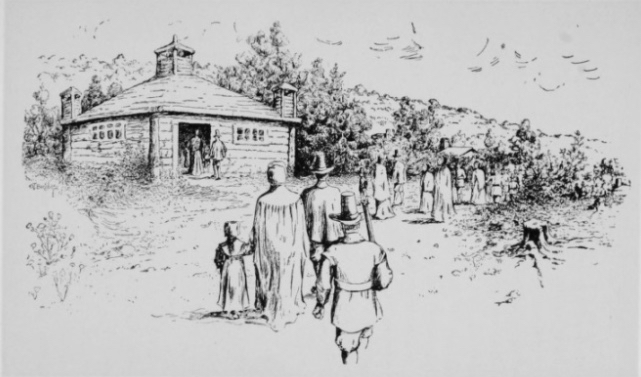
Image: Frank J. Urquhart, A short history of Newark

Martin Luther Cox was principal of Thirteenth Avenue Grammar School and presented this poem at the June 1910 commencement.

the ballad of seth boyden’s gift

by Alice Read Rouse

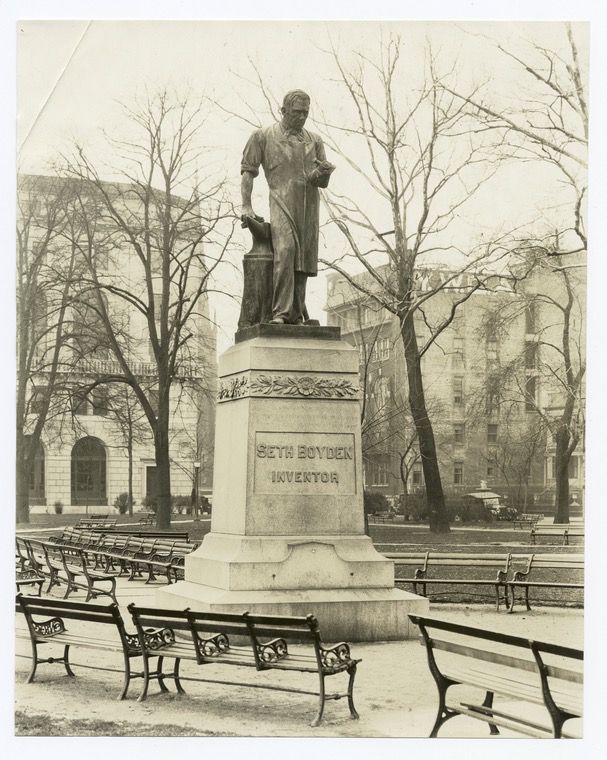
Image: The New York Public Library

High in the Square his statue stands,
        INVENTOR carved beneath:
But he who crimsoned the lips of Spring
        Might wear a Poet’s wreath.

Old Newark sat in its bosky streets,
        Tidy and prim and serene;
Prankt with posies and orchard sweets
        To the fringe of its marshes green.

‘Twas after the fighting of 1812
        Seth Boyden came to town;
He’d licked the British,—and they’d licked him,—
        And he wanted to settle down.

Old Newark called to him potently,
        Though none but himself could hear
That clashing summons as it clanged
        On his prophetic ear:

None but himself see that clean blue sky
        With its white little chubby clouds,
Grimed with the reek of his chimneys tall,
        Grim with his black smoke-shrouds.

“Thou hast lent me talents ten, Lord God,”
        To his Maker deep he prayed:
“An Thou prosper me, I will give them back
        Tenfold increased,” he said.

Long with his cunning hands he wrought,
        Long with his seething brain,
That God might not require of him
        His usury in vain.

He watched the hedgerow’d village lanes
        Where tinkling cows browsed home
Herded by whistling barefoot lads,
        Great thoroughfares become:

Stone-paven streets where clicked the heels
        In castanetted tune
Of all new Newark’s gentlefolk,
        Shod with his shining shoon.

Malleable to his iron will,
        He bent earth’s iron bars:
The lightning Franklin had lured down,
        He flashed back to the stars.

A thousand men he kept at work,
        A thousand ships at toil,
A thousand ways of increase he
        Wrought out upon the soil.

At length in life’s cool afternoon,
        He paced his garden-place:—
A garden clipt from Newark’s youth,
        Gay with its old-time grace.

Outside his gates he heard the growl
        Of labor chained to the wheel,
The roar of his captured genii bound,
        The shriek of his tortured steel.

He thought of old Newark’s bosky streets,
        Tidy and prim and serene,
Prankt with posies and orchard sweets
        To the fringe of its marshes green.

He said: “I have had my work to do
        Thy lendings to increase,
Lord God:—to pay Thee back Thy loan
        Before my days should cease.

“Now, ere my death-hour strike, I would
        I might just pleasure Thee!
Give Thee and Newark some quaint gift
        All free from merchantry.”

Up from the garden-sward there breathed
        An exquisite bouquet:
Fresh, faint, and fragrant as a wine
        For fairies on Mayday.

And glancing down, Seth Boyden saw
        The wonder at his feet:
Wild strawberries like elfin cups
        Brimmed with ecstatic sweet:

Too frail for aught save dryades
        To taste with leafy lips,
Yet aromatic as the juice
        That Puck in secret sips.

Seth Boyden smiled: with careful skill
        He culled the perfect plants.
Through patient moons he wove his spells
        Till knowledge conquered chance.

He fed and watered, pruned and plucked,
        Till from his garden-sod,
There blazed a berry fit to feed
        A hero or a god!

This was the gift Seth Boyden gave
        To all his world for boon;
That Heaven might smile and Newark feast
        From April on through June.

For the great epic of his toil
        Heaped laurels are his meed:
And garlands for the loveliness
        Of that last lyric deed.

High in the Square his statue stands,
        INVENTOR carved beneath:
But he who invented strawberries,
        Might wear a Poet’s wreath!

Seth Boyden came to Newark in 1815, setting up a harness and leather shop not far from the site of the present monument in Washington Park. A plaque added to the statue’s base lists some of his numerous achievements, among them the discovery of processes to make malleable iron and patent leather, both crucial to Newark’s prosperity. The tablet also notes his success in strawberry hybridization.

Historian Alice Read Rouse submitted “The Ballad of Seth Boyden’s Gift” to the 1916 poetry competition from her home in Covington, Kentucky. It was one of thirteen prizewinning poems.

the martyr, a revolutionary ballad

by Thomas Ward (“Flaccus”)

Image: Frank J. Urquhart, A short history of Newark

When on the field of battle the soldier sinks to death,
And to his suffering country’s cause devotes his latest breath,
His country, ever grateful, rewards him with a name
On everlasting marble carved, and hands him down to fame.

But in our early struggle, o’errun by cruel foes,
Full many a nameless martyr sank, weighed down by bitter woes:
Who suffers like the soldier, should reap renown as well—
Oh! sure he should not be forgot, whose trials now I tell.

‘T was night in deep mid-winter, when fields were choked with snow,
And widest streams were bridged with ice, and keenest blasts did blow;
A heavy muffled tramp through the village streets went by:
All shuddered in their beds, for they knew the foe was nigh.

Soon from that fearful silence alarming clamors peal,
And rising gleams along the snow the dreadful truth reveal;
‘Rouse! rouse ye all! the town is fired!’—cries friend to friend—’and lo!
The triple ranks! the flashing steel!—we’re mastered by the foe!’

Wide flames, with showers of dropping stars, that quench the stars on high,
Now flapping loud their mighty wings, rush flying up the sky:
Now mothers clasp their children, and wail aloud their woes,
And gathering, hide their little store from savage plundering foes.

For oft the rude marauders had plied their cruel trade,
And HEDDEN, with a few bold hearts, had oft the robbers stayed:
But now with stealthy step, at the hour of midnight dead,
They come!—they burst the doors—they drag the old man from his bed.

‘Renounce thy faith! yield up thy mates! or, by King George, we’ll cast
Thy rebel limbs on yonder snows to stiffen in the blast!’
‘My limbs are little worth.’ he cried; ‘their strength is nearly gone;
My tongue shall ne’er belie my heart, nor shame my cause: lead on!’

Then furious all, they throttled him; when ‘Hold!’ their leader cries,
‘Despatch him not! we’ll try his pith, before the rebel dies:
Let him with us unclad return! and though unmoved by steel,
Perchance a march along the snows will cool his patriot zeal!’

Loud yells applaud the sentence!—then, frantic with despair,
Wife, children kneel for mercy, but they find no mercy there:
For they rudely thrust them by, and they drag the old man forth,
And crouching quake his bare limbs, as they feel the cutting North.

Then rings the shouldered musket, then taps the rattling drum,
And with rapid step they tramp, for the freezing winds benumb:
By the savage light of flames on their dreary march they go,
That shoot their shadows far before, along the glaring snow.

No pity for their victim would move their hearts of stone,
But still his bare feet tread the snows that chill him to the bone:
And many an icy splinter would gash them with its blade—
The blood that stains his every step their brutal march betrayed.

And when his stiffened limbs would lag, by age and sickness lamed,
With bayonet-thrust they urge him on, till cruelty is shamed:
God bless the soldier’s heart! who cried, ‘This sight I cannot see!’
And round him threw his blanket warm, that clothed him to the knee.

Now hard as marble pavement, black Passaic stops the way:
Like serpent stiff in winter sleep, her torpid volume lay;
And in the midnight hush not a sound she gave the ear,
Save the long peal of parting ice, like thunder crackling near.

But still the word is ‘March!’ and they tramp the icy floor:
But the old man’s feet are numb, and they feel the cold no more.
Full many a weary mile he drags, but ere the break of morn,
In prison thrust, he drops at once, exhausted and forlorn.

Why linger in my story? His heavy trials past
Broke down the feeble strength of age—he drooped and sank at last:
But GOD the martyr’s cruel death has well avenged, for see!
His murderers beaten from the soil—his land, his children free!

In Newark the Revolutionary War was a civil conflict, driving a wedge between neighbors and dividing families.  A stalwart of the American side, Joseph Hedden Jr. oversaw confiscation of property belonging to “persons gone over to the enemy.” His zeal in ferreting out Loyalists and their possessions made him an obvious target for retaliation in the nighttime raid of January 25, 1780. The forced march to New York in unbearable cold and subsequent confinement in Provost prison hastened his death at the age of 51.

“The Martyr” appeared in the September 1841 number of The Knickerbocker, or New-York Monthly Magazine, as part of a cycle entitled Passaic: A Group of Poems Touching That River.

city of a hundred years

by William Hunter Maxwell

112199pv
Image: Library of Congress

A Tribute to Newark, New Jersey, Honoring by Celebration the One Hundredth Anniversary of the Granting of a Charter to the City by the State of New Jersey

Our City of a Hundred Years,
Born of rugged ideals,
Conquering fears and tears,
A soul sublime reveals.
Men of might hewed the way,
For Newark’s march ahead;
Their eyes visioned another day,
And other paths to tread.
Our City of a Hundred Years,
Pride of the Garden State,
Stalwart among its peers,
Grateful for its fate.
Service is King in our Realm,
Common comfort is the goal,
Since early fathers at the helm
Inscribed the Charter Roll.
Our City of a Hundred Years,
We honor its Charter Birth;
A home each worker fain reveres,
And gives his manhood worth.
’Tis for steerers of the ship,
As a crowded future nears,
To plan for others on the trip
Of another Hundred Years.
For yea, today, we reap the fruits
Of seeds that zeal hath sown,
So for tomorrow let’s set new roots,
For the glory of a Newark now unknown.

On March 18, 1836, Newarkers approved the incorporation of the city by a vote of 1,870 to 325. Twenty-four days later, on Monday, April 11, they elected Newark’s first mayor, William Halsey. The cornerstone of the first city hall was laid during his term, which lasted one year.

Journalist William Hunter Maxwell was a member of the Committee of One Hundred overseeing the 1916 anniversary celebrations, but had resigned in protest over the racism of some of its pronouncements. Still, his love of the city was constant and he often committed its praises to verse. This ode on the centennial of Newark’s charter was printed in The Life to Live and Other Plainpoems (1937).