broad street

by Augustus Watters

Image: newarkstory http://newarkstory.com/Newark_Story/Places_photos_2.html#42
Image: Newark Story

(1666-1916)

When lilacs bloom in urban bowers,
Sweet harbingers of summer hours,
And cherry-blossoms lightly fall
Like snowflakes by the garden wall;
When robins hide in apple-trees,
And pansies nod in every breeze,
And like cathedrals, tall and grand,
Our hoary elms majestic stand,
While underneath the current flows
Of human joys and human woes,
Then seems the street a mighty stream
On which we mortals drift and dream.
Here toiled the Fathers in the fields,
Where earth her truest treasure yields,
And here the Sons, with reverent eyes,
Behold a royal harvest rise.
Yet ever, ‘neath the starry cope,
The radiant barges Love and Hope
Move side by side with Grief and Care,
And all the flotsam of Despair.
In vain the pilots seek to force
Their way against the current’s course,
And where they’re bound, or whence they came,
Nor sage, nor bard can ever name.
And none of all the fleets that glide
Along the weird and heaving tide
Turn back their prows or ever teach
What Port the later Pilgrims reach.

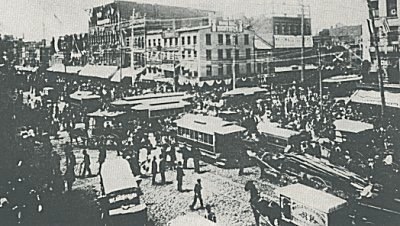
Frustration with Newark’s congested streets led to the opening in 1916—Newark’s 250th anniversary year—of the Public Service Terminal on Park Place, a few blocks north of Broad and Market. Linked to the terminal was the city’s earliest subway, a short trolley line segment beneath Cedar Street. The new terminal saw more than 2,500 streetcar stops per day in 1916.

Augustus Watters’ meditation on bustling Broad Street was included in The Newark Anniversary Poems, published the following year.

old mulberry street

by E. Alma Flagg

mulberry194001
Image: newarkstreets.com

From Chestnut Street north went
        that road of our childhood,
Fascinating all the way
From the tavern owned by one
        classmate’s folks,
Past a couple of factories
Fish market, shoemaker’s shop,
        hardware, grocery stores, laundry,
And a drug store with several
        large, shining globes,
Filled with liquid—red, yellow,
        green, blue—
And the candy stores where a
        penny bought
Lafayettes, lollipops, licorice, or
        Mary Jane,
Or even a grab-bag of assorted
Sweet, crunchy, chewy morsels,
Or a nickel bar of brown or pink or white taffy;
And on through Chinatown
Where restaurants served strange foods,
To the markets which
We could only visit on Saturdays.
The Markets! outdoor extravaganzas
Of meats, eggs, produce, fish, bread,
And, wondrous bright,
A great revolving cylinder
        roasting peanuts—
What a smell! and what a taste!
Hot peanuts, m-m-m, delicious!
Oh! what an adventure a
        trip to the markets—
        of Mulberry Street was!
Through busy crowds of people all intent,
And maybe bumping us about,
But it did not bother us.
The joy of being in the
        middle of it all
Went home with us to
        be savored
Till we went that way again.

Alma Flagg’s trip up “old Mulberry Street” can be traced (in reverse order) through the listings in Price & Lee’s 1940 Newark city directory, of which a small section is shown here. The poem is found in Flagg’s collection Lines, colors, and more (1998).

divident hill

by Elizabeth Clementine Kinney

dividenthill
Image: Old Newark

Pause here, O Muse! that Fancy’s eye
        May trace the footprints still
Of men that, centuries gone by,
        With prayer ordained this hill;
As lifts the misty veil of years,
        Such visions here arise
As when the glorious past appears
        Before enchanted eyes.

I see, from midst the faithful few
        Whose deeds yet live sublime–
Whose guileless spirits, brave as true,
        Are models “for all time,”
A group upon this height convened–
        In solemn prayer they stand–
Men, on whose sturdy wisdom leaned
        The settlers of our land.

In mutual love the line they trace
        That will their homes divide,
And ever mark the chosen place
        That prayer hath sanctified;
And here it stands–a temple old,
        Which crumbling Time still braves;
Though ages have their cycles rolled
        Above those patriots’ graves.

As Christ transfigured on the height
        The tree beheld with awe,
And near his radiant form, in white,
        The ancient prophets saw;
So, on this summit I behold
        With beatific sight,
Once more our praying sires of old,
        As spirits clothed in light.

A halo crowns the sacred hill,
        And thence glad voices raise
A song that doth the concave fill–
        Their prayers are turned to praise!
Art may not for these saints of old
        The marble urn invent;
Yet here the Future shall behold
        Their Heaven-built monument.

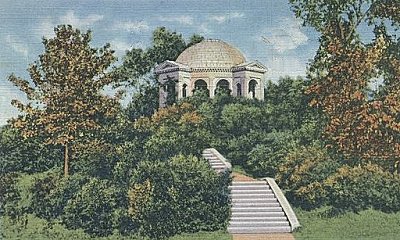
Elizabeth Clementine Stedman Kinney (née Dodge) was a prolific writer of poems and essays. Her “Divident Hill” was first printed in the Newark Daily Advertiser of September 10, 1849. Part of the historic boundary between Newark and Elizabeth, Divident Hill was crowned in 1916 by the stone pavilion pictured above.