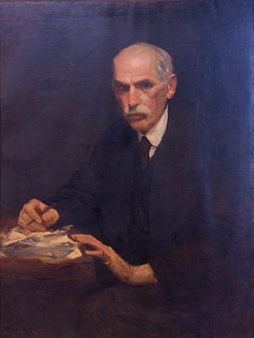
That is his portrait,—high bequest To our Museum’s hall. The artist painted at his best The one whose features well attest What mind and heart install.
There is no genius such as his Midst Newark’s throngs of men. To him be praise for what he is, And for his gracious ministries Past threescore years and ten.
His name and fame are heralded Where lore has reverence. Courageous followers daily tread Ascension paths his faith has led Soul’s triumph over sense.
He holds the keys of Learning’s doors To Wisdom’s House of Light. He gathers Culture’s golden stores, Interpreting the metaphors A city’s dreams incite.
His vision lured the princely gift Of a great merchant’s heart. Fine natures, they together lift The veils from Beauty, turn the drift Of wealth to calls of Art.
What streams of inspiration flow Out of his life’s survey! ’Neath healing shades they gently go, While time can never overthrow The hopes along their way.
All hail to Newark’s honored Sage This five and twentieth year! For him be long and mellowing age, With vistas of earth’s heritage That comes from his career.
LIBERATOR
by Gerald Raftery
He hurled no ultimatum at the state Nor led a revolution out to cry An empty creed against the empty sky. Nor ever did he play upon the hate Of poor for rich, of ignorant for great. And since his slow revolt was fine and high For him no banners dip along the sky, No cannons roar, no millions venerate.
His deed was not a sudden, blaring thing; It was a lifework, patient, unacclaimed. And now before the searching mind of youth The serried thinkers of the ages fling Their gold. This man made knowledge free, unchained; He loosed the slow, invading tide of truth.
To John Cotton Dana, Newark’s great champion of democratic culture, the worth of poetry and the other arts lay in one’s own experience of them. The pioneering director of the city’s library and museum considered popular songs and jingles “good poetry to the thousands who read and love them.” Dana insisted on the presence of poetry “in life itself, in homely everyday relations, in passing sentiments,” whether or not it found expression in the written word. (The Newarker, July 1912)
Lyman Whitney Allen composed his tribute on seeing Douglas Volk’s portrait exhibited in the newly opened home of the Newark Museum. The museum building, paid for by businessman and philanthropist Louis Bamberger (“the princely gift / of a great merchant’s heart”), was dedicated in 1926. In the same year Dana turned 70—on August 19—and marked 25 years of service to the artistic and cultural life of his adopted city. Since 2009 Volk’s painting has been displayed in the Dana Room of the Dana Library, on the Newark campus of Rutgers University.
Allen’s poem was printed in the Newark Sunday Call of March 6, 1927. Gerald Raftery’s, one of many homages paid Dana after his death, appeared in the New York World on September 16, 1929, and in the Newark Evening News three days later.
Great City of our love and pride, Whose centuried fame is nation-wide, And wider than the alien seas, To her we cry “All hail!” and bring Devotion’s gifts the while we swing Censers of burning loyalties.
She answers in the regnant mood Of Love’s triumphant motherhood, As round her surge the chants and cheers Of joyous hosts that celebrate Her times of eld, her new estate, Her quarter of a thousand years.
II
The sun in heaven did shine And all the earth sang “glory.” ’Twas Beauty’s immemorial sign, And Nature’s annual story. The woodland birds were all awing; The hills and vales were rich with bloom; ’Twas Mayday, heyday of the Spring, And Life’s fresh gladness and perfume.
The fairest flower that decks the earth, In any clime or season, Is that of a great ideal whose worth Time proves at the hest of Reason. ’Twas such they brought, in those days of yore, And planted deep on our Jersey shore,— A strange new flower whose growth became Love’s healing for the civic frame.
It spread and every dawn was brighter And every creature obeyed its thrall; We count the others lesser, slighter— The Rose of Freedom is worth them all. The bluebirds know it, The grasses show it, The south winds waft it through mart and street; All else may perish, ’Tis ours to cherish This Jersey blossom from Robert Treat.
III
Hail Robert Treat the Puritan, And the brave thirty of his clan! And that far fair Elizabeth, Whose feet were first to tread our soil, A Puritan maid, whose betrothal breath, Fragrant with legendary grace that knows not death, Works witchery naught may e’er despoil!
Superior souls were they, Who, in yon earlier time Of Oraton’s rude Indian sway, Began this commonwealth sublime. They laid foundations deep and strong. The while they built they sang that battle song The Ironsides chanted at Naseby and Marston Moor, And all the hosts of freedom shout it forevermore.
The eyes of later sons behold Their father’s faith and dreams of old, Their Puritanism clear and brave, Love’s sterner instrument to save, Truth’s temple built with frame august, To keep our great committals from the dust.
IV
List to the stir of the minute men! Hark to the roll of drums And the tramping of arméd feet! Lo, the great commander comes— Washington, leading a great retreat! Welcome them patriots, now as then!
What soul was his to perceive the stair From sky down sheer to the Delaware, And trailing pageantry of light! What seer of the nearing Christmas night To hear God’s bells through the wintry gloom Toll out the foeman’s doom!
O seven-year fury of war, For sake of a golden dream! No whit of Old Glory, or Stripe or Star, Shall ever bear stain or mar, While men remember redemption’s stream, And cherish the all-consuming blaze Of Freedom’s holy battle ire— Those Revolutionary days When Jersey’s blood was fire.
V
O Peace, thou gentle one! No sound of belching gun Displays thy heavenly part; For Beauty’s architect thou art. Thou buildest domes of grace That catch and echo back The spirit’s joyous singing. Thy high and sacred place Is where no tempest’s wrack Its bolts of hate are flinging.
The elements of air and earth! What willing slaves they fast became To those new masters! Solid worth Rose from the dust to shining frame. Th’ expulsive smithy fire, The mill-wheel’s creaking sounds, Stage-coach, the “Old First” spire, “The Hunters and the Hounds,” The workshop, mart and school, And “Cockloft Hall,” And Combs and Boyden snapping custom’s rule Across the knees of genius!—History’s thrall Enwraps and brings the glow of worthy pride To us to whom our fathers’ gifts were undenied.
VI
War clouds were wildly gathering. One rode through the City’s streets, Under Fate’s horoscopes. Men bowed in awe as he passed— Lincoln, the hope of a Nation’s hopes, Riding to meet the approaching blast. O Newark, what memories spring Out of thy deep heart-beats!
The black storm rolled, surcharged with thunder, While levin of hate tore the sky asunder; The earth yawned wide and incarnadine; Deep hells flared forth where heavens had been; And Jersey’s soul was a sacred cup Filled unto the brim with patriot blood, And offered, thank God, sublimely up For Freedom and Country. And thus she stood, And thus men marched, her heroes marched— The ebon sky with light unarched— And thus the regiments marched, and marched away, The regiments marched day after day, While tears were hot upon ashen faces, And anguish was mistress of love’s embraces. O God! but it was terrible, terrible,— ’Twas part of a Nation’s taste of hell, To be inspirer to oppresséd nations, Emancipator of future generations. O City of heroes! Thou didst thy duty well.
Beautiful days since then have been— Days of our golden heritage. Right is the warrior’s master wage; Peace is the garden that freemen win.
VII
What is this with its mighty thunderings Shaking a city’s fundaments? This is the voice composite of toil that springs Out of ten thousand fiery vents. This is the roar of a city’s industrial life. Throb of her engines, whirr of her wheels, Furnace and dynamo, traffic and artistry rife, Strenuous giant that rages and reels Backward and forward with passion cyclonic strained, Lifting gigantic arms and hands Glutted with products, by sweat and by sinew gained, Offered to native and alien lands.
Wise men who follow Love’s starry frame, Here in this modern age, See where it hovers now Sheer over smokestack and belching of flame. Greet Right’s increasing wage, Unto his triumphs bow.
VIII
Queen City of Industry! And whence doth wisdom come? Never a mortal son, Only the Thronéd One Is great enough for thee And all thy radiant future’s sum. Thy sires immortal on heights above Chant Vision’s increasing strain,— ’Tis God alone has the right to reign, Since He is the Lord of Love.
The discords of drudgery turn to the melodious measures That fill the machinery of toil; Faith’s song of emancipation, time’s chiefest of treasures, Ascends out of life’s turmoil. The heart of the quickening world rejoices; Democracy’s prophets command, “Make way!” While Wealth and Labor, with federate voices, Proclaim the Earth’s New Day, And all the hosts of service spring Up the steep slopes of righteousness, To answer Justice with loud “Yes,” To answer Love as ’twere their King.
IX
Out of the marshes she proudly rises, Greeting her Golden Age; Civic symbol of Art’s emprises, Liberty’s heritage, Triumph of Industry, Glory of Miracle, Facing the Future’s alluring spell.
Set all the whistles blowing! Set all the flags a-flying! Cheer her predestined majesty! Chant her apocalypse! Up to her feet the sea is flowing; Thousands of eager ships are lying Waiting her on the invaded sea. Hers are the sea and the ships. Blow, whistles blow! Wave flags unfurled! Newark belongs to the world.
Lyman Whitney Allen was poet laureate of Newark’s 250th anniversary festivities.
The Ode was a commissioned work, delivered at the opening exercises on May 1, 1916, in the new Proctor’s Palace at 116 Market Street. Inside the cavernous theater “every seat from pit to gallery was occupied,” exulted the celebration’s official journal The Newarker, “and the boxes shone resplendent with the wealth and fashion of the State and city.”
Is it wrong for the thrush to sing? Can the crocus keep back its bloom? And shall not a soul that feels the Spring Break forth from its house of gloom?
O passionate heart, be strong! Thou wert made, like the birds and the flowers, For music and fragrance the whole day long In the April light and showers.
To every one it is given To love, and to hope, and to do; There’s never a power on the earth or in Heaven Can throttle a soul that is true.
Lyman Whitney Allen was pastor of South Park Presbyterian Church for 27 years. Author of Newark’s official celebration ode for the 1916 commemorations, he withdrew from full-time ministry later that year to devote himself to literature. “A Spring Song” was printed in The Newarker of April 1916 and in The Newark Anniversary Poems.
The hour was come, the Nation’s crucial hour; A crisis of the world, a turn of time; The ages’ hope and dream. And one undaunted soul, sinewed with power, Freedom’s anointed, rose to height sublime, Imperial and supreme;
And, lifting high o’er groaning multitude His sovereign sceptre, smote with such a stroke The chains of centuries, That earth was shaken to its farthest rood; That millioned manacles asunder broke, And myriad properties
Became, in one immortal moment,—men; Free with the free in all the rounded earth; Redeemed by martyr blood; To stand with faces to the light again, Attaining, through their resurrection birth, To human brotherhood.
From 1889 to 1916 Lyman Whitney Allen was pastor of South Park Presbyterian Church where Lincoln, on the way to his first inauguration in 1861, had made brief remarks before a throng of Newarkers. Allen’s book-length prize poem Abraham Lincoln, from which this excerpt is taken, first appeared in the New York Herald of December 15, 1895.

 newarkpoems