the smithy of god

by Clement Wood

Image: Newark Story
Image: Newark Story

          A CHANT

                        I

[A bold, masculine chant.]

I am Newark, forger of men,
Forger of men, forger of men–
Here at a smithy God wrought, and flung
Earthward, down to this rolling shore,
God’s mighty hammer I have swung,
With crushing blows that thunder and roar,
And delicate taps, whose echoes have rung
Softly to heaven and back again;
Here I labor, forging men.
Out of my smithy’s smouldering hole,
As I forge a body and mould a soul,
The jangling clangors ripplewise roll.

[The voice suggests the noises of the city.]

Clang, as a hundred thousand feet
Tap-tap-tap down the morning street,
And into the mills and factories pour,
Like a narrowed river’s breathing roar.

Clang, as two thousand whistles scream
Their seven-in-the-morning’s burst of steam,
Brass-throated Sirens, calling folk
To the perilous breakers of din and smoke.
Clang, as ten thousand vast machines
Pound and pound, in their pulsed routines,
Throbbing and stunning, with deafening beat,
The tiny humans lost at their feet.

Clang, and the whistle and whirr of trains,
Rattle of ships unleased of their chains,
Fire-gongs, horse-trucks’ jolts and jars,
Traffic-calls, milk-carts, droning cars . . .

[A softer strain.]

Clang, and a softer shiver of noise
As school-bells summon the girls and boys;
And a mellower tone, as the churches ring
A people’s reverent worshipping.

[Still more softly and drowsily, the last line whispered.]

Clang, and clang, and clang, and clang,
Till a hundred thousand tired feet
Drag-drag-drag down the evening street,
And gleaming the myriad street-lights hang;
The far night-noises dwindle and hush,
The city quiets its homing rush;
The stars glow forth with a silent sweep,
As hammer and hammered drowse asleep . . .
Softly I sing to heaven again,
I am Newark, forger of men,
Forger of men, forger of men.

                        II

[Antichorus, with restrained bitterness, and notes of wailing and sorrow.]

You are Newark, forger of men,
Forger of men, forger of men . . .
You take God’s children, and forge a race
Unhuman, exhibiting hardly a trace
Of Him and His loveliness in their face. . .
Counterfeiting his gold with brass,
Blanching the roses, scorching the grass,
Filling with hatred and greed the whole,
Shrivelling the body, withering the soul.

What have you done with the lift of youth,
As they bend in the mill, and bend in the mill?
Where have you hidden beauty and truth,
As they bend in the mill?

Where is the spirit seeking the sky,
As they stumble and fall, stumble and fall?
What is life, if the spirit die,
As they stumble and fall?

[With bitter resignation.]

Clang, and the strokes of your hammer grind
Body and spirit, courage and mind;
Smith of the devil, well may you be
Proud of your ghastly forgery;
Dare you to speak to heaven again,
Newark, Newark, forger of men,
Forger of men, forger of men?

                        III

[Beginning quietly, gathering certainty.]

I am Newark, forger of men,
Forger of men, forger of men.
Well I know that the metal must glow
With a scorching, searing heat;
Well I know that blood must flow,
And floods of sweat, and rivers of woe;
That underneath the beat
Of the hammer, the metal will writhe and toss;
That there will be much and much of loss
That has to be sacrificed,
Before I can forge body and soul
That can stand erect and perfect and whole
In the sight of Christ.

[Sadly and somberly.]

My hammer is numb to sorrows and aches,
My hammer is blind to the ruin it makes,
My hammer is deaf to shriek and cry
That ring till they startle water and sky.

And sometimes with me the vision dims
At the sight of bent backs and writhing limbs;
And sometimes I blindly err, and mistake
The perfect glory I must make.

[Rising to a song of exultant triumph.]

But still I labor and bend and toil,
Shaping anew the stuff I spoil;
And out of the smothering din and grime
I forge a city for all time:
A city beautiful and clean,
With wide sweet avenues of green,
With gracious homes and houses of trade,
Where souls as well as things are made.
I forge a people fit to dwell
Unscathed in the hottest heart of hell,
And fit to shine, erect and straight,
When we shall see His kingdom come
On earth, over all of Christendom,–
And I stand up, shining and great,
Lord of an unforeseen estate.
Then I will cry, and clearly then,
I am Newark, forger of men.

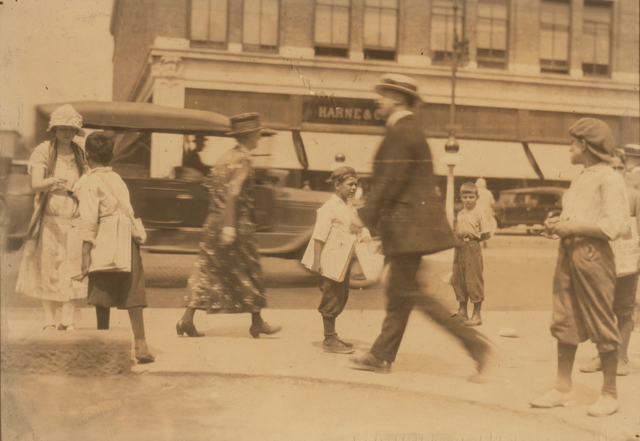
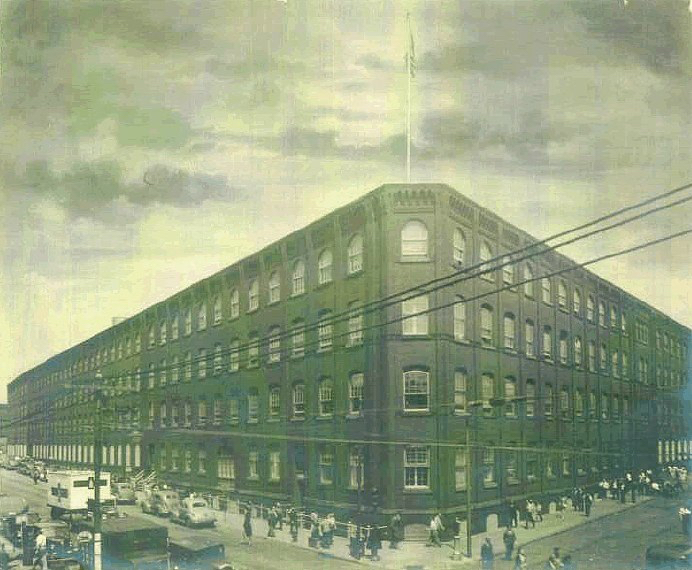
For Clement Wood, who relinquished a brief, checkered legal career in his native Alabama for a life of writing and teaching in New York, poetry was “the shaped expression of man’s desires,” and only achieved greatness when it expressed, “to the largest group of people over the longest stretch of time, their individual and collective wish-fulfillments.” (The Craft of Poetry, 19-20)

Wood claimed no such greatness for “The Smithy of God” but, of more than nine hundred submissions from forty-two states and five foreign countries, this poem most impressed the seven-judge panel of the 1916 Newark poetry competition: it won handily the first-place prize.

newark is home

by E. Alma Flagg

Image: Newark Public Library

What is a city and what is a home?
What makes each more than a place?
Skyscrapers stretching to dizzying heights?
Vehicles bent on a race?
Elegant Hepplewhite gracing a room?
Curtains resplendent in lace?

Shall we consider what makes each a fact?
Can we reach that which is real?
There is no building that fulfills our quest,
No car that shows what we feel,
Furniture neither that answers our need,
Fabric nor colors that heal.

Cities are made by people who live
Working and playing in turn,
Those who together in programs unite,
Focused on common concern:
Beauty, good health, and a bountiful life,
Peace and goodwill here to learn.

Homes are created by people who love;
Caring pervades every space;
Helping or listening or just being there
Sharing the family place;
Summoning memories out of the past
Memories time can’t erase.

Newark is my city, and in it my home,
Here I developed through years,
Seeing dear loved ones move out of this life,
Saying farewell through my tears,
Seeing newcomers arrive on the scene,
Banishing weakness and fears.

City, O city, I call you my own–
Blood, sweat, and tears make it true!
Friendships and good times are part of the whole,
With troubles and struggles no few.
People and purposes always in flux
Here, Newark, I’m staying with you.

Trailblazing educator Alma Flagg included these verses in her second book of poetry, Feelings, Lines, Colors (1980).

helen of newark: two poems

Version 2
Image: Michael Lenson

OF HER, WHOSE EYES HAVE DONE IT
On Helen of Newark

by “G. of New-Jersey”

                “The conquered thou dost conquer o’er again,
                Inflicting wound on wound!”

I did!–nor could I help it!–for her eye
        Fell on me, with love’s lightnings, and begot
A transport so unspeakable, that my
        Enraptured soul, of earthly things, knew not,
But felt as tho’ all nature had gone by,
        And it were fixt in a celestial spot,
Alone with some angelic being left,
And of all other thoughts than ecstasy, bereft!

O language! thou art beggarly and rude
        For such a strain as those bright eyes inspire!–
That hallow’d–nameless–wild beatitude
        Of all the soul can feel or can desire,
Which swallow’d up my being–and subdu’d
        All other faculties, needs words of fire!–
And I would give some years of painful care
To spend the rest of life with one so sweetly fair.

Frown if ye please, ye cold ones!–I aver
        From my heart’s knowledge, such delights have been;
And I care not how soon I may incur
        Your epithets–“extravagance and sin!”
But if there be one who can gaze on her
        And feel not the emotions start within
Which beauty’s loveliness and worth demand,
O may I ne’er esteem, nor take him by the hand!

Newark, Monday morning, June 5, 1820.


HELEN, OF NEWARK

by “Village Minstrel”

I knew by her haughty contraction of brow,
        And the curl of her lip, that fair Helen was proud!–
And I said, though my heart must her beauties allow,
        ‘Tis pity a frown should such loveliness cloud.

‘Twas night–on her sofa she sweetly reclin’d;
        Its light o’er her features the chandelier threw;
All was still, save her ringlets that play’d in the wind,
        And her bright eye that roll’d in voluptuous blue!

O, heavens! I exclaim’d as enraptured I view’d–
        What angel of nature–of beauty is this?
If her mind be with equal enchantments endued,
        To call her my own, would be life’s richest bliss!

In the shade of retirement, how sweet to repose–
        To the world and its harrassing tumults unknown;
And to know that through life, undisturb’d to its close,
        Her heart–her affections–her charms were my own.

Yet I thought if these charms were but vainly display’d,
        To entrap the warm gaze with coquetish intent,
Their triumph was short–for they quickly would fade,
        And leave a reproach for their virtue misspent!

How fair–how exceedingly fair are some flowers,
        Which bloom but a day, and then wreck on the wind!
They return not again, though the night weep in showers,
        And they leave no memento–no fragrance behind!

But Heaven forbid that such fate should be thine,
        Thou loveliest one of life’s loveliest few!
O! fair as thy charms, may thy character shine–
        Thy smiles be sincere–thy affections be true!

Newark, Monday morning, August 20, 1821.

Written more than a year apart, these pieces were both published in the New-Jersey Eagle: the first on June 9, 1820, the second on August 24, 1821.

“G. of New-Jersey” was a sobriquet of Sylvester Graham, who would gain worldwide notoriety as the apostle of unbolted flour. The identity of “Village Minstrel” is unknown.

the fallen pageant star

by Henry Wellington Wack

Image courtesy of the Newark Public Library via radius-magazine

Time: 1 A.M.
Temperature: Just Freezing.
Wind Velocity: Rooseveltian.

Oh, if ‘twould only thaw upon this stage,
And cold raw winds would even once abate
Upon our Pageant shanks and unprotected skins—
Then would our love remain—unturned to rage
At May’s mad blasts—while Poet Tom, unagitate,
Gently megaphones at our dramatic sins
        And begs us never mind the Arctic gusts
        That pneumonize our necessary busts!

Never again shall our ambitious rôles include
The part of Herald to this gay old Town,
Until fair Newark’s thirty-first of May
Shall be so balmy as to singe the nude
In art—from sombre Puritan to clown—
Or tog us up in buskins lined with hay.
        And yet, that Civic Germ we would sustain—
        May lure us out—to do our worst again.

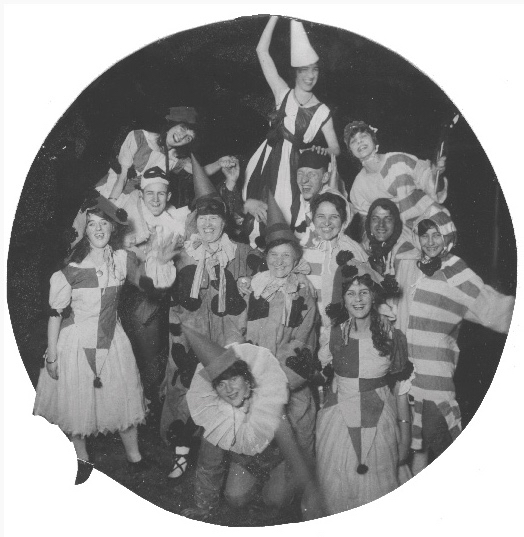
Written and directed by Thomas Wood Stevens, the Pageant of Newark was an elaborate piece of historical theater and allegory enacted in Weequahic Park from May 30 to June 2, 1916. The production engaged thousands of Newarkers as performers, costumers and set builders. It played, by one estimate, to a quarter of a million spectators.

Henry Wellington Wack was the chief publicist of the city’s 250th anniversary observances; in the Pageant he was appropriately cast as the Herald of Newark. The above vignette of his experience was printed in The Newarker of June 1916.

news

by Max J. Herzberg

A crow caws wildly in the nest-hung trees—
A distant farmer sowing grain he sees.

Two savages converse with gesturings—
Word of fat deer one to the other brings.

A nomad minstrel tells in lilting ditties
Of war and mighty deeds and far-off cities.

“The battle’s lost!” a blood-stained horseman calls
To a scared village. “Flee! Our country falls!”

A portly townsman reads in his gazette
Of earthquake, hanging, wedding, sale, and debt.

Today, electric messengers devour
All space with speed: time shrinks into an hour.

Today, the whole of mankind pays its dues
Of instantaneous, multifarious news.

Image: Library of Congress

On May 19, 1791, printer John Woods produced the inaugural issue of Woods’s Newark Gazette from his shop on Broad Street. In a ceremony on the same date in 1928, students of Central High School unveiled a bronze plaque outside the Hahne and Company department store, designating the site where the city’s first newspaper was born.

Max J. Herzberg, head of the English department at Central High and literary editor for the Newark Evening News, composed this poem for the plaque’s dedication. It was one of several poems read at the event and published in William Lewin‘s booklet A Story of New Jersey Journalism.

a song of cities

by Theodosia Garrison

Image: Jerry McCrea/The Star-Ledger

Babylon and Nineveh
Ephesus and Tyre,—
These were names to thrill us once,
Seeing, as we read,
Wall and gate and citadel,
Golden dome and spire,—
All the glory that youth sees
O’er the dust and dead.

Cities of the lordly names:
Sybaris, Damascus;
Doubtless, too, their little lads
Dreaming as we dreamed,
Visioned older cities still,
Far as ever theirs from us,
Cities that their Grandsires built
With words that glowed and gleamed.

Babylon and Nineveh,
Troy Town and Rome,
Little did we think one day,
Until we wandered far,
How dearer and more dreamed of
The city of our home,—
The commonplace, gray city
Where yet our treasures are.

Bagdad and Carthage
Sybaris, Damascus,
Babylon and Nineveh,
Troy Town and Rome:
You may hold my fancy still,
Great names and glorious;
But O, my commonplace, gray town,
‘Tis here my heart comes home.

Newark native Theodosia Garrison served as a judge of the 1916 poetry competition. The resulting volume of Newark Anniversary Poems included this contribution.

the city of heritage

by Anna Blake Mezquida

Down where the swift Passaic
        Flows on to the placid bay,
Where the marshes stretch to the restless sea,
And the green hills cling in the mountain’s lee,
There the sad-eyed Lenni-Lenape
        Unchallenged held their sway.

Gentlest of all their neighbors,
        Proud race of the Delaware,
They lived in the land where their fathers dwelt,
They killed the game and they cured the pelt,
And marked the blue in the wampum belt—
        The purple and blue so rare.

When day tripped over the meadows
        Fresh as a maiden trim,
They skirted the trails where the black swamps lie,
They notched the cedars to guide them by,
And wandered free as the birds that fly
        Beyond the river’s rim.

But few were the moons that silvered
        The mountain’s hoary side,
When over the banks where the waters foam,
Over the fields where they loved to roam,
Into the heart of their forest home
        They watched the pale-face stride.

Unconquered, and loath to conquer,
        They hid the arrow and bow;
The mat was spread for the honored guest;
They hung bright beads on the stranger’s breast,
And mutely signing, they bade him rest
        Before the camp-fire’s glow.

The suns of a hundred noondays
        Blazed down on river and hill,
And the pale-face walked in the red-man’s land;
A pious, fearless and strong-souled band,
For home and for country they took their stand,
        And served God with a will.

Where the waters gleamed in splendor,
        And the meadows glistened green,
They founded a town with an English name;
Their sternness shielded it like a flame,
And woe to the creature of sloth or shame
        Who dared let himself be seen!

They founded the house of learning;
        They built them the place of trade;
They guarded their laws by the force of might—
The laws that they held as a free man’s right;
And first to pray, they were first to fight
        When foemen stood arrayed.

And staunch were their children’s children,
        Brave men of a stalwart breed,
Who fought for the land where their fathers fought,
And kept the faith that was dearly bought,
That a brother-man, in the shackles caught,
        Forever might he freed.

And into the growing city
        Poured German and Celt and Scot
All seeking the land of the sore-oppressed—
The land that all free-born souls had blest,
And put of their manhood’s brawny best
        Into the melting pot.
        .         .         .         .         .         .         . 

The moccasined feet have padded
        Into the silence vast,
And the smoke-stacks belch where the camp-fires glowed,
Yet the white man reaps what the red man sowed,
For the friendliness to the stranger showed
        Shall live while the town shall last.

Unfearing, true and sturdy,
        The Puritan left his mark;
Though he sleeps beneath the grassy sod,
Though a million feet o’er his bones have trod
Yet he leaves his faith and his love of God
        To light men through the dark.

The soldier’s battles are over;
        His deeds but a written page!
Now the living pass by his low green tent,
But the patriot fires of a young life spent,
And a country whole from a country rent
        He leaves to a future age.

The toiler that strove and builded,
        And into the furnace hurled
Not coals alone, but his hopes and dreams,
Has lighted a beacon that ever gleams,—
While ships that sail on a hundred streams
        Shall bear his gifts to the world.

Then rise to your heritage, Newark!
        It cannot be swept away
Like chaff by the sullen north winds blown,
Or barren seed that is lightly sown,
For out of the past has the present grown—
        The city men love today!

Image: Joseph Atkinson, The history of Newark, New Jersey (1878)

Anna Blake Mezquida produced poetry, short stories, plays, film scenarios, and newspaper and magazine pieces in her native San Francisco. This work won the second prize in Newark’s 1916 poetry competition.

military park

by Joseph Fulford Folsom

ESS Newark http://www.playle.com/listing.php?i=BEACHGUY1705
Image: Playle’s Auctions

Old drilling-green! you register
The city life. You are the glass
Reflecting what it thinks and feels,
The stage on which its actions run,
Its face on which emotions play,
You screen the laughing comedy
That comes and goes with every hour;
You set the scene for tragedies
That reel out endlessly their pain.

War’s atmosphere was early blown
Across your velvet lawn. The tramp
Of rough-shod feet crushed down the grass
When rumors of the savage foe
Alarmed. You saw the Jersey Blue,
And later welcomed Washington,
Close followed by the British troops,
And every war of free America
In some way touched your sacred soil.

Your tempting shadows know the tale
The lover stammers like a prayer,
And beads with fervent kisses laid
Upon the lips of his fair shrine;
And not Old Trinity itself,
That nearby lifts its graceful spire
Among the trees, more zeal inspires,
For love is like in aisle or green,
With one Great Lover over all.

The brush of tripping baby feet
You feel—as ocean feels the kiss
Of rippling zephyrs on its face—
You nourish them on your full breast
With light and air—kind nature’s food.
You give the tired mother rest,
And for the jaded clerk at noon
You make a land of dreams to prop
His crumbling hope of better days.

You know the secrets of the clan
That sit and drone the hours away–
The disappointed and the broke,
The down-and-outer and the bum—
The living tragedies that run
Along with gay prosperity—
You know it all, old drilling-ground!—
You register the city’s soul,
And we unmoved look on the show.

The Newark Sunday Call carried this poem in its August 10, 1919, edition.

our nameless heroes

by William J. Fielding

On the Two Hundred and Fiftieth Anniversary Celebration
of Newark, N. J., 1666-1916

I sing not of the honored names so favored with acclaim,
But pay my humble tribute to the heroes without fame.
The plain and unassuming folk who shared the burdened life
Amid the virgin wilderness and elemental strife;
The pioneers who felled the trees and tilled the broken soil,
And paved the way for future growth by hardship, pain and toil!
My homage goes to such as these, unhonored and unsung,
Who made the primal sacrifice when Newark’s days were young.

I speak a friendly word for them whose labors are unknown,
Whom fickle fame has never kindly recognition shown;
The rank and file of sturdy men, and women by their side,
Who braved the hidden dangers here as settlers to abide;
The strugglers of the early years who broke the rugged ground
And passed from spheres of usefulness to graves all unrenowned.
To these forgotten, nameless ones, and those who followed them,
Into the Great Obscurity, I sing this requiem!

And so on down the steady line since that eventful morn,
When out of human labor pains our civic life was born,
I hail the toilers in the fields and at the handy trades,
And those who’ve done the drudgery that custom says degrades;
The workers of the stoic strain who bore the greatest load,
Who kept the wheels of progress rolling o’er the time-marked road;
The builders of a sturdy past that stood for future fame,
The men who gave their sweated flesh and died obscure in name.

A bitter foe of every war to conquer or despoil,
A hater of the heartless fiend who would the world embroil,
I lay a fitting laurel wreath upon the common grave—
On Mother Earth—in recognition of the nameless brave
Who fought on bloody battlefields to set a people free,
And gave their lives to move the cause of human liberty.
Custom lauds the honored names. I eulogize no less
The heroes who so coldly rest in blank forgottenness.

I pay a solemn tribute to the hero host unnamed,
The army of constructiveness that industry has claimed;
The soldiers of production in the factory, shop and mill,
Whose workmanship has made the name of Newark speak their skill.
To the victims and the martyrs, I add my special meed—
To those who have been sacrificed for avarice and greed—
The children, men, and women who have perished at their work,
And the toilers who’ve been stricken in holocausts or murk.

Let none forget the commonplace—the widows worn with care,
Who’ve battled singlehanded with the demon of despair;
The orphans and the helpless ones who’ve braved the ways unknown
And faced the struggles of the world, unguided and alone.
Let’s not forget the multitude that suffered through the years,
Whose nights of silent anguish have been bathed in bitter tears—
Heroic souls of motherhood whose love has lit the way
In treading the unbeaten paths to seek the Better Day.

I find a word of favor for the heroes seldom named—
The firemen who risk their lives in danger-traps enflamed;
The officers, on busy streets where traffic most congests,
Whose deeds in face of jeopardy their bravery attests.
So, come, salute the legions here, and those of other days,
Who’ve added to our wide renown and reaped no words of praise;
And let us, as an echo of this late Historic Fête,
Give honor to the Nameless Heroes ere it is too late!

Image: Gasser via Newark Story
Image: Henry Gasser via Newark Story

William J. Fielding was an activist, editor and author. From 1915 to 1918 he edited The Newark Leader, the weekly paper of the local Socialist Party.

This song of Newark’s unsung was included in Fielding’s Pebbles from Parnassus, comprising rhymes of revolt and flitting fancies (1917).