The grand old trees of Newark, How royally they stand, The splendor of their branches O’ershadowing the land. I listen to their sighings, To catch each whispered word, To me the sweetest music That ear has ever heard.
The summer is advancing, I hear his fervid tread, But on the streets of Newark A benison is shed— The blessing of the elm-trees, That murmur overhead.
What tales, oh trees of Newark, Your Delphic lips could tell! What buds of sweet affection Beneath your foliage swell. What troths have you heard plighted When, in the moonlit stroll, Fair Juliet and her Romeo Have whispered soul to soul.
Oh, grand old trees of Newark, Your voice is in my heart, And when your leaves are falling, The tears unbidden start. Forever will remembrance Still garner with its sheaves The glory of your arches, And the music of your leaves.
In its annual report for 1916 the city’s Shade Tree Commission counted 65,427 trees on the streets of Newark, almost half of which the Commission had itself planted since its creation in 1904. “Newark,” said late city historian Charles Cummings, “has always had a love affair with trees.”
The verses above are unattributed. They were included by Augustus Watters in his volume Poems, published in Newark in 1892.
So beautiful it is, this April dusk, This quiet twilight after wistful rain, That everything is breathless, lest it stir The mystery that haunts this meadow lane.
A hush is clinging to the hallowed air. I hear the murmur of the looms of Spring. I see the testament of leaf and grass; And glory lurk in every simple thing!
Until I think, within this wistful dusk, Within this miracle of bud and tree, Heaven must be a land of haunted lanes, Where April blossoms out eternally!
Born and raised in Newark, Louis Ginsberg (1895-1976) became one of the most widely read American poets of the twentieth century. In his later years Ginsberg’s verse found new audiences through public readings with his son, the Beat poet Allen Ginsberg.
“April Twilight” appeared in The Attic of the Past and other lyrics (1920).
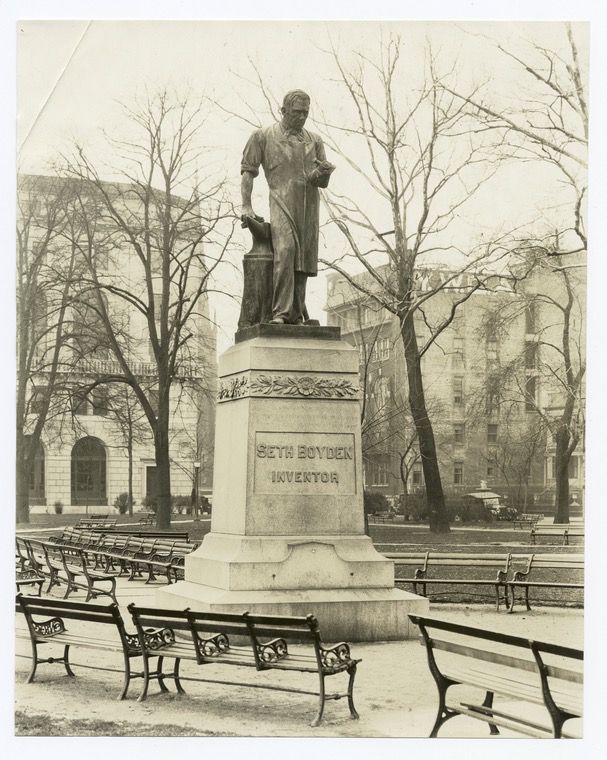
High in the Square his statue stands, INVENTOR carved beneath: But he who crimsoned the lips of Spring Might wear a Poet’s wreath.
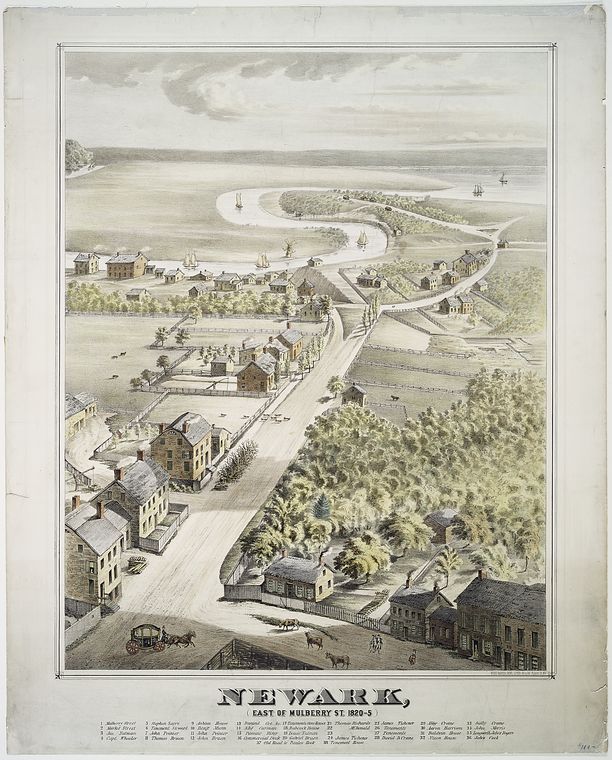
Old Newark sat in its bosky streets, Tidy and prim and serene; Prankt with posies and orchard sweets To the fringe of its marshes green.
‘Twas after the fighting of 1812 Seth Boyden came to town; He’d licked the British,—and they’d licked him,— And he wanted to settle down.
Old Newark called to him potently, Though none but himself could hear That clashing summons as it clanged On his prophetic ear:
None but himself see that clean blue sky With its white little chubby clouds, Grimed with the reek of his chimneys tall, Grim with his black smoke-shrouds.
“Thou hast lent me talents ten, Lord God,” To his Maker deep he prayed: “An Thou prosper me, I will give them back Tenfold increased,” he said.
Long with his cunning hands he wrought, Long with his seething brain, That God might not require of him His usury in vain.
He watched the hedgerow’d village lanes Where tinkling cows browsed home Herded by whistling barefoot lads, Great thoroughfares become:
Stone-paven streets where clicked the heels In castanetted tune Of all new Newark’s gentlefolk, Shod with his shining shoon.
Malleable to his iron will, He bent earth’s iron bars: The lightning Franklin had lured down, He flashed back to the stars.
A thousand men he kept at work, A thousand ships at toil, A thousand ways of increase he Wrought out upon the soil.
At length in life’s cool afternoon, He paced his garden-place:— A garden clipt from Newark’s youth, Gay with its old-time grace.
Outside his gates he heard the growl Of labor chained to the wheel, The roar of his captured genii bound, The shriek of his tortured steel.
He thought of old Newark’s bosky streets, Tidy and prim and serene, Prankt with posies and orchard sweets To the fringe of its marshes green.
He said: “I have had my work to do Thy lendings to increase, Lord God:—to pay Thee back Thy loan Before my days should cease.
“Now, ere my death-hour strike, I would I might just pleasure Thee! Give Thee and Newark some quaint gift All free from merchantry.”
Up from the garden-sward there breathed An exquisite bouquet: Fresh, faint, and fragrant as a wine For fairies on Mayday.
And glancing down, Seth Boyden saw The wonder at his feet: Wild strawberries like elfin cups Brimmed with ecstatic sweet:
Too frail for aught save dryades To taste with leafy lips, Yet aromatic as the juice That Puck in secret sips.
Seth Boyden smiled: with careful skill He culled the perfect plants. Through patient moons he wove his spells Till knowledge conquered chance.
He fed and watered, pruned and plucked, Till from his garden-sod, There blazed a berry fit to feed A hero or a god!
This was the gift Seth Boyden gave To all his world for boon; That Heaven might smile and Newark feast From April on through June.
For the great epic of his toil Heaped laurels are his meed: And garlands for the loveliness Of that last lyric deed.
High in the Square his statue stands, INVENTOR carved beneath: But he who invented strawberries, Might wear a Poet’s wreath!
Seth Boyden came to Newark in 1815, setting up a harness and leather shop not far from the site of the present monument in Washington Park. A plaque added to the statue’s base lists some of his numerous achievements, among them the discovery of processes to make malleable iron and patent leather, both crucial to Newark’s prosperity. The tablet also notes his success in strawberry hybridization.
Historian Alice Read Rouse submitted “The Ballad of Seth Boyden’s Gift” to the 1916 poetry competition from her home in Covington, Kentucky. It was one of thirteen prizewinning poems.
I sicken of men’s company— The crowded tavern’s din, Where all day long with oath and song Sit they who entrance win; So come I out from noise and rout To rest in God’s Green Inn.
Here none may mock an empty purse Or ragged coat and poor, But Silence waits within the gates, And Peace beside the door; The weary guest is welcomest, The richest pays no score.
The roof is high and arched and blue, The floor is spread with pine; On my four walls the sunlight falls In golden flecks and fine; And swift and fleet, on noiseless feet The Four Winds bring me wine.
Upon my board they set their store— Great drinks mixed cunningly, Wherein the scent of furze is blent With odor of the sea, As from a cup I drink it up To thrill the veins of me.
It’s I will sit in God’s Green Inn Unvexed by man or ghost, Yet ever fed and comforted, Companioned by mine host, And watched at night by that white light High-swung from coast to coast.
Oh, you who in the House of Strife Quarrel and game and sin, Come out and see what cheer may be For starveling souls and thin, Who come at last from drought and fast To sit in God’s Green Inn!
A Newark-born poet, Theodosia Pickering Faulks published under the name Theodosia Garrison. “The Green Inn” first appeared in the July 1907 issue of Scribner’s Magazine.
When on the field of battle the soldier sinks to death, And to his suffering country’s cause devotes his latest breath, His country, ever grateful, rewards him with a name On everlasting marble carved, and hands him down to fame.
But in our early struggle, o’errun by cruel foes, Full many a nameless martyr sank, weighed down by bitter woes: Who suffers like the soldier, should reap renown as well— Oh! sure he should not be forgot, whose trials now I tell.
‘T was night in deep mid-winter, when fields were choked with snow, And widest streams were bridged with ice, and keenest blasts did blow; A heavy muffled tramp through the village streets went by: All shuddered in their beds, for they knew the foe was nigh.
Soon from that fearful silence alarming clamors peal, And rising gleams along the snow the dreadful truth reveal; ‘Rouse! rouse ye all! the town is fired!’—cries friend to friend—’and lo! The triple ranks! the flashing steel!—we’re mastered by the foe!’
Wide flames, with showers of dropping stars, that quench the stars on high, Now flapping loud their mighty wings, rush flying up the sky: Now mothers clasp their children, and wail aloud their woes, And gathering, hide their little store from savage plundering foes.
For oft the rude marauders had plied their cruel trade, And HEDDEN, with a few bold hearts, had oft the robbers stayed: But now with stealthy step, at the hour of midnight dead, They come!—they burst the doors—they drag the old man from his bed.
‘Renounce thy faith! yield up thy mates! or, by King George, we’ll cast Thy rebel limbs on yonder snows to stiffen in the blast!’ ‘My limbs are little worth.’ he cried; ‘their strength is nearly gone; My tongue shall ne’er belie my heart, nor shame my cause: lead on!’
Then furious all, they throttled him; when ‘Hold!’ their leader cries, ‘Despatch him not! we’ll try his pith, before the rebel dies: Let him with us unclad return! and though unmoved by steel, Perchance a march along the snows will cool his patriot zeal!’
Loud yells applaud the sentence!—then, frantic with despair, Wife, children kneel for mercy, but they find no mercy there: For they rudely thrust them by, and they drag the old man forth, And crouching quake his bare limbs, as they feel the cutting North.
Then rings the shouldered musket, then taps the rattling drum, And with rapid step they tramp, for the freezing winds benumb: By the savage light of flames on their dreary march they go, That shoot their shadows far before, along the glaring snow.
No pity for their victim would move their hearts of stone, But still his bare feet tread the snows that chill him to the bone: And many an icy splinter would gash them with its blade— The blood that stains his every step their brutal march betrayed.
And when his stiffened limbs would lag, by age and sickness lamed, With bayonet-thrust they urge him on, till cruelty is shamed: God bless the soldier’s heart! who cried, ‘This sight I cannot see!’ And round him threw his blanket warm, that clothed him to the knee.
Now hard as marble pavement, black Passaic stops the way: Like serpent stiff in winter sleep, her torpid volume lay; And in the midnight hush not a sound she gave the ear, Save the long peal of parting ice, like thunder crackling near.
But still the word is ‘March!’ and they tramp the icy floor: But the old man’s feet are numb, and they feel the cold no more. Full many a weary mile he drags, but ere the break of morn, In prison thrust, he drops at once, exhausted and forlorn.
Why linger in my story? His heavy trials past Broke down the feeble strength of age—he drooped and sank at last: But GOD the martyr’s cruel death has well avenged, for see! His murderers beaten from the soil—his land, his children free!
In Newark the Revolutionary War was a civil conflict, driving a wedge between neighbors and dividing families. A stalwart of the American side, Joseph Hedden Jr. oversaw confiscation of property belonging to “persons gone over to the enemy.” His zeal in ferreting out Loyalists and their possessions made him an obvious target for retaliation in the nighttime raid of January 25, 1780. The forced march to New York in unbearable cold and subsequent confinement in Provost prison hastened his death at the age of 51.
“The Martyr” appeared in the September 1841 number of The Knickerbocker, or New-York Monthly Magazine, as part of a cycle entitled Passaic: A Group of Poems Touching That River.
There’s no leaf shows its love of dance as much as aspens do. In the least breeze out come the castanets, and as the wind steps up the measure that it sets the leaves all revel in the dance without restraint. They party on and on until the wind is out of breath. When it resumes the leaves explode in dance again.
They weaken as they age, and in the winter of their lives they lose their last reserves of energy—and the Pied Piper wind charms them away.
Robert Lowenstein, a legendary teacher of languages at Weequahic High School, was fired in the anti-Communist purges of the 1950s. The school board reversed the dismissal and reinstated him in 1961.
“The Pied Piper” appeared in the 2011 issue of Journal of New Jersey Poets. Lowenstein died in 2013, aged 105.
Spirit of living Truth, Fresh in immortal youth, Yet aged as Eternity! Come, at the fervid calls Of hearts that, ever seeking after thee, To thy great purpose dedicate these walls: Come, and spread here thy broad and beaming wings, Where, in thy name, the Muse her humble tribute brings.
Spirit of Art, divine! This edifice shall be a shrine Where thy true worshippers may kneel: Standing sublime in Learning’s cause, The impress of thy mighty laws Its form majestic will reveal, While the same glorious Sun shall make it bright, Or the same Moon shall gild it with her light, As have for ages shed their beams upon The hallowed ruins of the Parthenon! And Wisdom’s goddess, here shall own All that approach to seek her lore, No less, than where was raised the throne Which first her votaries knelt before.
Knowledge shall here unfold Her “treasures new and old;” Science lay open her mysterious heart, That searching eyes its inmost depths may see; And Helicon’s pure fount its streams impart To all who thirst for living poesy! These opening gates will languages unlock, And free shall flow old Homer’s tide of song, As when, in ancient days, from Horeb’s rock Gushed limpid waters for the eager throng.
Britannia’s bards shall dwell Beneath this classic dome, And visit—Fancy’s dream to tell— The laborer’s humble home: And History’s undying page Here the eventful past shall state; Or our brief present, to a future age Perchance relate: Toil in these cheering walls forgot, The weary soul refreshed shall be, And riches wait to bless the lot Of patient Industry— Wealth, such as shaping intellect hath wrought From the imperishable mines of Thought.
Spirit of Eloquence, whose voice Made Academic groves rejoice In Plato’s days of old! We dedicate to Thee this Hall— Here ever at thy trumpet-call May Truth again grow bold, And startle Error from his secret hold.
Spirit of Science! here inspect The mysteries of Philosophy; Or with thy telescope direct To starry wonders in the sky. Spirit of Music, here awake! This dome with airs melodious fill, And every listening spirit, make With rapture thrill!
Spirit of pure Religion! deign Within this temple to abide, For Art and Science build in vain, Unless Thou o’er their work preside: The crumbling touch of Time Lays low the edifice sublime; But if Thy foot-prints there are found, The spot whereon it stood “is holy ground;” And every tribute offered there to Thee The wreck of nature shall survive, And in the hearts of God and Angels live Among the records of Eternity.
Newark’s first city library, numbering 1,900 books, opened in 1848 in Library Hall, a three-story building on Market Street. Until the creation forty years later of a free public library, use was limited to shareholders and paying subscribers.
These verses, read at the dedication by William C. Prime, were reread in 1899 when the cornerstone was laid for the library’s present building at 5 Washington Street. The poem was first published in the Newark Daily Advertiser of February 22, 1848.
A Tribute to Newark, New Jersey, Honoring by Celebration the One Hundredth Anniversary of the Granting of a Charter to the City by the State of New Jersey
Our City of a Hundred Years, Born of rugged ideals, Conquering fears and tears, A soul sublime reveals. Men of might hewed the way, For Newark’s march ahead; Their eyes visioned another day, And other paths to tread. Our City of a Hundred Years, Pride of the Garden State, Stalwart among its peers, Grateful for its fate. Service is King in our Realm, Common comfort is the goal, Since early fathers at the helm Inscribed the Charter Roll. Our City of a Hundred Years, We honor its Charter Birth; A home each worker fain reveres, And gives his manhood worth. ’Tis for steerers of the ship, As a crowded future nears, To plan for others on the trip Of another Hundred Years. For yea, today, we reap the fruits Of seeds that zeal hath sown, So for tomorrow let’s set new roots, For the glory of a Newark now unknown.
On March 18, 1836, Newarkers approved the incorporation of the city by a vote of 1,870 to 325. Twenty-four days later, on Monday, April 11, they elected Newark’s first mayor, William Halsey. The cornerstone of the first city hall was laid during his term, which lasted one year.
Journalist William Hunter Maxwell was a member of the Committee of One Hundred overseeing the 1916 anniversary celebrations, but had resigned in protest over the racism of some of its pronouncements. Still, his love of the city was constant and he often committed its praises to verse. This ode on the centennial of Newark’s charter was printed in The Life to Live and Other Plainpoems (1937).
There was once a beautiful garden, A Garden of Yesterday— It was echoing with the laughter Of children in happy play. Sweet flowers were in this garden, And fruit trees, green and tall— Their branches making a bower, With the blue sky over all.
Then the years passed over this garden— This Garden of Yesterday— The city homes towered above it, The children all went away. For Life with its manifold duties Had called them, rejoicing and glad, And, alone with the trees and the flowers, The heart of the garden was sad.
Then over the beautiful garden, This Garden of Yesterday, There lingered a faint cloud of memories, Of days that were far away. Outside the beautiful garden, The city’s traffic steamed, But within its leafy seclusion, The lovely garden dreamed.
Then at last there came to this garden, This Garden of Yesterday, The sound of the laughter of childhood, Of a tiny laddie at play. The child of one of the children, Once dancing beneath the trees, Or climbing up high in the branches, With curls tossing bright in the breeze.
And now the old Garden is wakened, ’Tis a Garden of Today. Once more it is echoing music Of a child’s voice, sweet and gay. And the dear, old garden is happy, Its playtime has come at last, And the heart of the garden is hearing The songs of the present and past.
According to a note in the undated manuscript of this poem, found in the files of The New Jersey Historical Society, the “old Newark garden” in the inscription belonged to her sister, Grace Cadmus Ward.
The magic of the day is the morning I want to say the day is morning high and sweet, good morning.
The ballad of the morning streets, sweet voices turns of cool warm weather high around the early windows grey to blue and down again amongst the kids and broken signs, is pure love magic, sweet day come into me, let me live with you and dig your blazing
“Ballad of the Morning Streets” is from the collection Black Art, published in 1966.






 newarkpoems