First, feel, then feel, then read, or read, then feel, then fall, or stand, where you already are. Think of your self, and the other selves . . . think of your parents, your mothers and sisters, your bentslick father, then feel, or fall, on your knees if nothing else will move you, then read and look deeply into all matters come close to you city boys— country men Make some muscle in your head, but use the muscle in yr heart
“Young Soul” appeared in Black Magic, a collection of poems composed between 1961 and 1967.
The old jail on New Street
has what looks
ironically like a
sedate, white painted
front door.
Over it a funny
electric clock with a
gaudy neon rim
keeps time.
Two wide and handsome
magnolia trees frame the walk
on either side.
But
when I drive by from work
sometimes the van is
in the yard and the
young men
the handcuffed young men
climb awkwardly down.
They can’t see the clock
from the side yard and
they don’t look at
the trees.
What do they see?
What would I see
if I climbed out of
a prison van
hunched and handcuffed?
Defeat
despair and a
no-future world–
apprehension filling
my belly like wet cement.
Muggers
addicts
car thieves and
drunks, yes.
But, men, too!
O, God! There is more to being a man than this!
There’s joy to being a man!
There’s peace to being a man!
There’s confidence in
achievement
security in oneself and
loving and sharing.
But, who will tell them? O, God! who can tell them?
Every day
another
van-load climbs down
hunched and
handcuffed beside
wide magnolia trees.
There must be someone to tell them! Is it you or me?
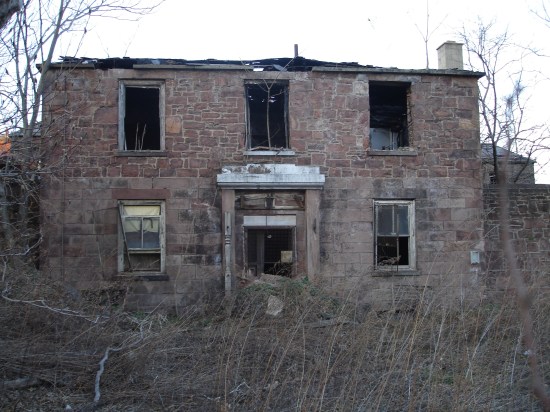
Parts of the old Essex County Jail on New Street (including the administration building, pictured above) still stand, in a ruinous condition, one hundred eighty years after it was built.
Margaret Tsuda’s “Old Jail on New Street” first appeared in the Christian Science Monitor of March 29, 1971, and was republished in her collection Cry love aloud (1972).
“Let me be free, or let me die!” A thousand lips across the years Have raised this valiant cry.
Thus cried brave men across the sea; So Patrick Henry did proclaim. They wanted liberty.
The plea today is still the same; Freedom denied, means there’s no life That’s worthy of the name.
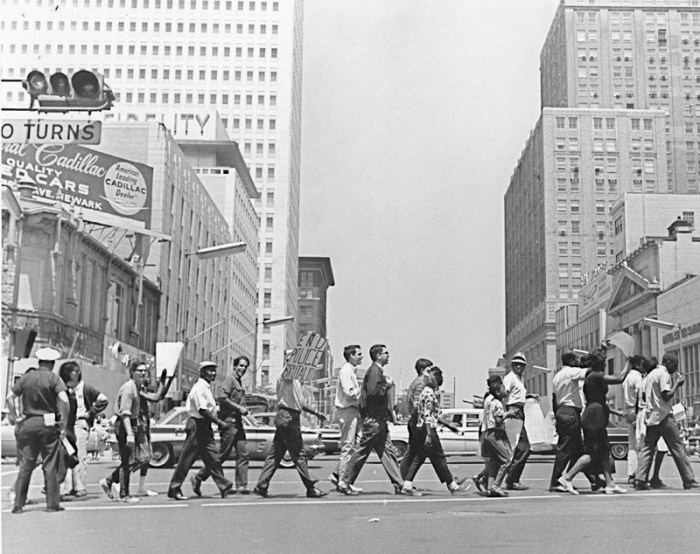
Today the people of Montgomery, Inspired by Martin King of Gandhi fame, Walk to fulfill their destiny.
Where peace comes at oppression’s cost No peace can ever be but strife. We stand . . . or all is lost.
As a young man Nathan Wright Jr. participated in the 1947 Journey of Reconciliation, a precursor to the Freedom Rides challenging segregation in the South. Twenty years later, as director of urban work for the Episcopal Diocese of Newark, he chaired the first National Conference on Black Power, held in Newark in July 1967.
“We stand,” from his collection The Song of Mary (1958), has the postscript “Written on the first anniversary of the Montgomery, Alabama bus boycott, December 1956.”
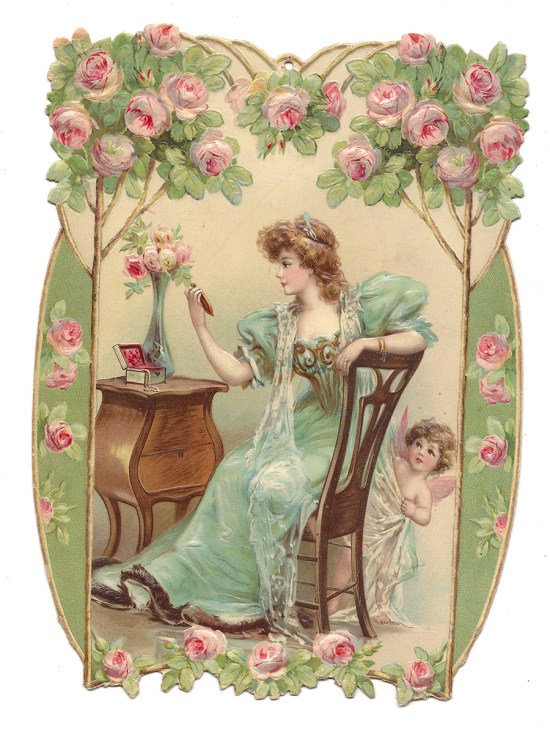
When the short wintry day was o’er, A comely maiden sat before A table, where lay spread Three valentines, of style and hue Quite dainty,—forth the first she drew, And laughingly she read: “Oh! Lady, I would be a flower, To die in fragrance on your breast; Or a chaste star, at midnight hour To kiss your eyelids while you rest; Or a soft breeze, at mid-day fair To lift the ringlets of your hair And whisper tender wishes there.”
‘Twas signed with a romantic name; She knew who sent it just the same, And fixed it in her mirror’s frame, In future to amuse; Then smiling sweetly, took apart A second “herald of the heart,” And found amid that work of art These verses to peruse: “Fair Damsel, would that you might need A champion bold, or warrior true, By brave emprize to win the meed Of laurel wreaths, and smiles from you; Against all comers I would stand, Your doughty knight with sword in hand, To do, or die, at your command.”
This was subscribed by “Roderick Dhu,” Full well the clerkly hand she knew, And that “a cloth-yard shaft” he drew That ne’er was dipped in gore;— She put this one away with care, Then with an interested air Took up the last epistle there, And these lines pondered o’er: “Dear Mary, I have loved you long, And I will love you evermore, My heart is stout, my arm is strong, I am not versed in lover’s lore. Nor flowing phrases can I bring, But if my suit is no vain thing I pray you wear this little ring.”
She kissed the name below,—twas “John,” And hid it where her brooch went on,— Or somewhere thereabout,— The circlet fitted very well, And in a reverie she fell, Until the light went out.
A Newark attorney, Pilch included this poem in his volume Homespun verses, published in 1882.
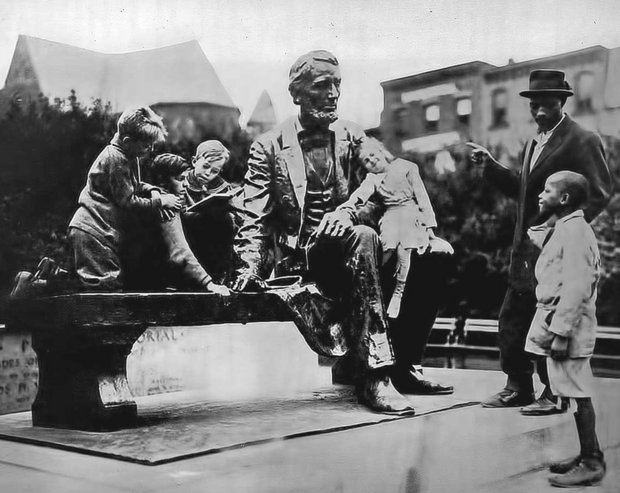
Joseph Fulford Folsom was a Presbyterian pastor and local historian, as well as a poet. He wrote a regular column on historical matters for the Newark Evening News, signing himself The Lorist. His poem on the Lincoln statue was included in the 1912 volume The Newark Lincoln.
Alone, upon the broad low bench he sits, From carping foes and friends alike withdrawn; With tragic patience for the spirit dawn He waits, yet through the deep set eyes hope flits As he the back unto the burden fits. Within this rugged man of brains and brawn The quiv’ring nation’s high powered currents drawn, As waves of love and kindness he transmits.
O prairie poet, prophet, children’s friend! Great brained, great willed, great hearted man and true, May we, like thee, in prayerful patience plod With courage toward the wished for, peaceful end! May we thy helpful friendliness renew, Thou war worn soul communing with thy God!
This celebration of Newark’s beloved Lincoln statue, first printed in the New York Sun, was reprinted in The Book of Lincoln (1919) compiled by Mary Wright-Davis.
The hour was come, the Nation’s crucial hour; A crisis of the world, a turn of time; The ages’ hope and dream. And one undaunted soul, sinewed with power, Freedom’s anointed, rose to height sublime, Imperial and supreme;
And, lifting high o’er groaning multitude His sovereign sceptre, smote with such a stroke The chains of centuries, That earth was shaken to its farthest rood; That millioned manacles asunder broke, And myriad properties
Became, in one immortal moment,—men; Free with the free in all the rounded earth; Redeemed by martyr blood; To stand with faces to the light again, Attaining, through their resurrection birth, To human brotherhood.
From 1889 to 1916 Lyman Whitney Allen was pastor of South Park Presbyterian Church where Lincoln, on the way to his first inauguration in 1861, had made brief remarks before a throng of Newarkers. Allen’s book-length prize poem Abraham Lincoln, from which this excerpt is taken, first appeared in the New York Herald of December 15, 1895.
The dragon is in the street dancing beneath windows pasted with colored squares, past the man who leans into the phone booth’s red pagoda, past crates of doves and roosters veiled
until dawn. Fireworks complicate the streets with sulphur as people exchange gold and silver foil, money to appease ghosts who linger, needy even in death. I am
almost invisible. Hands could pass through me effortlessly. This is how it is to be so alien that my name falls from me, grows untranslatable as the shop signs,
the odors of ginseng and black fungus that idle in the stairwell, the corridor where the doors are blue mouths ajar. Hands gesture in the smoke, the partial moon
of a face. For hours the soft numeric click of mah-jongg tiles drifts down the hallway where languid Mai trails her musk of sex and narcotics.
There is no grief in this, only the old year consuming itself, the door knob blazing in my hand beneath the lightbulb’s electric jewel. Between voices and fireworks
wind works the bricks to dust—hush, hush— no language I want to learn. I can touch the sill worn by hands I’ll never know in this room with its low table
where I brew chrysanthemum tea. The sign for Jade Palace sheds green corollas on the floor. It’s dangerous to stand here in the chastening glow, darkening
my eyes in the mirror with the gulf of the rest of my life widening away from me, waiting for the man I married to pass beneath the sign of the building, to climb
the five flights and say his Chinese name for me. He’ll rise up out of the puzzling streets where men pass bottles of rice liquor, where the new year is liquor, the black bottle
the whole district is waiting for, like some benevolent arrest—the moment when men and women turn to each other and dissolve each bad bet, every sly mischance,
the dalliance of hands. They turn in lamplight the way I turn now. Wai Min is in the doorway. He brings fish. He brings lotus root. He brings me ghost money.
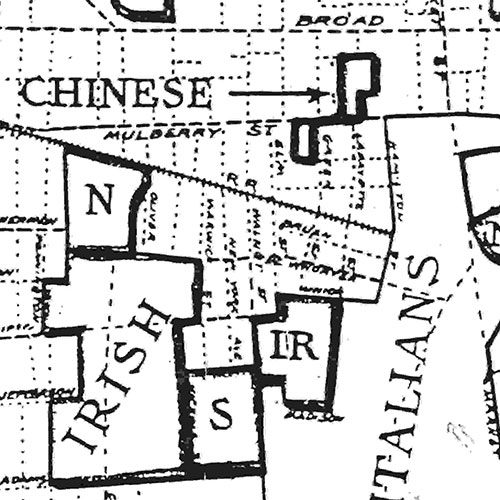
A teenage runaway and high school dropout, Lynda Hull eventually became a college professor widely acclaimed for her poetry. Newark’s once bustling Chinatown off Mulberry Street was largely a memory by the time she wrote “Chinese New Year,” which appeared in her collection Ghost Money (1986).
God of my fathers, Please accept these lips You flattened on my face With your long kiss; These lips that lose their way Around your name… Accept these eyes Which cannot pierce the veil Bonded like plywood For three-hundred years.
I claim you kin By virtue of the fact That the Sun’s love Was burned into my genes Not to curse Ham, But to caress a soul Which can create Black, tan, beige joy And fling it in the face Of Blue-eyed Death
II
I claim you kin By virtue of the fact That I can translate Hell Into a Spiritual; Can ‘make a joyful noise’ Before the tree of death; Before the polls Scylla And Charybdis guard With charred perversions Of their Son-of-God.
I claim you kin By virtue of the fact That I shall walk again Through the White Sea, A child from your Black Phallus on each hand, Another…as a smile Within my eyes, Into the fecund womb Of man’s birth-rights. There is no death Can alter me from this.
III
Then…only then, When all our sons are men And not the petty Function of their skins, I want to lie Ten-thousand miles removed And hear my brother Oozing through the brush At break of day, Plucking our lunch, Which stands upon four legs, From throbbing life.
At Market and Broad I stood one day; Market Street traffic was on its way. I looked to the left; I looked to the right; I looked at the warning—“Wait for Light.” There it was—planted in the street; Letters white and tall at pedestrians’ feet. “Wait for Light”—in the asphalt there, A traffic caution of wisdom rare. I thought to myself as the phrase I read, “Wait for Light”—means use your head. And again I thought, at the green Light’s nod, “Wait for Light”—means wait for God. When the road is rocky and the way is dark, ’Tis then we crave the tiniest spark. And time and again, if we’d “Wait for Light,” The Invisible Hand would lead us aright.
“Wait for Light” was featured in the December 9, 1944, installment of “Evenings Out” by Maxwell’s colleague at the Star-Ledger, longtime columnist Jerry Nusbaum. The following week the Director of Public Safety, John B. Keenan, personally read the poem into the records of the Newark City Commission.


 newarkpoems