snow

by E. Alma Flagg

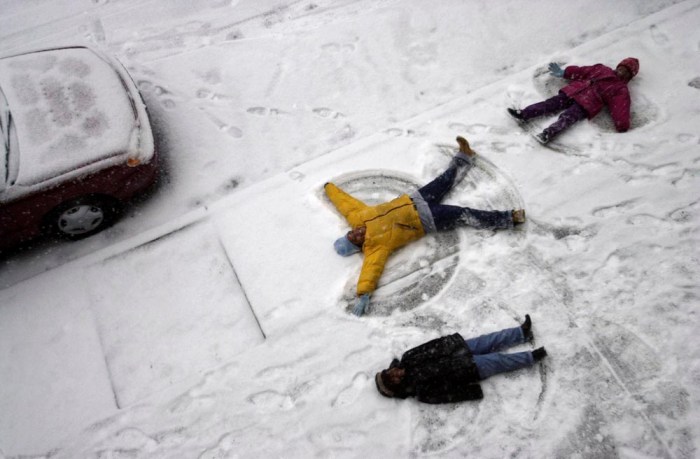
Sh! it’s snowing!
Magic stuff that makes
The world a picture-book!
Soft and silent,
Fuzzy snow that hides
Each form and seeks each nook!

Look in wonder!
All the world that was
So dark is fair to see.
Breathe, but lightly,
Lest the sight that thrills
Us vanish suddenly.

Image: Matt Rainey/The Star-Ledger

E. Alma Flagg was poet laureate of East Side High School’s class of 1935. She taught Newark children for many years and was appointed the city’s first black principal of an integrated school, serving at Hawkins Street School in the Ironbound. In 1967 she became an assistant superintendent of the Newark schools. A North Ward elementary school is named for her.

“Snow” was included in a commemorative edition of Flagg’s poems, Lines, colors, and more, published in 1998.

a winter song

by Augustus Watters

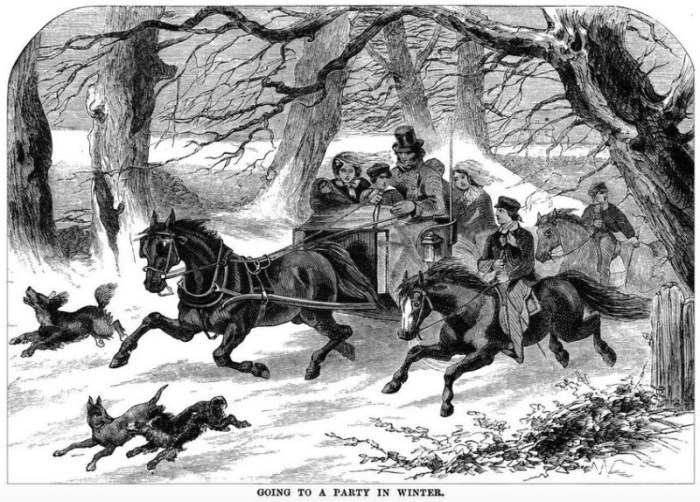
godeys_18644
Image: Godey’s Lady’s Book

What reck we though round our lodges
        Savage storms incessant howl,
Tho’ fell winds with frantic malice
        Ever at our windows prowl.
Can we not fling to the shutters,
        And the logs in mountains heap—
Drown the tempest with our singing
        While the flames in frenzy leap!

Bellow on, relentless menials,
        Passing far your chief’s command,
Wreaking on the homeless wand’rer
        More than spite of pirate band.
Drag from out his bed the cedar,
        Snap the tossing boughs in twain;
Snow-intrenched, we still defy you,
        Laugh at all your scowling train.

’Fore the blaze we’ll crowd the closer,
        Swifter pass the cider round,
Louder raise the hearty chorus,
        Wilder let our glee resound.
Mid the clicking of our hammers,
        Crushing fast the oily nut,
We’ll forget that flowers have faded,
        Or that winds their fury glut.

If within your heart, my brother,
        Boreas plants no icy sway,
If the love we pledged each other,
        Midst the breath of balmy May,
Hath not met the fate of daisies,
        Smiling once o’er all the mead,
Gayly we may clink our glasses
        And the storm-king never heed.

“A winter storm” is included in Augustus Watters’ Poems, published in Newark (1892).

my graffito

by Margaret Tsuda

If I were given to
graffiti, I would
chalk up on walls
        love/duty
        duty/love

Thought of as inimical
these two words are
really
obverse and reverse
coined of the same metal—
base or pure of our
own selection.

Ask some who knew
both very well:
the Apostle Paul
Florence Nightingale
Martin Luther King.
They will tell you that the
larger the
love the
greater the labor.

        love/duty
        duty/love

Four letter words?


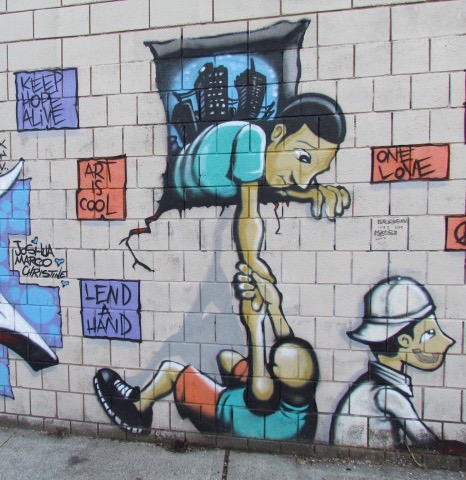
img_8413-1 (3)
Image: Jordan Allen

Shortly after the United States entered World War II, New-York born Margaret Tsuda was evacuated from California to a Utah internment camp because of her Japanese ancestry. She later made her home in Newark, where she published two books of poetry. “My Graffito” appeared in the Christian Science Monitor of March 17, 1970, and in her collection Cry Love Aloud (1972).

the pinnacle

by Richard Testa

To the pinnacle of truth I climb.
What, no pinnacle, no truth?
Then where do I climb?
Why so breathless?  Why exhausted?
I know I labor: labor towards
Something, somewhere, somehow.
Is it not ascent?  I know I stand
Where I can see much more
Than I saw before.
I know it was something I grasped;
I know levels I’ve passed.
No?  You say I cannot be certain?
Then why so breathless?  Why exhausted?
I’ll cease to labor: go towards
Anything, anywhere.

O graying gray!  O uncertain grayness!
What is it dims my vision so?
It is but a passing cloud, I know, but frightening.
What is frightening about uncertain journey,
About clouds, about hazy grayness?
On, shall I go on?  Is there hope?

O blackest black!  O liquid blackness!
Submerged, my eyes, my ears; I drink blackness.
Yet do I thirst for light, for light do I thirst.
Will I go on to solid nothingness?
There is a light, I know, at the pinnacle I knew.

You told me there was no pinnacle
Or that I could be certain of its uncertainty
Or some such knowable unknowingness.
But I will ascend again,
For I know I have descended.

Born in Newark, Richard D. Testa left to enter a Catholic seminary, lived for two years as a Trappist monk, then returned to teach English in the Newark schools. “The Pinnacle” appeared in the July-August 1962 issue of the locally published magazine Four Corners.

what makes a city

by William Hunter Maxwell

These tall buildings of steel and stone,
They’re not the city.        
These paved streets and gorgeous homes,
They’re not the city.        
This modern equipment and trappings high-tone,
That’s not the city.        
These cathedrals sublime with mighty domes,
They’re not the city.        
No! None of this is the city!
The city is not in steel nor stone,
Howe’er splendid that may be;        
The city is not in things alone,
That only express a material degree.        
The city is made of manhood worth,
The warp, woof, and web of life;        
Those whose labors while on earth
Help in lessening hate and strife;        
Human being with right heart-beats,
Men whose lives are lived for others;        
Folks who never play at cheats,
Or do aught to harm their brothers.        
What makes a city are folks who’re real,
Endowed with a spirit for the common weal.

William Hunter Maxwell was a groundbreaking journalist who founded the first African American newspaper in New Jersey, the Herald News.  He also worked as Sunday editor at the Newark Ledger and features editor at the Newark Star-Ledger, the first black writer to hold those positions. “What Makes a City” appeared in The Life to Live and Other Plainpoems (1937).

divident hill

by Elizabeth Clementine Kinney

dividenthill
Image: Old Newark

Pause here, O Muse! that Fancy’s eye
        May trace the footprints still
Of men that, centuries gone by,
        With prayer ordained this hill;
As lifts the misty veil of years,
        Such visions here arise
As when the glorious past appears
        Before enchanted eyes.

I see, from midst the faithful few
        Whose deeds yet live sublime–
Whose guileless spirits, brave as true,
        Are models “for all time,”
A group upon this height convened–
        In solemn prayer they stand–
Men, on whose sturdy wisdom leaned
        The settlers of our land.

In mutual love the line they trace
        That will their homes divide,
And ever mark the chosen place
        That prayer hath sanctified;
And here it stands–a temple old,
        Which crumbling Time still braves;
Though ages have their cycles rolled
        Above those patriots’ graves.

As Christ transfigured on the height
        The tree beheld with awe,
And near his radiant form, in white,
        The ancient prophets saw;
So, on this summit I behold
        With beatific sight,
Once more our praying sires of old,
        As spirits clothed in light.

A halo crowns the sacred hill,
        And thence glad voices raise
A song that doth the concave fill–
        Their prayers are turned to praise!
Art may not for these saints of old
        The marble urn invent;
Yet here the Future shall behold
        Their Heaven-built monument.

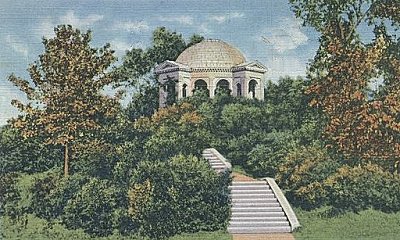
Elizabeth Clementine Stedman Kinney (née Dodge) was a prolific writer of poems and essays. Her “Divident Hill” was first printed in the Newark Daily Advertiser of September 10, 1849. Part of the historic boundary between Newark and Elizabeth, Divident Hill was crowned in 1916 by the stone pavilion pictured above.

the soul of the city

by Edward N. Teall

(Newark: 1666-1916)

Write a poem of Newark? I think you are mad!
What is there poetic in Newark?
For Pegasus, what has Newark but the pound?
Suppose Homer sang at the Four Corners!
Newark might pity his beard and blindness,
But as for his verse—Poof!

If a poet walked through Broad Street,
Newark would laugh at his long hair,
Newark would jeer and jibe,
And in the end kill him with disregard more cruel than scorn or the flung stone,
Or spew him out of the corporate urban mouth.

Write a poem of Newark?

Write a poem of the stomach ache,
A poem of a droning beehive!
Hammer out words to fit the strident cacophonies
Wrung by some exiled son of Italy
Out of a box on wheels
With wheezy bellows in its bowels
And the meter regulated by a handle on a crank shaft.

Would not that be the music of an American city?

Still! Milton wrote of a beehive,
“As when in Spring the sun with Taurus rides,”
You know those lines of limpid melody.
(John Milton was nobody’s fool—
When it came to smiting the lyre.)

Are humans less usable stuff
Of poetry than apis?

And others have spun music out of their inward pains,
Wrung vocal harmonies from physical discords—
And a stomach ache is not less a part
Of man’s grotesquely constituted being
Than are those maladies of soul
Whose treatment made the Tragedist of Avon great!

And a city of America
In this conglomerate era
Is a huge and writhing indigestion.

There must be poetry in it!
Celebrate the years of Newark?
What is a year, that number it,
Name it as we do the new baby,
Or Newark’s new hotel—
As Robert Treat had in a name
Identity distinct?

A year is so much growth?
So many new homes, new babies,
New methods in your mills,
So many sprouting tombstones in your graveyards,
So many new voices in your pulpits,
New faces (sealed with wax of hypocrite polite attention) in the pews;
So many new streets laid open
(Gashing and scarring the ancient hills and fertile fields)—
So many new names entered on the baptismal record (or the station-house blotter),
So many more minted dollars
In municipal coffers
(Or sidetracked into political pockets)—
So many suburbs ingurgitated?

But if the Founders could return,
We would read
In their city
A Poem!

The steel cars,
The tracks in the streets
And high powered, soft cushioned limousines, juggernauts of swift moving pleasure;
The crowds on the pave, some in haste
And some richer in leisure than purpose
And staring with insolence at their betters
Or idly in at the rich display in shop windows;
The little group of Salvation Army heroes;
Your markets, unresting, where consumer hunts
Like a Daniel Boone of the new time;
Your railroads, that bear from afar
The wheat and rich fruits to fill you,
And rough ores and lumber and leather
To glut greedy maws of machinery
Finishing wares to go back through the land,
Spreading the proclamation that goods
Made in Newark
Are best—
Your homes multitudinous,
Prosperous, happy,
Or clouded with pains of the body
Or shadows of sin in the soul—
Your turrets that gleam in the sun blaze,
Your offices, schoolrooms and bookrooms,
Hospital wards and museums,

Here is the stuff of your life!

Here are the sources deep hidden
Whence rills of influence issue
To merge with the current, broad bosomed and laden with argosies—
Not of commodity commerce only or mainly,
But deep draughted, hull full of Newark,
Weighted and freighted till Plimsoll marks vanish,
Immersed in life’s waters yet onwardly moving—
The stream of the Spirit of Newark,
Proclaiming her kin to the common,
Yet making her Newark, none other!

I say to you, seeing this vision,
That he who shall take up your challenge,
Having the soul of the poet—
He who shall see you just as you are
And clothe you splendidly in words,
Shall be filled with the breathing of music
And vibrantly utter
The soul that is in thee,
In Newark!

And ye have done well to hang harps in the wind.

Edward Teall’s entry in the 1916 poetry competition won a $50 prize. It was later published in The Newark Anniversary Poems.
IMG_3751