celebration ode

by Lyman Whitney Allen

Image: Arshile Gorky via artblog
Image: Arshile Gorky via Artblog

                        I

Great City of our love and pride,
Whose centuried fame is nation-wide,
        And wider than the alien seas,
To her we cry “All hail!” and bring
Devotion’s gifts the while we swing
        Censers of burning loyalties.

She answers in the regnant mood
Of Love’s triumphant motherhood,
        As round her surge the chants and cheers
Of joyous hosts that celebrate
Her times of eld, her new estate,
        Her quarter of a thousand years.

                        II

The sun in heaven did shine
        And all the earth sang “glory.”
’Twas Beauty’s immemorial sign,
        And Nature’s annual story.
The woodland birds were all awing;
        The hills and vales were rich with bloom;
’Twas Mayday, heyday of the Spring,
        And Life’s fresh gladness and perfume.

The fairest flower that decks the earth,
        In any clime or season,
Is that of a great ideal whose worth
        Time proves at the hest of Reason.
’Twas such they brought, in those days of yore,
And planted deep on our Jersey shore,—
A strange new flower whose growth became
Love’s healing for the civic frame.

It spread and every dawn was brighter
        And every creature obeyed its thrall;
We count the others lesser, slighter—
        The Rose of Freedom is worth them all.
The bluebirds know it,
The grasses show it,
        The south winds waft it through mart and street;
All else may perish,
’Tis ours to cherish
        This Jersey blossom from Robert Treat.

                        III

Hail Robert Treat the Puritan,
And the brave thirty of his clan!
        And that far fair Elizabeth,
Whose feet were first to tread our soil,
        A Puritan maid, whose betrothal breath,
        Fragrant with legendary grace that knows not death,
Works witchery naught may e’er despoil!

Superior souls were they,
        Who, in yon earlier time
Of Oraton’s rude Indian sway,
        Began this commonwealth sublime.
They laid foundations deep and strong.
The while they built they sang that battle song
The Ironsides chanted at Naseby and Marston Moor,
And all the hosts of freedom shout it forevermore.

The eyes of later sons behold
Their father’s faith and dreams of old,
Their Puritanism clear and brave,
Love’s sterner instrument to save,
Truth’s temple built with frame august,
To keep our great committals from the dust.

                        IV

List to the stir of the minute men!
        Hark to the roll of drums
                And the tramping of arméd feet!
        Lo, the great commander comes—
                Washington, leading a great retreat!
Welcome them patriots, now as then!

What soul was his to perceive the stair
From sky down sheer to the Delaware,
And trailing pageantry of light!
What seer of the nearing Christmas night
To hear God’s bells through the wintry gloom
Toll out the foeman’s doom!

O seven-year fury of war,
        For sake of a golden dream!
No whit of Old Glory, or Stripe or Star,
Shall ever bear stain or mar,
        While men remember redemption’s stream,
And cherish the all-consuming blaze
        Of Freedom’s holy battle ire—
Those Revolutionary days
        When Jersey’s blood was fire.

                        V

O Peace, thou gentle one!
No sound of belching gun
Displays thy heavenly part;
For Beauty’s architect thou art.
Thou buildest domes of grace
        That catch and echo back
                The spirit’s joyous singing.
Thy high and sacred place
        Is where no tempest’s wrack
                Its bolts of hate are flinging.

The elements of air and earth!
        What willing slaves they fast became
To those new masters! Solid worth
        Rose from the dust to shining frame.
Th’ expulsive smithy fire,
The mill-wheel’s creaking sounds,
Stage-coach, the “Old First” spire,
        “The Hunters and the Hounds,”
The workshop, mart and school,
        And “Cockloft Hall,”
And Combs and Boyden snapping custom’s rule
        Across the knees of genius!—History’s thrall
Enwraps and brings the glow of worthy pride
To us to whom our fathers’ gifts were undenied.

                        VI

War clouds were wildly gathering.
        One rode through the City’s streets,
                Under Fate’s horoscopes.
                        Men bowed in awe as he passed—
                Lincoln, the hope of a Nation’s hopes,
                        Riding to meet the approaching blast.
O Newark, what memories spring
        Out of thy deep heart-beats!

The black storm rolled, surcharged with thunder,
While levin of hate tore the sky asunder;
The earth yawned wide and incarnadine;
Deep hells flared forth where heavens had been;
And Jersey’s soul was a sacred cup
        Filled unto the brim with patriot blood,
And offered, thank God, sublimely up
        For Freedom and Country. And thus she stood,
And thus men marched, her heroes marched—
The ebon sky with light unarched—
And thus the regiments marched, and marched away,
The regiments marched day after day,
While tears were hot upon ashen faces,
And anguish was mistress of love’s embraces.
O God! but it was terrible, terrible,—
’Twas part of a Nation’s taste of hell,
To be inspirer to oppresséd nations,
Emancipator of future generations.
O City of heroes! Thou didst thy duty well.

Beautiful days since then have been—
        Days of our golden heritage.
        Right is the warrior’s master wage;
Peace is the garden that freemen win.

                        VII

What is this with its mighty thunderings
        Shaking a city’s fundaments?
This is the voice composite of toil that springs
        Out of ten thousand fiery vents.
This is the roar of a city’s industrial life.
        Throb of her engines, whirr of her wheels,
Furnace and dynamo, traffic and artistry rife,
        Strenuous giant that rages and reels
Backward and forward with passion cyclonic strained,
        Lifting gigantic arms and hands
Glutted with products, by sweat and by sinew gained,
        Offered to native and alien lands.

Wise men who follow Love’s starry frame,
        Here in this modern age,
                See where it hovers now
Sheer over smokestack and belching of flame.
        Greet Right’s increasing wage,
                Unto his triumphs bow.

                        VIII

Queen City of Industry!
        And whence doth wisdom come?
                Never a mortal son,
                Only the Thronéd One
Is great enough for thee
        And all thy radiant future’s sum.
Thy sires immortal on heights above
        Chant Vision’s increasing strain,—
’Tis God alone has the right to reign,
Since He is the Lord of Love.

The discords of drudgery turn to the melodious measures
        That fill the machinery of toil;
Faith’s song of emancipation, time’s chiefest of treasures,
        Ascends out of life’s turmoil.
The heart of the quickening world rejoices;
        Democracy’s prophets command, “Make way!”
While Wealth and Labor, with federate voices,
        Proclaim the Earth’s New Day,
And all the hosts of service spring
        Up the steep slopes of righteousness,
        To answer Justice with loud “Yes,”
To answer Love as ’twere their King.

                        IX

Out of the marshes she proudly rises,
        Greeting her Golden Age;
Civic symbol of Art’s emprises,
        Liberty’s heritage,
Triumph of Industry, Glory of Miracle,
Facing the Future’s alluring spell.

Set all the whistles blowing!
        Set all the flags a-flying!
                Cheer her predestined majesty!
                        Chant her apocalypse!
Up to her feet the sea is flowing;
        Thousands of eager ships are lying
                Waiting her on the invaded sea.
                        Hers are the sea and the ships.
Blow, whistles blow! Wave flags unfurled!
Newark belongs to the world.

Lyman Whitney Allen was poet laureate of Newark’s 250th anniversary festivities.

The Ode was a commissioned work, delivered at the opening exercises on May 1, 1916, in the new Proctor’s Palace at 116 Market Street. Inside the cavernous theater “every seat from pit to gallery was occupied,” exulted the celebration’s official journal The Newarker, “and the boxes shone resplendent with the wealth and fashion of the State and city.”

robert treat

by Allen F. Brewer

Image: Library of Congress

They’ve Robert Treat dramatics
        And a Robert Treat cigar,
Our beer—the pride ‘o Newark’s sons
        Is “Treated” near and far;
They tack his name to fads and frills,
        To hats and brands of shoes,
And Robert Treat’s the slogan
        On some groceries we use.
We’ve got a Robert Treat hotel,
        Our pride today, you bet,
His name’s upon a Newark school
        And soon a cigarette.
And e’en the highest hope of every
        Newarker we meet,
Is to name his “nineteen sixteen boy”
        A Junior Robert Treat.
Thus, should the shade of dear old Bob
        Appear to us today,
What shock must greet his eyes to see
        His name in such display.
The Hallelujah Chorus
        May not chant his name aloud,
But still we’ll bet Bob Treat is famed
        Up where the angels crowd.

According to art historian Ezra Shales, products emblazoned one hundred years ago with the figure of founder Robert Treat and other symbols of Newark’s Puritan past included “cuff links, lapel buttons, brooches, flag buttons, tie clasps, ash trays, silver loving cups, napkin rings, paper weights, jewel cases, match boxes, baby’s mugs, leather coin purses, cigarette holders, book covers and watch charms.”

Allen F. Brewer’s jesting homage to all things “Treat” ran in the September/October 1916 edition of The Newarker.

the first city planning

by Leonard Harmon Robbins

Image: S. H. Congar, in Jonathan F. Stearns, First Church in Newark (1851)

Jasper Crane,
With rod and chain,
Plotted down
Newark Town.
Gray with age,
Grave and sage,
The plan he laid
When the town was made.

Pierson, pastor
And Treat, the master,
Lent him aid
When the lines were laid;
Wisest three
In the colony,
And Crane was quick
At arithmetic.

“Build,” quoth he,
“Fair to see;
Serve them well
Who here shall dwell.”
The years increase
To centuries—
His work was good
And his work has stood.

Broad Street wide,
The city’s pride,
Throve and grew
On the lines he drew;
And the Training Place,
Our breathing space
In the city’s heart,
He set apart.

To him we owe
The pretty show
Of living green,
The spot serene
Now Washington Square.
The townsfolk there
Drove cart and shay
On Market Day.

The Corners Four
His imprint bore—
A wildwood then,
Untrod by men.
He could not see
That the cross would be
The busiest way
In the land one day.

The East Back Street
And the West Back Street,
Though each may claim
A prettier name,
Follow the lines
Of his designs;
Still run by the chain
Of Jasper Crane.

Thousands go
To and fro
In the lanes he broke
For the Founder folk.
The town’s still new;
There is work for you,
There are paths to lay
As in his day.

Jasper Crane is credited with laying out the original commons and streets of New Haven.  He left Connecticut in 1666 for Newark, of which he and Captain Robert Treat became the first magistrates. Evidence is scarce that Crane in fact delineated Broad Street, the Training Place (now called Military Park), the present Mulberry and Washington Streets or other components of Newark’s earliest town plan.

Leonard Harmon Robbins wrote for the Newark Evening News, producing light verse which he later published as Jersey Jingles (1907). “The First City Planning” appeared in the News of May 6, 1916.

the builders

by Berton Braley

Alland (1)
Image: Alexander Alland via Newark Public Library

Never a jungle is penetrated,
        Never an unknown sea is dared,
Never adventure is consummated,
        Never a faint new trail is fared,
But that some dreamer has had the vision
        Which leads men on to the ends of earth,
That laughs at doubting, and scorns derision,
        And falters not at the cynic’s mirth.

So the dreamer dreams, but there follows after
        The mighty epic of steel and stone,
When caison, scaffold and well and rafter
        Have made a fact where the dream was shown;
And so with furnace and lathe and hammer,
        With blast that rumbles and shaft that gleams,
Her factories crowned with a grimy glamour,
        Newark buildeth the dreamers’ dreams.

Where the torrent leaps with a roar of thunder,
        Where the bridge is built or the dam is laid,
Where the wet walled tunnel burrows under
        Mountain, river and palisade,
There is Newark’s magic of nail or girder,
        Of spikes and castings and posts and beams,
The need and wants of the world have spurred her,
        Newark—city that builds our dreams.

She has fashioned tools for the world’s rough duty,
        For the men who dig and the men that hew,
She has fashioned jewels for wealth and beauty,
        She has shod the prince and the pauper, too;
So the dreamer dreams, he’s the wonder waker,
        With soul that hungers and brain that teems,
But back of him toils the magic-maker,
        Newark—city that builds his dreams.

A prolific versifier and lyricist, Berton Braley won a $50 prize for this submission to Newark’s 250th anniversary poetry contest in 1916.

a city on a hill

by Joseph Fulford Folsom

Newark! to-day begins thy lamp to shine
With power high to flash the distant peaks
With messages of hope.  Thy gladness speaks,
And lo! a nation’s soul is knit with thine:

A city on a hill thou art, a shrine
Of homing pilgrims, who afar the streaks
Of thy new dawn behold—a dawn that breaks
Prophetic of a day without decline:

Ah! may that gleam forever love reveal,
That in the common heart lives warm and pure,
And spends itself for all humanity;
And may the dawning of a nobler weal
Of spirit beauty, and of goodness, lure
Our souls to light and civic sanity.

A writer of historical pieces, a clergyman, and the recording secretary and librarian of the New Jersey Historical Society, Folsom published this sonnet in the March 1916 issue of The Newarker.

the ballad of seth boyden’s gift

by Alice Read Rouse

Image: The New York Public Library

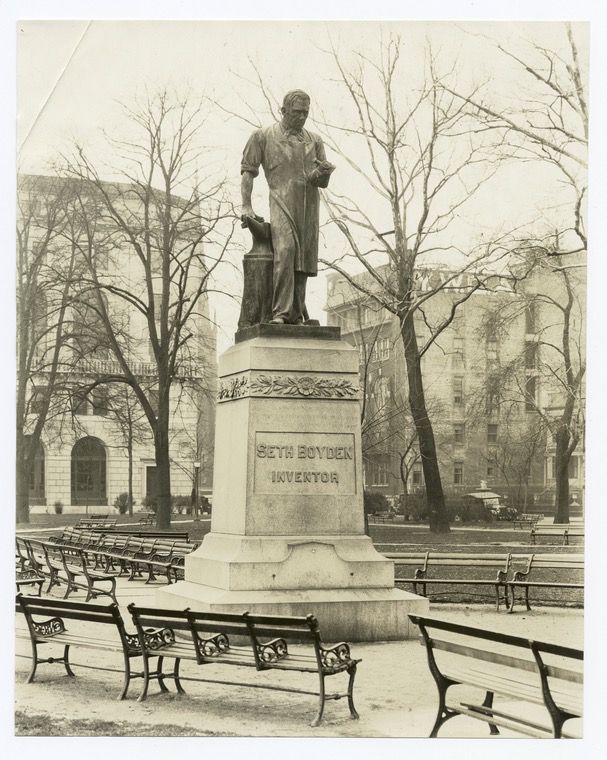
High in the Square his statue stands,
        INVENTOR carved beneath:
But he who crimsoned the lips of Spring
        Might wear a Poet’s wreath.

Old Newark sat in its bosky streets,
        Tidy and prim and serene;
Prankt with posies and orchard sweets
        To the fringe of its marshes green.

‘Twas after the fighting of 1812
        Seth Boyden came to town;
He’d licked the British,—and they’d licked him,—
        And he wanted to settle down.

Old Newark called to him potently,
        Though none but himself could hear
That clashing summons as it clanged
        On his prophetic ear:

None but himself see that clean blue sky
        With its white little chubby clouds,
Grimed with the reek of his chimneys tall,
        Grim with his black smoke-shrouds.

“Thou hast lent me talents ten, Lord God,”
        To his Maker deep he prayed:
“An Thou prosper me, I will give them back
        Tenfold increased,” he said.

Long with his cunning hands he wrought,
        Long with his seething brain,
That God might not require of him
        His usury in vain.

He watched the hedgerow’d village lanes
        Where tinkling cows browsed home
Herded by whistling barefoot lads,
        Great thoroughfares become:

Stone-paven streets where clicked the heels
        In castanetted tune
Of all new Newark’s gentlefolk,
        Shod with his shining shoon.

Malleable to his iron will,
        He bent earth’s iron bars:
The lightning Franklin had lured down,
        He flashed back to the stars.

A thousand men he kept at work,
        A thousand ships at toil,
A thousand ways of increase he
        Wrought out upon the soil.

At length in life’s cool afternoon,
        He paced his garden-place:—
A garden clipt from Newark’s youth,
        Gay with its old-time grace.

Outside his gates he heard the growl
        Of labor chained to the wheel,
The roar of his captured genii bound,
        The shriek of his tortured steel.

He thought of old Newark’s bosky streets,
        Tidy and prim and serene,
Prankt with posies and orchard sweets
        To the fringe of its marshes green.

He said: “I have had my work to do
        Thy lendings to increase,
Lord God:—to pay Thee back Thy loan
        Before my days should cease.

“Now, ere my death-hour strike, I would
        I might just pleasure Thee!
Give Thee and Newark some quaint gift
        All free from merchantry.”

Up from the garden-sward there breathed
        An exquisite bouquet:
Fresh, faint, and fragrant as a wine
        For fairies on Mayday.

And glancing down, Seth Boyden saw
        The wonder at his feet:
Wild strawberries like elfin cups
        Brimmed with ecstatic sweet:

Too frail for aught save dryades
        To taste with leafy lips,
Yet aromatic as the juice
        That Puck in secret sips.

Seth Boyden smiled: with careful skill
        He culled the perfect plants.
Through patient moons he wove his spells
        Till knowledge conquered chance.

He fed and watered, pruned and plucked,
        Till from his garden-sod,
There blazed a berry fit to feed
        A hero or a god!

This was the gift Seth Boyden gave
        To all his world for boon;
That Heaven might smile and Newark feast
        From April on through June.

For the great epic of his toil
        Heaped laurels are his meed:
And garlands for the loveliness
        Of that last lyric deed.

High in the Square his statue stands,
        INVENTOR carved beneath:
But he who invented strawberries,
        Might wear a Poet’s wreath!

Seth Boyden came to Newark in 1815, setting up a harness and leather shop not far from the site of the present monument in Washington Park. A plaque added to the statue’s base lists some of his numerous achievements, among them the discovery of processes to make malleable iron and patent leather, both crucial to Newark’s prosperity. The tablet also notes his success in strawberry hybridization.

Historian Alice Read Rouse submitted “The Ballad of Seth Boyden’s Gift” to the 1916 poetry competition from her home in Covington, Kentucky. It was one of thirteen prizewinning poems.

city of a hundred years

by William Hunter Maxwell

112199pv
Image: Library of Congress

A Tribute to Newark, New Jersey, Honoring by Celebration the One Hundredth Anniversary of the Granting of a Charter to the City by the State of New Jersey

Our City of a Hundred Years,
Born of rugged ideals,
Conquering fears and tears,
A soul sublime reveals.
Men of might hewed the way,
For Newark’s march ahead;
Their eyes visioned another day,
And other paths to tread.
Our City of a Hundred Years,
Pride of the Garden State,
Stalwart among its peers,
Grateful for its fate.
Service is King in our Realm,
Common comfort is the goal,
Since early fathers at the helm
Inscribed the Charter Roll.
Our City of a Hundred Years,
We honor its Charter Birth;
A home each worker fain reveres,
And gives his manhood worth.
’Tis for steerers of the ship,
As a crowded future nears,
To plan for others on the trip
Of another Hundred Years.
For yea, today, we reap the fruits
Of seeds that zeal hath sown,
So for tomorrow let’s set new roots,
For the glory of a Newark now unknown.

On March 18, 1836, Newarkers approved the incorporation of the city by a vote of 1,870 to 325. Twenty-four days later, on Monday, April 11, they elected Newark’s first mayor, William Halsey. The cornerstone of the first city hall was laid during his term, which lasted one year.

Journalist William Hunter Maxwell was a member of the Committee of One Hundred overseeing the 1916 anniversary celebrations, but had resigned in protest over the racism of some of its pronouncements. Still, his love of the city was constant and he often committed its praises to verse. This ode on the centennial of Newark’s charter was printed in The Life to Live and Other Plainpoems (1937).

a spring song

by Lyman Whitney Allen

Is it wrong for the thrush to sing?
        Can the crocus keep back its bloom?
And shall not a soul that feels the Spring
        Break forth from its house of gloom?

O passionate heart, be strong!
        Thou wert made, like the birds and the flowers,
For music and fragrance the whole day long
        In the April light and showers.

To every one it is given
        To love, and to hope, and to do;
There’s never a power on the earth or in Heaven
        Can throttle a soul that is true.

12923754-mmmain
Image: Robert Sciarrino/The Star-Ledger

Lyman Whitney Allen was pastor of South Park Presbyterian Church for 27 years.  Author of Newark’s official celebration ode for the 1916 commemorations, he withdrew from full-time ministry later that year to devote himself to literature. “A Spring Song” was printed in The Newarker of April 1916 and in The Newark Anniversary Poems.

to newark

by Haniel Long

The day a modern city celebrates
Her age, and wonders what her life may mean,
Long dead philosophers could come to her,
Poets and scientists should throng to her,
And the most noble thoughts of men and women
Alive and dead, should quicken in her mind.
The clouds and stars should speak, nor should the fields
Be dumb; and the procession of the years
Should bring her many a richly ‘broidered word
Taken from the loom of time.
                                                           What would they say?
Newark, the years would bring the self-same words
They brought of old to Baghdad and Peking
And many an elder city now forgotten,
The self-same words they bring to San Francisco,
London, Berlin; for they would say to you
That though the gardens of the distant past
Are fair in memory, and though the dust
Of ancient times came to consummate flower
In many a beautifully bodied girl
And boy, in many a tender-hearted woman
And stalwart man, this life of ours today
Is quite as fair, and animated dust
As precious. They would say to you that still
Apples of the Hesperides are bright
And waiting to be picked, and days are fresh,
And dogwood still is white in early May.
And they would say that never any town
Was more belovèd of eternity
Nor given a more golden chance. Newark,
You have the only stuff that ever was
Of glory, for you have the souls of men:
The dream of love and justice which you weave
Out of the faces in your thoroughfares,—
A girl-like sunlight on the tasseled corn;
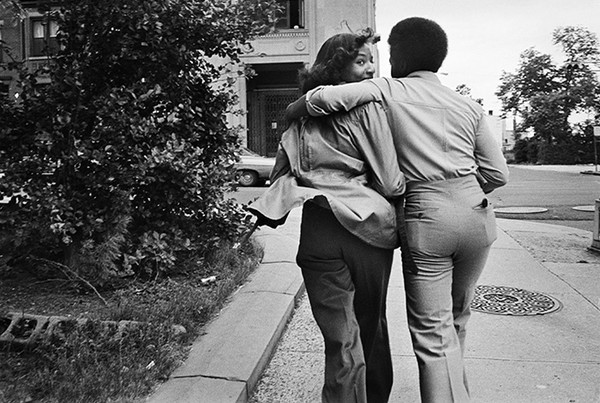
Beside her, eager with his love, a youth
Whose stride is music and whose laugh is wine,—
The dream you weave of them, the dream you weave
Of all your children and their hopes and fears,
Will be a prophecy of time to come,
When, in the wisdom of his ageless heart,
Mankind shall build the City Beautiful.


Image: Guzman via glitteratiincorporated.com

While teaching English in Pittsburgh, Long submitted this entry to the 250th anniversary poetry competition. It appeared in the September/October 1916 edition of The Newarker and The Newark Anniversary Poems

broad street

by Augustus Watters

Image: newarkstory http://newarkstory.com/Newark_Story/Places_photos_2.html#42
Image: Newark Story

(1666-1916)

When lilacs bloom in urban bowers,
Sweet harbingers of summer hours,
And cherry-blossoms lightly fall
Like snowflakes by the garden wall;
When robins hide in apple-trees,
And pansies nod in every breeze,
And like cathedrals, tall and grand,
Our hoary elms majestic stand,
While underneath the current flows
Of human joys and human woes,
Then seems the street a mighty stream
On which we mortals drift and dream.
Here toiled the Fathers in the fields,
Where earth her truest treasure yields,
And here the Sons, with reverent eyes,
Behold a royal harvest rise.
Yet ever, ‘neath the starry cope,
The radiant barges Love and Hope
Move side by side with Grief and Care,
And all the flotsam of Despair.
In vain the pilots seek to force
Their way against the current’s course,
And where they’re bound, or whence they came,
Nor sage, nor bard can ever name.
And none of all the fleets that glide
Along the weird and heaving tide
Turn back their prows or ever teach
What Port the later Pilgrims reach.

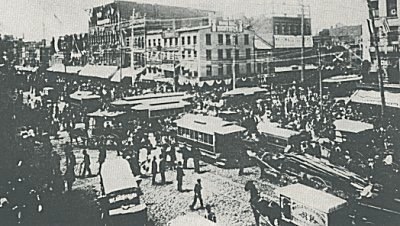
Frustration with Newark’s congested streets led to the opening in 1916—Newark’s 250th anniversary year—of the Public Service Terminal on Park Place, a few blocks north of Broad and Market. Linked to the terminal was the city’s earliest subway, a short trolley line segment beneath Cedar Street. The new terminal saw more than 2,500 streetcar stops per day in 1916.

Augustus Watters’ meditation on bustling Broad Street was included in The Newark Anniversary Poems, published the following year.