the dress

by C. K. Williams

Image via The Star-Ledger

In those days, those days which exist for me only as the most elusive memory now,
when often the first sound you’d hear in the morning would be a storm of birdsong,
then the soft clop of the hooves of the horse hauling a milk wagon down your block

and the last sound at night as likely as not would be your father pulling up in his car,
having worked late again, always late, and going heavily down to the cellar, to the furnace,
to shake out the ashes and damp the draft before he came upstairs to fall into bed;

in those long-ago days, women, my mother, my friends’ mothers, our neighbors,
all the women I knew, wore, often much of the day, what were called “housedresses,”
cheap, printed, pulpy, seemingly purposefully shapeless light cotton shifts,

that you wore over your nightgown, and, when you had to go to look for a child,
hang wash on the line, or run down to the grocery store on the corner, under a coat,
the twisted hem of the nightgown, always lank and yellowed, dangling beneath.

More than the curlers some of the women seemed constantly to have in their hair,
in preparation for some great event, a ball, one would think, that never came to pass;
more than the way most women’s faces not only were never made up during the day,

but seemed scraped, bleached, and, with their plucked eyebrows, scarily masklike;
more than all that it was those dresses that made women so unknowable and forbidding,
adepts of enigmas to which men could have no access, and boys no conception.

Only later would I see the dresses also as a proclamation: that in your dim kitchen,
your laundry, your bleak concrete yard, what you revealed of yourself was a fabulation;
your real sensual nature, veiled in those sexless vestments, was utterly your dominion.

In those days, one hid much else, as well: grown men didn’t embrace one another,
unless someone had died, and not always then; you shook hands, or, at a ball game,
thumped your friend’s back and exchanged blows meant to be codes for affection;

once out of childhood you’d never again know the shock of your father’s whiskers
on your cheek, not until mores at last had evolved, and you could hug another man,
then hold on for a moment, then even kiss (your father’s bristles white and stiff now).

What release finally, the embrace: though we were wary–it seemed so audacious–
how much unspoken joy there was in that affirmation of equality and communion,
no matter how much misunderstanding and pain had passed between you by then.

We knew so little in those days, as little as now, I suppose, about healing those hurts:
even the women, in their best dresses, with beads and sequins sewn on the bodices,
even in lipstick and mascara, their hair aflow, could only stand wringing their hands,

begging for peace, while father and son, like thugs, like thieves, like Romans,
simmered and hissed and hated, inflicting sorrows that endured, the worst anyway,
through the kiss and embrace, bleeding from brother to brother into the generations.

In those days there was still countryside close to the city, farms, cornfields, cows;
even not far from our building with its blurred brick and long shadowy hallway
you could find tracts with hills and trees you could pretend were mountains and forests.

Or you could go out by yourself even to a half-block-long empty lot, into the bushes:
like a creature of leaves you’d lurk, crouched, crawling, simplified, savage, alone;
already there was wanting to be simpler, wanting when they called you, never to go back.

C. K. Williams was born and spent his boyhood in Newark. This poem, appearing in The Atlantic Monthly of June 1999, was also part of the Pulitzer Prize-winning collection Repair.
a vision of 1916

by Joseph Fulford Folsom

Image: Louis H. Ruyl in The Newarker (1916)
Image: Louis H. Ruyl in The Newarker

The bells rang music, but the blare
Of trumpets made Four Corners sound
Like some weird throng. Such clamor there
The silent Training Place I found.

Vague shadows hung about the shrine
Long named Old Trinity. Among
The trees where bending paths entwine,
An antique figure moved along.

A Founder looked he, but he said:
“Call me the Spirit of the Town,
Among the living, not the dead,
Walk I unceasing up and down.”

“Good Spirit,” said I, “what bright cheer
To our fair city do you bring?
Spin us the vision of the seer,
Just at the New Year’s opening.”

An ember kindled in his glance,
That soon shot forth prophetic fire;
And then, with fervid utterance,
Predictive spoke the ghostly sire:

“The manes and the stars foretell
A greater Newark, till her fame
Resplendent cast a wondrous spell
On land or sea, where sounds her name!”

Amazed heard I the gracious seer,
Too good the augur seemed for true;
But when I plead again to hear
He turned, and waved his hand adieu.

The bells still carolled, and the gleam
Of lights electric kissed the snow–
“Perhaps,” mused I, “a hollow dream,
If not, let Newark prove it so.”

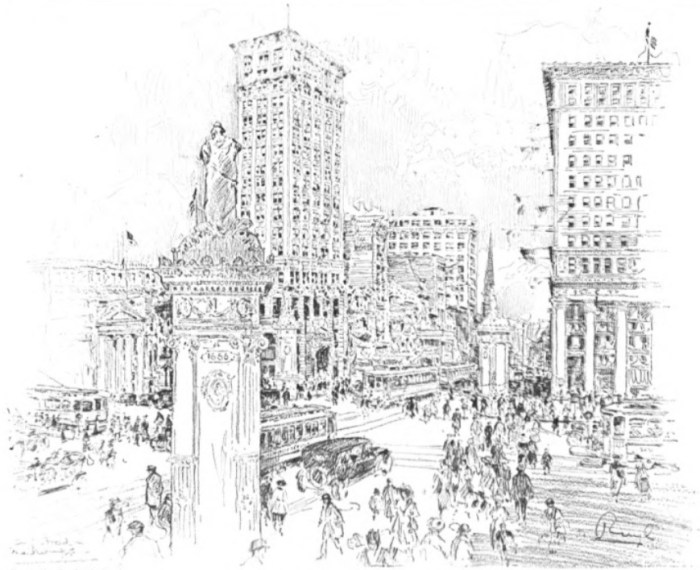
The decorative scheme of Newark’s 250th anniversary festivities included four plaster and wood pylons at the Four Corners, 23 feet in height, and two dozen smaller pylons spread out along Broad and Market Streets, each adorned with an instructive saying. Conceived as “things of beauty and guideposts to learning,” the pylons proved, according to newspaper reports, chiefly useful as objects for idlers to lean or smokers to strike matches on. They were removed in August 1916.

The author of the above verses, printed in The Newarker in January 1916, reported that his poem’s prophecy of “a greater Newark” figured on one of the Broad Street pylons. That stanza does not, however, appear on a list of pylon legends published in the June issue of The Newarker.

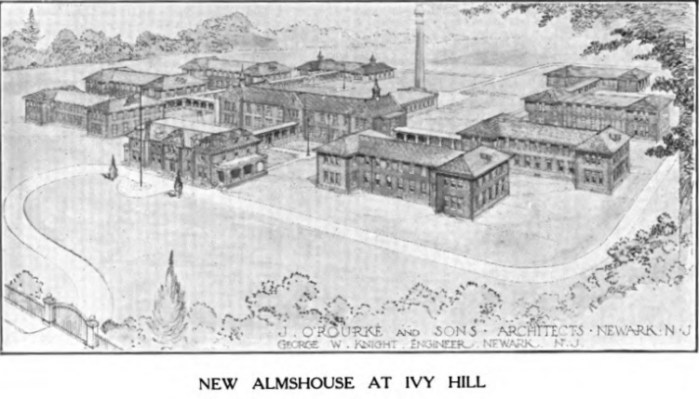
the shades of ivy hill, newark

by Ruth Holzer

Image: Manual of the Common Council, 1914

Somewhere in the shadow
of the gutted poorhouse on the hill,
the fat lady still chops fried onions

and chicken liver in a scarred wooden bowl
while yammering at her husband
so all the neighbors can hear.

Down the street a deranged woman,
naked under her mink coat, escapes
again, chased by her guilt-filled daughter

into the yard of the widowed Neapolitan
sisters who continue impassively
tending their grapevines.

The foster mother in her big brick house
harbors another brood of thugs.
Even the crooked Russians are looking to get out.

In 1916 Newark’s inadequate almshouse on Elizabeth Avenue was replaced by a spacious complex at Ivy Hill, on the city’s western limits. In the 1950s the adjacent poor farm became the site of the Ivy Hill Apartments. The poorhouse buildings have since been demolished.

This piece appeared in the Journal of New Jersey Poets in 2010.

puritan newark

by Katherine Baker

        Puritan Newark,
The Martha of cities,
Careful and provident
Sits at her spindles.

        Down the world’s pathways
Hobo and Tsar,
Shod by her industry,
Borne in her carriages,
Jeweled or clothed by her,
Pass without gratitude.

        Still her shrewd sons,
Like their stern forebears
Who came from Connecticut,
Make their religion
The gospel of usefulness,
Still with their hymnals
Wadding their guns.

        Jews, in her factories,
Pollacks and Finns and Greeks,
Sweat out new destinies:
Wring from strange chemicals
Lives for their children,
Wealth for the world.

        Build for their children
Her schools and her aqueducts,
Build themselves citizens
Of no mean city;
Forge in her foundries
The soul of America.

        So when swift trains
Are rolling through Newark,
Men at the windows see,
Far down a busy street,
Flash in perspective
The Goddess of Liberty.

Image: 925-1000.com
Image: Online Encyclopedia of Silver Marks, Hallmarks and Makers’ Marks

The writings of Katherine Baker were featured in several leading literary magazines of her day. “Puritan Newark” took one of the prizes in the city’s poetry contest in 1916.

In 1917 Baker volunteered as a war nurse; she would attain the rank of corporal and receive the Croix de Guerre for her heroic service in Europe, work that led to a physical collapse from which she never recovered. She died in 1919.

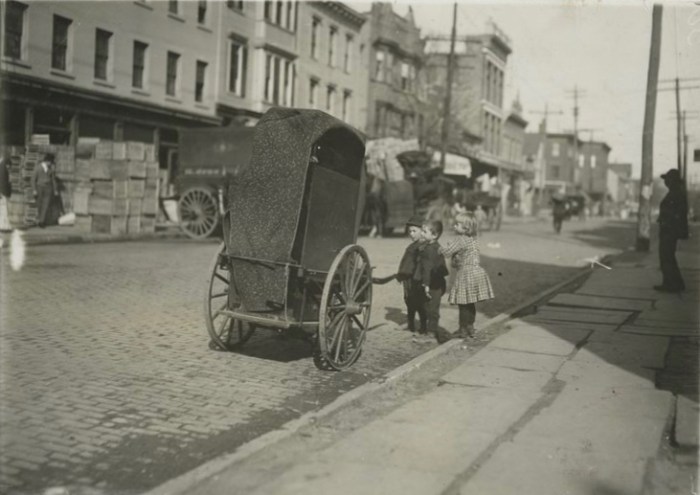
waverly avenue

by Betty H. Neals

Image: New York Public Library

Just a panorama
down a city street!
A wagon vendor
(the poor folk’s auctioneer),
odd children playing,
skipping here and there
on Waverly Avenue.

                          Small trade stores;
                          confectionaries;
                          grills displayed with meat
                          caked on the stick;
                          houses two by two;
                          a hybrid tree;
                          a beauty shop;
                          a funeral home
                          separated by the cobblestones.

When wagon wheels roll over broken cobblestones
the poor folk’s auctioneer’s low tones combine,
to make a music of their own:

                          “Apples red and sweet potatoes,
                          Collard greens and red tomatoes,
                          32, 16, 29, 2 ! 32, 16, 29, 2 !
                          Clip-pity clop, clip-pity clop,
                          Clip-pity clop, clip-pity clop.”
                          “16 cents per pound (to one)
                          29 cents two pounds (to one)
                          32 cents two pounds (to two)
                          What can Big Apple do for you?”
                          Clip-pity clop, clip-pity clop,
                          Clippity, clippity, clippity clop.

Just a panorama
down a city street!
A wagon vendor
(the poor folk’s auctioneer),
odd children playing,
skipping here and there
on Waverly Avenue.

                          Two children come
                          directly after school
                          ’bout twice a month.
                          Auctioneer comes by along about that time.
                          The two kids play some game about a line.
                          Two children pass the beauty shop.
                          Beautician glances up, but does not stop.
                          Pedantically, she mocks them at their game:
                          “‘A line unstepped upon brings wealth and fame.’
                          “There they come! Lord, look here!
                          Skipping over lines pass the auctioneer.
                          She’s grabbing on the rail, eh?
                          I think she’s kind of scared.
                          You watch and see. He’ll take her hand.
                          She’ll straighten up her head.

                          ’Bout the time the auctioneer’s through
                          they’ll be finished grieving, too.
                          Tell me they look around, then sign their name.
                          Then burst into tears, just all in vain.

                          “That sign above the door don’t seem to bother them.
                          Seems like they read it, ‘Funeral Home – Drop in.’
                          “… How old?… I think she’s eight… he’s ten.
                          “Lord, they sure have plenty folks to die, Ha!
                          I just don’t understand it! Why? Ha!
                          Seems like fear would make those children turn and run.
                          Can’t see how watching dead folks could be fun.”

Just a panorama
down a city street!
A wagon vendor
(the poor folk’s auctioneer),
odd children playing,
skipping here and there
on Waverly Avenue.

                          Clip-pity clop, clip-pity clop;
                          Auctioneer’s timing’s just like a clock.

                          The children close the door behind them.
                          They tiptoe down the stairs,
                          exchange a quick knowing smile,
                          dry their tears, continue their game.
                          “A line unstepped upon brings wealth and fame.”

                          The beautician, halfway looking through the glass,
                          throws her head back and laughs
                          puts down the curling iron,
                          hops with a shimmy
                          as if she saw that line:
                          “Tell you how I’d have played that game,
                          Just wealth, wealth, wealth!
                          No fame, fame, fame!”

                          The customers laughed and cheered.
                          And as the auctioneer appeared,
                          The horses tapped out, “clip-pity clop.”
                          The beautician yelled to him:
                          “Auctioneer, stop!”

                          Auctioneer sings:
                          “32, 16; 16, 1;
                          Everything is just about gone.

                          “Apples, Lady? Weigh them out and see.
                          They cost 29, you got 26, that makes minus three.”

                          “To make this bargain even,
                          Suppose I take out one.”
                          The auctioneer nods in agreement
                          as he yells out, “GONE!”
                          She handed him the apple.
                          The children go on playing.
                          When wagon wheels roll over broken cobblestones,
                          The poor folk’s auctioneer’s low tones,
                          combine to make a music of their own.

Just a panorama
down a city street!
A wagon vendor
(the poor folk’s auctioneer)
odd children playing,
skipping here and there
on Waverly Avenue.

This 1973 poem by Newark native Betty Neals appeared in her collection Move the Air. Waverly Avenue was renamed Muhammad Ali Avenue in 1978.

these shall prevail

by Theodosia Garrison

War laid bugle to his lips, blew one blast–and then
The seas answered him with ships, the earth with men.

Straight, Death caught his sickle up, called his reapers grim,
Famine with his empty cup came after him.

Down the stairs of Paradise hastened angels three,
Pity, and Self-Sacrifice, and Charity.

Where the curved, black sickles sweep, where pale Famine clings,
Where gaunt women watch and weep, come these of wings.

When the red wrath perisheth, when the dulled swords fail,
These three who have walked with Death–these shall prevail.

Hell bade all its millions rise; Paradise sends three;
Pity, and Self-Sacrifice, and Charity.

Image: Newark Public Library via influenzaarchive.org

Newark’s location on the Atlantic coast and its chemical and steel industries proved crucial to U.S. mobilization in the First World War. Wartime activities also profoundly transformed the city. Gazing into the future, a leading attorney commented that women involved in Red Cross work would no longer be content “to live lives of uselessness.”

Theodosia Garrison published this poem in the February 1918 Good Housekeeping magazine.

and why not?

by William Hunter Maxwell

Image: The Graphics Fairy

On the stage of life they say,
Each must play a part;
My sister’s part is merry and gay
And why not?

Her thoughts are free, her smiles allure,
And why not?
Her sighs are light, for she is pure,
And why not?

The Summer Sun makes us glad,
And why not?
My sister though is never sad,
For in sunshine she is clad.

The flower, the tree, the grass is new
And why not?
They are happy for spring and sister too,
And why not?

How sweet the song of the early bird,
And why not?
A word from sister they have heard,
It makes them glad and never sad,
And why not?

Her soft sweet breath is like the rose,
And why not?
Why she is happy she always knows,
And why not?

And why not? I ask. Why, this is it:
On the stage of life they say,
Each must play a part.
My sister’s part is merry and gay,
And thus a soft, sweet heart.

These verses are preserved in journalist Maxwell’s papers at the New Jersey Historical Society.

courage

by Joseph Fulford Folsom

War of America

An Interpretation of Gutzon Borglum’s “Wars of America”

Fanfare and lights! Make way the master-play
        Of these United States, redeemed and free!
Up patriots! Hurrah the brave array
        And pageant of the soul of history!

Sheer supermen these captains in the van,
        Phalanxed as some steep avalanche at pause,
A moment poised in raptured gaze they scan
        The radiant future of their holy cause.

Afar the fabled peaks delectable they catch,
        Eternity is mirrored in their eyes,
Beyond the rough and mist-bound path they watch
        Entranced the new Democracy arise.

Stern pioneers of liberty they stand,
        Like giant demi-gods who strove of old,
Or mated with the daughters of the land
        To multiply a brood of heroes bold.

Behind them rolls such human tidal wave
        As never since the first moon lit the night
Swept over land or sea, a host that gave
        Its sacred all a sacrifice to right.

O force invincible! O soldiers bluff!
        O men and women of the rank and file,
Grim servitors who tarry by the stuff,
        Your parts we hail with high acclaim the while.

Some San Juan hill they seem to scale again,
        Or Lookout’s terraced slope. And by their side
The horses of the Shenandoah strain,
        With conscious comradeship–pathetic pride.

To hold the blood-wet mount of high resolve
        The toilers sweat, the women bear and rear,
Upon the unarmed grand reserve devolve
        The burdens of the home, the toil, the tear.

O height! eternal as man’s long ascent,
        You call to us like that in Galilee,
Where Jesus, Moses and Elias spent
        One night in brotherhood and prophecy.

Tongue-tied awhile we watch the action flow,
        And then the pent emotion breaks and cries:
“Speak! prologue, from the wings, and let us know
        What this foregathered pantomime implies.

“We want the secret word, the master’s key,
        To make this thrilling drama free for all,
One name to character the mystery,
        Before the cast go off and curtains fall.”

With clay-stained palms upraised the sculptor speaks:
        “The task of visioned hours at last is done;
From out my hands this art to freedom breaks,
        To be interpreted through time alone.”

Yet more he spoke: “The word you ask was seen
        At Trenton, and at Chateau Thierry fight,
As always in the victories between–
        It speaks forever in the bronze–Good night!”

“Wars of America,” the last and grandest of Gutzon Borglum’s four sculptures for Newark, was part of a bequest from furniture store magnate Amos Hoagland Van Horn, a Civil War veteran who died in 1908. The colossal bronze includes figures of officers and foot soldiers, family members, a Red Cross nurse, a conscientious objector and two horses.

“Courage” was read at the monument’s unveiling in Military Park on May 31, 1926.

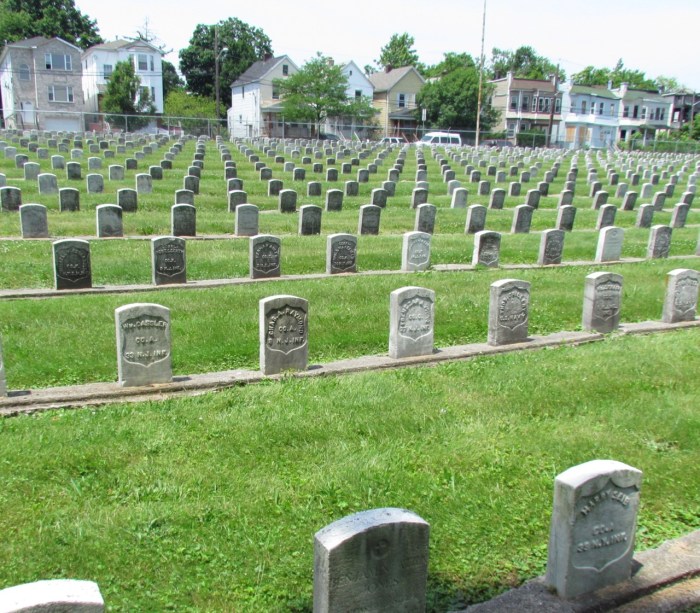
lines for decoration day

by Frederick H. Pilch

Image: Jordan Allen
Image: Jordan Allen

We meet to-day to decorate
        Our soldiers’ graves with flowers,
And vow their way to emulate
        Whenever danger lowers;
We gladly call their chieftains great,
        And welcome them with cheers,
For love of all who met dread Fate
        Like Union Volunteers.

In dark morass where mosses trail,–
        By bayous lone and still,–
In mountain pass where rainbows vail
        The limpid plunging rill,–
On quagmire’s crust, or arid plain,
        Afar from human tears,
Interred by dust and leaves and rain,
        Sleep Union Volunteers.

In barren sands along the shore
        Where ocean billows beat,
In forest lands where men no more
        In awful warfare meet,
On slopes remote where battles raged
        And warriors fought their peers,
With nought to note who were engaged,–
        Lie Union Volunteers.

They loved their soil, their homes, their wives,
        Their children, sweethearts, sires;–
Their honest toil brought quiet lives,
        And moderate desires;
With high resolve they said farewell
        To all that life endears,
Determined Treason to repel
        As Union Volunteers.

The few lie here,–the many there
        Still slumber where they fell,
Roses and clover blossoms fair
        And violets mark them well:
And though so far from home they lie
        We give them smiles and tears,
And honor with both shout and sigh
        Those Union Volunteers.

But as they bravely bled and died
        In agony and pain,
We say to-day with honest pride
        They did not die in vain;
For though the thinning legions go
        Adown the slope of years,
Freedom and Unity we owe
        To Union Volunteers.

Another generation bold
        Crowds on the stage of life.
To them the war’s a story told
        Of other people’s strife;
But in their hands our flag will fly
        Above all foes and fears,
On them our Nation can rely
        For Union Volunteers.

Six Civil War regiments were formed and trained at Camp Frelinghuysen, then an open field between the Morris Canal and Roseville Avenue. The first of these, the 13th New Jersey Infantry, left Newark on August 31, 1862, fought at Antietam, Chancellorsville and Gettysburg, and participated in the siege of Atlanta and the March to the Sea. The Volunteers of the 13th remained in the Union service until the war’s end.

Attorney Frederick Pilch published this poem in the 1882 compilation Homespun verses.

newark bay

by H. G. Dwight

Image: Valerie Larko
Image: Valeri Larko

I have stood on the bluffs of Scutari
and watched the morning mists smoke out of the Golden Horn–
full of fairy ships and iridescent sails,
like a harbor of the Happy Isles.
And I have watched the pinnacles of Seraglio Point
prick up black and slim and strange as the Arabian Nights
against a sanguine sky.

I have wandered among the lonely pillars of the Parthenon,
and wondered how those Greeks of long ago made them so simple and so noble,
and how even so many suns could turn them into amber,
and how the antique drama of the day
looked between them as if I had never seen it before,
ending above the Bay of Salamis–
Was it a triumph? Was it a tragedy?–
in an unearthly fume of gold and violet.

I have sat in the ruined theatre at Taormina,
where mask and buskin mime no more,
but where a scene is set immortal in the world
of the jewel-blue Ionian Sea,
and the far-off opal mountains of Calabria,
and the lovely line of the Sicilian coast,
with its lacy ruffle of foam,
and the Sicilian hills,
bare and dark and grave, yet secretly aflame with oleander,
and the white town sitting on its high shelf of rock in the sun,
and little Mola aloft on her crag like a castle in a fairy story,
and supreme over all, hanging between blue and blue in a shimmer of silver,
the enchanted cone of Ætna.

I have climbed the North Cape,
into an Arctic wind you could not stand against,
into an Arctic fog swirling like a madman’s brain.
The wind tore terrifying chasms in the fog,
and through them dropped splinters of a lost midnight sun,
or through them, out of a void of thunder,
the spray of melted icebergs
spouted up chimneys of black rock.
It made me ashamed of the crowded shelter hut,
where tourists giggled into the spray of champagne
or scribbled picture postcards.

But I like Newark Bay.
You don’t know where it is unless you are a Jersey commuter!
And no cliffs encircle it.
No famous cities lend it a little of their renown.
No beautiful buildings are reflected in it.
No typhoon ever tore it out of its bed.
Nor is the color of it very wonderful.

Never mind.
It has a wonderful way of catching color from the sun.
It has a wonderful way of rippling under the moon.
It has a wonderful way of darkling to infinity,
of somehow expressing what you feel when you rumble across it at midnight,
Tired and happy and unhappy and exalted after listening to violins.
And you should see the gold that twinkles around it in the dark,
that spatters it when the factories are alight.

I like the long lines of the chimneys, too,
and the smoke that flutters from them on the wind.
I like the barges that puff up and down from nowhere to nowhere,
on errands strange as any Indian patamar.
At night they give you such a friendly wink of a green eye!
I like the visions of hill-towns you catch from it on a clear day.
I like the black bridges that wade across it,
and the trains that slide so smoothly over them,
all day and all night, in a blur of black or gold–
and the sense of its loneliness,
and of so many million interwoven destinies that shuttle to and fro
and leave it lonely again.
I like those great beds of reeds that border it,
humble and green and alive to every whim of the air.
I like those little straggling wooden piers
and flat-bottomed boats at leash under a certain factory.
They always make me think of a certain palace on the Grand Canal,
a palace of delicate marbles carved long before factories or bridges came to Newark Bay,
in which a princess lives.
But she would not be a princess,
nor would she live in that palace,
if it were not for that factory on Newark Bay.
How ingenious some people are!
And how many ways there are of achieving palaces on the Grand Canal!
And I can manufacture nothing more ingenious than verses,
and they will never achieve me a palace on the Grand Canal!

Never mind.
I like a certain corner in Newark Bay
where a little inlet runs out beside a bridge.
On the shore some signboards make a fantastic splash of color
as you flash past them on the train.
Through the water marches a file of piles,
with restless green reflections fastened to them.
And shore and water meet each other so intimately,
in such an undulating line!
I will stand up for that line, even after the coast of Sicily.
I wish I could etch the grace and the humor and the subtlety of that line.
And beyond it the bay opens under the sky,
wide and pale as a Venetian lagoon.
And far away, high and white and incredible as the other world,
glimmers a tower in New York.

Born and schooled in Ottoman Turkey where his father was a missionary, Harrison Griswold Dwight used his extensive knowledge of the Near East serving in the diplomatic corps and writing fiction and non-fiction.

“Newark Bay” was featured in the September 1916 Atlantic Monthly.