a woman’s a woman for all that

by William Hunter Maxwell

Image: Mary L. Martin, Ltd.

Women grow different with the years,
Old Father Time will tell you so.
They string along with the cup that cheers,
And hate the modes of long ago.

Oh, yes, they smoke and drink a lot.
Some like to be thin, but few like fat.
And even though hard knocks they’ve got,
A woman’s a woman for all that.

They love to go to a baseball game,
You’ll find ’em at the ring-side too.
In many things their taste’s the same
As the men who see them through.

Some of them dress just like a man,
Sport a cane and wear a soft hat;
They even talk base when they can.
Still, a woman’s a woman for all that.

In every sport you’ll find her name;
They row, they drive, they conquer the air.
In law and medicine they’re not lame,
And in the pulpit they’re more than fair.

They can gamble, they can swear,
And still knock a fresh man flat.
The ballot is theirs most everywhere.
Still, a woman’s a woman for all that.

They’ve got men eating out of their hands;
In many places, they’re cock o’ the walk.
Big business and trade, woman understands,
And thoroughly knows her salesman’s talk.

Upon the heels of man, she’s steadily treading;
Both his shoulders are near on the mat.
But no matter now, which way she’s heading,
A woman’s a woman for all that.

Among Maxwell’s papers at the New Jersey Historical Society is a manuscript of this poem, showing the concluding stanza’s “Both his shoulders are near on the mat” altered to read “In the political ring, she flings her hat.” We give the text as printed in Maxwell’s 1937 volume The Life to Live and Other Plainpoems.
epitaphs

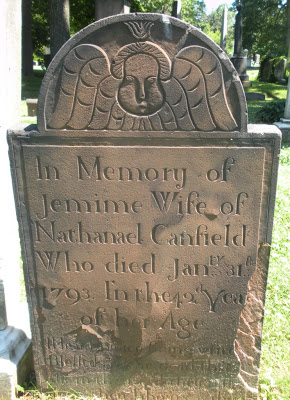
from the graveyard of the First Presbyterian Church

Image: Engraved
Image: Engraved

Death once more has been among us
        Our beloved friend is gone
Who was near and dear unto us
        Thus we’re falling one by one.

–epitaph of William Baldwin, aged 61 years


Lo! on a narrow neck of land
Twixt two unbounded seas we stand
        Yet how insensible!
A point of time–a moment’s space 
Removes us to yon heavenly place
        Or shuts us up in Hell.

–epitaph of William Hughes, aged 24 years


Far from afflictions, toil and care
        The happy soul has fled
The breathless clay shall slumber here
        Among the silent dead.

–epitaph of Catharine Garret, aged 56 years 8 months


So fades the lovely blooming flower
Sweet smiling solace of an hour
So soon our transient comforts fly
And pleasures only bloom to die

–epitaph of Mary W. Hay, aged 3 years 3 months


These verses are taken from a manuscript volume in the New Jersey Historical Society. They were copied in the nineteenth century from gravestones in the burial ground of Newark’s Old First Church, now the site of the Prudential Center.

hymn to “lager”

by Diogenes

Image: beerhistory.com
Image: BeerHistory.com

To ancient rhymers, leave Parnassian dreams,
        Nor be by Helicon, a fruitless lagger;
No inspiration crave from fabled themes,
        But sing, oh muse, of Lager.

Old Jove his nectar would have spilled in scorn,
        And Mars have strutted with a statelier swagger;
Could they have swigged it from a foaming horn
        Of modern, mortal Lager.

Away with wine, tap of chivalric times,
        Whose ruby tide made every tongue a wagger;
Ring out ye bards, and troubadours, your rhymes
        In praise of nobler Lager.

Brandy, farewell, thou art not just the thing;
        One trimming nip of thee will make us stagger;
But we can sit and swill, and swig and sing,
        Thro’ mimic seas of Lager.

“Our first physicians,” too, “are free to say,”
        It cureth many an ill, and ache, and ager;
Oh bless Hygieia, bless the happy day
        That gave thee healing Lager.

My country, thou hast a great multitude
        (God grant that none of them may evil augur.)
Of fashions, born across the briny flood,
        Among them guzzling Lager.

To churlish Britain, and to worthless France,
        Thou owest many a scornful sneer, and swagger,
But higher claims Bavaria doth advance,
        Her precious gift was Lager.

Then Io pæan! Howl the triumph stave;
        Confusion to each sumptuary gagger,
Death to the craven who would man enslave,
        By shutting off his Lager.

What! in this glorious land of liberty,
        Among all lands of earth the fiercest bragger,
What mockery to call the people “free,”
        And yet prohibit Lager.

Rouse, all ye burly brewers every where,
        Fight for your sacred beer, each noble yager,
Rally around your vats, and grimly swear
        Death to the foes of Lager.

And you ye Yankees, whose most noble aim
        Is swilling half a cask without a stagger,
(Brave rivalry, ye apes of foreign shame,)
        Strike for your precious Lager.

Shall free born Europeans cringe to laws
        Which clash with appetite? Out dirk and dagger,
Strike home, brave hearts in this most holy cause,
        Strike to the death for Lager.

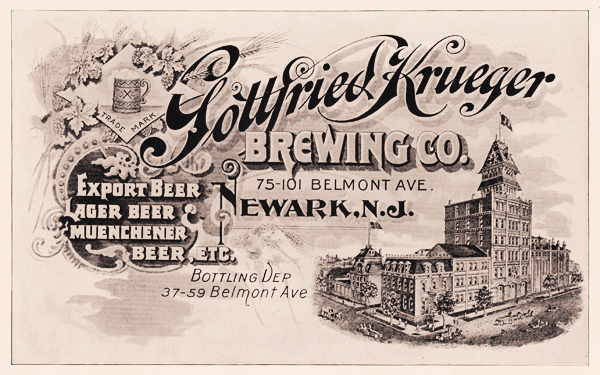
Newark’s beer brewing industry shaped the city, largely due to a once thriving German community. But interfering officials, competing ethnic groups and hostile temperance movements made certain that its place in civic life was never secure. Criminality and occasional violence fueled opposition: the stabbing death of Conrad Bauer, a German beer hall proprietor, was blamed on the existence of “this lager bier saloon and its attractions, this providing of music and dancing, the carrying on of a business which furnishes … such temptation to the young.”

The above anthem appeared a mere five months prior to Bauer’s killing, in the Newark Daily Advertiser of March 5, 1855.

cobwebs

by George Bancroft Duren

Image: imgur.com
Image: imgur.com

Life is like a cobweb:
And we the spiders toiling at the rapid looms of time,
Weave steadily life’s tapestry with a rich thread of years,
Binding the strands of passing days together as we climb
Up to the cobweb’s summit through the sparkling dew of tears.

So with the spider when October comes,
Turning each green leaf to a rattling husk,
We find the finished cobweb hanging there
Deserted in the melancholy dusk.

Life has its grim October, too,
And when it calls we each must leave behind
The cobweb of whatever life we spun
So those to come may test its mesh and find
Our character by what the loom has done.

Newark News editor George Bancroft Duren included these lines in his 1921 collection Written in Sand.

star ledger

by Lynda Hull

Image: Cinema Treasures

Almost time to dress for the sun’s total eclipse
        so the child pastes one last face
in her album of movie stars–Myrna Loy
        and Olivia de Havilland–names meant to conjure
sultry nights, voluptuous turns across
        some dance floor borne on clouds. Jean Harlow.

Clipped from the Newark evening paper, whole galaxies
        of splendid starlets gaze, fixed to violet pages
spread drying on the kitchen table. The child whispers
        their names when she tests “lorgnettes”
made that morning out of shirtboards, old film
        negatives gleaned from her grandmother’s hat box.

Through phony opera glasses, hall lights blur
        stained sepia above her, and her grandmother’s
room is stained by a tall oak’s crown, yellow
        in the window. Acorns crack against asphalt
three floors down. The paper promised
        “a rare conjunction of sun and moon and earth.”

Her grandmother brushed thick gray hair.
        Cut glass bottles and jewel cases.
Above the corset her back was soft, black moles
        she called her “melanomas” dusted across
powdery skin like a night sky, inside out.
        The Spanish fan dangles from her wrist

and when she stands she looks like an actress
        from the late-night movies. The child sifts
costume brooches, glass rubies and sapphires,
        to find the dark gold snake ring with emerald chips
for eyes. She carries the miniature hourglass
        to the sagging porch, then waiting turns it over

and over. Uncertain in high heels, she teeters
        and the shawl draped flamenco-style keeps sliding off
her shoulder, so she glances up the block to Girl Scouts
        reeling down the flag. The child hates their dull uniforms,
how they scatter shrieking through leafsmoke and the sheen
        of fallen chestnuts. She touches the ring, heavy

on a ribbon circling her neck, then thinks she’ll sew
        the album pages with green embroidery silk.
Her grandmother snaps the fan and they raise lorgnettes
        to the sun’s charcoaled face, its thin wreath
of fire. Quiet, the Girl Scouts bow their heads–sleek
        Italian ones and black girls with myriad tight braids.

Streetlights hum on, then the towers of Manhattan flare
        beyond the river. The earth must carve its grave ellipse
through desert space, through years and histories
        before it will cross with sun and moon this way again.
Minor starlets in the child’s album will fade and tatter,
        fleeting constellations with names flimsy as

the shawl that wraps her shoulders. She’ll remember this
        as foolish. The girls by the flag will mostly leave
for lives of poverty, crippled dreams, and Newark
        will collapse to burn like another dying star.
But none of this has happened. Afternoon has stilled
        with the eclipse that strips them of their shadows,

so each one stands within their own brief human orbit
        while the world reverses, then slowly, recovers.

Newark-born Lynda Hull’s “Star Ledger” is from her award-winning collection of the same name, published in 1991.

dirt

by C. K. Williams

ESS Newark Talmud Torah Cem Rebecca Goldberg 1932

My grandmother is washing my mouth
out with soap; half a long century gone
and still she comes at me
with that thick, cruel, yellow bar.
All because of a word I said,
not even said really, only repeated,
but Open, she says, open up!
her hand clawing at my head.

I know now her life was hard;
she lost three daughters as babies,
then her husband died, too,
leaving young sons, and no money.
She’d stand me in the sink to pee
because there was never room in the toilet.
But, oh, her soap! Might its bitter burning
have been what made me a poet?

The street she lived on was unpaved,
her flat two cramped rooms and a fetid
kitchen where she stalked and caught me.
Dare I admit that after she did it
I never really loved her again?
She lived to a hundred, even then.
All along it was the sadness, the squalor,
but I never, until now, loved her again.

Newark native C. K. Williams contributed “Dirt” to the April 12, 1999, issue of The New Republic. It appeared in his collection Repair, published in the same year.

on the roads to newark bay

by Frank J. Urquhart

Image: Library of Congress

Near the old lighthouse pagoda, lookin’ northward from the Kills,
There’s a clumsy bridge a-squattin’ where the Bay wash backs and fills;
And its serried ranks of piling in close order grimly stand
While they buffet back the waters from the swiftly heaping sand.

        On the roads to Newark Bay,
        Where the iron horses neigh,
        Where the meadow grasses murmur o’er the muskrats at their play;
        On the roads to Newark Bay,
        Where the railroads have their way,
        And the locomotives thunder, Eastward, Westward, night and day.

It is thirty years and over since those wooden soldiers filed,
Sent a-scoutin’ by the Central when the people were beguiled
Into thinkin’ ’twas campaignin’ for a year and a day—
But they stuck, those wooden soldiers did, for they’d been sent to stay.

        “Temporary,” Central said;
        “Open bridge, high overhead.
        “We will build a little later”—yes, they will, when we are dead;
        On the roads to Newark Bay,
        Where the railroads hold their sway,
        Where the regiments of piling shoulder closer day by day.

Go ye up beyond the marshes, where the river reaches low,
Where ten thousand steamy bannerets announce the toil below;
Where the forge fires’ labored breathings throb in rhythm with the roar
Of a city hard at making things beside the oozy shore.

        Go ye up from Newark Bay,
        Where they wait a better day,
        When the tides shall team with traffic on a deep, free waterway;
        When our craft shall seaward wing,
        And the coasters commerce bring;
        And the flags of many nations midst our factory smoke shall fling.

We are sick of wastin’ language on the men that rule the rail;
For ’tis wheels, not keels, they’re runnin’, and our pleas do not avail;
Though the West beats at our gateway, cryin’ “More room to the sea!”
And the deep calls to the river, “Come ye closer unto me.”

        Smilin’ face but clawlike hand;
        Law! too well we understand;
        They would rule upon the waters as they dominate the land.
        On the roads to Newark Bay,
        Where the railroads have their way,
        And the locomotives thunder, Eastward, Westward, night and day.

By 1892, three railroad companies—the Central of New Jersey, the Pennsylvania, and the Lehigh Valley—had bridged Newark Bay. This boatmen’s reproach of the rail barons appeared in the Newark Sunday Call of November 24, 1907, four years before the opening of direct passenger service to Newark from Manhattan.

pleasure and pain

by Frederick W. Ricord
from the French of Charles Hubert Millevoye

Image: Tri-State Antiques

Of old, within the realms of Jove,
Came Pleasure and his sister Pain—
Twin offspring of the Queen of Love,
Whom, e’en the gods, to woo, were fain.
The nurse, to Jove, the children brings,
Who throws on each a searching glance.
Pleased with the boy, he gives him wings,
But, to the sister, nothing grants.

“How shall I to the earth descend,”
Asks Pain, “from this abode so high?
How shall I, like my brother, wend
My way, in safety, through the sky?”
Jove answer’d: “Banish your alarms;
On Pleasure’s wings, hence, you may steal;
And, then, those injured by your arms,
Your brother will be near, to heal.”

As nothing, now, their flight could stay,
The twain departed from the sky;
And soon to earth they made their way,
And soon their pow’rs began to try.
With care, did Pain conceal her dart
Beneath her brother’s golden wing;
And, so, when one produced a smart,
The other did a solace bring.

Now Pain, by Pleasure, brought to naught,
Resolv’d, at length, to go alone;
But, then, was Pleasure still more sought,
While Pain, of course, was wish’d by none.
Yet Pain, while Pleasure, she reviles,
Will always near her brother keep;
So he, who with the brother smiles,
Must, also, with the sister weep.

Twice elected mayor of Newark, Frederick W. Ricord was an accomplished translator, issuing two volumes of English Songs from Foreign Tongues. The first, completed in 1878, included this version of “Plaisir et Peine.” Millevoye’s original follows.

                En même temps Plaisir et Peine
                Naquirent au divin séjour:
                De Cythère l’aimable reine
                À ces jumeaux donna le jour.
                Le dieu qui lance le tonnerre
                Leur départit des attributs:
                Il donna des ailes au frère;
                Pour la sœur il n’en resta plus.

                “Qui me conduira sur la terre,
                Dit-elle au monarque des dieux,
                Moi, qui ne puis, comme mon frère,
                Franchir l’espace radieux?”
                Il répond: “Bannis tes alarmes,
                Descends sur l’aile du Plaisir;
                Les blessures que font tes armes,
                Il prendra soin de les guérir.”

                Voilà donc que Peine et son frère
                Viennent nous imposer des lois;
                Sitôt qu’ils ont touché la terre,
                Ils font usage de leurs droits.
                Peine avec soin cachait son arme
                Sous l’aile de son protecteur:
                Quand l’une arrachait une larme,
                L’autre accordait une faveur.

                Et du Plaisir quittant les ailes,
                Peine veut seule voyager,
                Plaisir est caressé des belles,
                Peine … aucun ne veut s’en charger.
                Elle vient, malgré sa colère,
                Le reprendre pour conducteur,
                Et celui qui loge le frère
                Doit avec lui loger la sœur.

newark

by Minnie J. Reynolds

A hundred years he slept beside
The meadows with their salty tide;
Without, the century rushed and screamed—
But still he slept, and never dreamed.

The bees buzzed round him where he lay;
The honied scent of new-mown hay
Came wafted down the village street—
Those hundred placid years to greet.

The second laggard century crept,
Slow loitering on, and still he slept;
But in his sleep he dreamed and stirred—
And on his lips a muttered word.

Troubled, he turned; he vaguely sighed;
His eyes, half opened, saw the wide
Horizons that, beyond his ken,
Swept out into the world of men.

With shriek and shot and clangorous din
Came his third century leaping in;
He sprang to meet it with a roar—
The giant wakes, to sleep no more.

By the salt meadows there he stands,
With knotted muscles, iron hands,
And fills a thousand rushing keels,
And turns ten thousand thousand wheels.

He hurls the rushing trains afar,
He calls where distant peoples are,
And bids them work with sweating speed
His clamorous engines still to feed.

And islands in far southern seas
For him denude their tropic trees;
And in the jungle’s endless night
Toil slaves to feed the giant’s might.

His harvest field is all the earth,
Raw wealth he gleans, and gives it birth
In forms of use for all the world;
His flag of toil is never furled.

By the salt meadows there he stands,
A giant, with his iron hands
Grasping a throttle open wide—
And round him sweep horizons wide.

Image: Library of Congress

Minnie Reynolds was a journalist and executive secretary of the Women’s Political Union of New Jersey. From the WPU’s Newark headquarters she organized rallies and meetings in factories and neighborhoods, in advance of an October 1915 statewide referendum on the question of extending voting rights to women. New Jersey was one of four states that rejected women’s suffrage that year.

Reynolds’s “Newark” was a prizewinning entry in the 1916 poetry contest held for the city’s 250th anniversary.

to esperanza

by Henry William Herbert

121pygmalion1969y
Image: Michael Lenson

Ay! thou art pure, and beautiful, and young,
        With thy dark tresses, and thy neck of snow,
As limner e’er portrayed, or minstrel sung:
        No shadow yet hath stained that lustrous brow,
Nor blighting grief its haggard dimness flung
        O’er those transparent eyes, in which the light—
The beaming radiance of a soul unwrung—
        Floats, like the moon mirror’d on waters bright,
A peaceful glory, incorrupt by wo,
And nearest heaven of aught that shines below;

For happiness to thee hath been a dower
        Changeless and constant.  Passion ne’er came nigh,
To scorch, like summer noon, the delicate flower,
        Bidding its tender charms consume and die;
Nor stern remorse, the coldest, keenest power
        That shakes frail reason on its tottering throne,
Around thee spread the clouds, that still must lower
        When the wild storm, which raised them, far hath flown;
Nor slighted love, nor kindness unreturned,
Chilled the clear flame that in thy bosom burned.

Sweet as home-music to the exile’s ear,
        Are thine untutored harmonies of voice;
And thy light laugh, with thrilling accents dear,
        Compels its every hearer to rejoice;
Thy summer-seeming friends, untried by fear,
        Or doubt, or danger—faithful all, and free—
Thy world, one paradise of deathless cheer—
        Thy life, one voyage o’er a tranquil sea,
Without or rock to break its azure sheen,
Or treacherous shoal the sunny deeps between.

Young hearts have bounded wild, when thou wert by—
        And eloquent tongues have breathed their incense near,
Half aspiration proud—half timid sigh
        And thou hast lent a fondly credulous ear
To creatures of a world—itself a lie!—
        Creatures—that smile and truckle, fawn and kneel,
Giving their breath of life to swell the sail
        That asks no aid, but prompt to turn the wheel,
Veer but one point of fortune’s changeful gale,
In impotent revenge, and paltry hate,
That they were less than thee, their queen of late.

Oh! wouldst thou never learn to rue thy lot—
        To loath the very race, of which thou art;
Scorning it so, that thou canst hate it not—
        Oh! wouldst thou never gnaw thy gentle heart,
Undone, deserted, trampled, and forgot—
        Then soothe not—love not—list not—nor believe!
Hope not on earth to find one holy spot,
        Where foes will spare—and friends will not deceive!
Better untrusting, unbetrayed, to die,
Than look for truth, love, honor, save on high!

In 1836 and 1837 Herbert produced two sumptuous volumes of original literature by American authors entitled The Magnolia. Intended to vie with “the fairest of the European annuals,” it proved too costly and was discontinued. Herbert published several of his own poems in The Magnolia for 1837, including the one here.