I explain the silvered passing of a ship at night, The sweep of each sad lost wave The dwindling boom of the steel thing’s striving The little cry of a man to a man A shadow falling across the greyer night And the sinking of the small star.
Then the waste, the far waste of waters And the soft lashing of black waves For long and in loneliness.
Remember, thou, O ship of love Thou leavest a far waste of waters And the soft lashing of black waves For long and in loneliness.
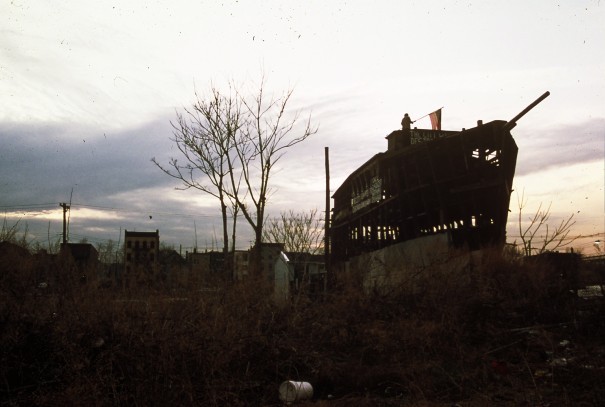
A three-story brick house at 14 Mulberry Place was home to Stephen Crane from his birth in 1871 until 1874. Efforts to save the Crane homestead as a historic site failed. It was razed in 1940, some of the bricks being incorporated into a playground on the site. No traces of this playground remain today.
Author of the celebrated war novel The Red Badge of Courage, Crane published his second book of poems, War Is Kind, in 1899. It featured the lines above.
The thing ye tread, although seeming dead, may turn and wound the heel, And words of brass that seem to pass may come back words of steel. The deeds of man are of boundless span, whether for good or ill, And much of his woe began ages ago, and will last for ages still.
Ye found me fair and as clear as air; ye were careless and dense and dumb. Ye have done thy will with my waters, until ye have made me a thing to shun. For greatness ye sought, and toiled and wrought, unmindful of what ye did To my tides that flow at thy feet, and so my sickening face I hid.
And ye grew in power, but hour by hour, unwitting, ye weakened, too. As ye piled thy wealth there stole by stealth a pall o’er my waters blue. Thy gold heaps grew, but the dross ye threw with wanton scorn to me. Now I bid ye cease; and give me release! Go carry thy scum to the sea!
On every bark I’ll place the mark of the unclean curse ye’ve given. ‘Round shop and stack my steaming wrack shall coil and writhe to heaven. From the sight of me thy people shall flee and hush their merry laughter; And my waters shall spread, with the fever they dread, the death that follows after.
The fouling of Passaic waters can be traced through centuries of human use along their entire 80-mile length. While the river as a whole has entered a period of recovery, mid-twentieth-century contamination of sediments in the lower Passaic so far seems beyond the powers of nature, or human ingenuity, to reverse.
Frank J. Urquhart is best known as the author of A Short History of Newark, first issued by the Newark Public Library in three parts and later collected and reprinted in book form. The work was used extensively in the city’s schools. “The Passaic’s Song of Reproach” appeared in the Newark Sunday Call on March 1, 1903.
They tell me of enchanted lands Where Summer reigneth ever; Where skies divine forever shine, And Boreas rages never. Where gondoliers, on silver streams, ‘Neath halloed arches glide, And mirth and music flood the night As moonlight floods the tide.
And still I read of mystic realms Beyond the shore of time, Where streets are paved with pearly gems, And harps forever chime. Where sexless angels ever sing, In adoration deep, And through the starry corridors Eternal anthems sweep.
But ah! no cloudy palaces, Nor Rome, nor Galilee, Can thrill me like an Essex brook Or Jersey cherry-tree. And every wilding rose whose breath Makes glad a Summer brake With me hath greater power to charm Than Moses’ brazen snake.
On fair Passaic’s placid breast, That ripples toward the sea, I’d rather glide at eventide Than on the Thames or Dee; For there, in boyhood’s happy hour, I plunged beneath the spray, And in the Summer’s golden light Washed all my sins away.
In that delightful blossom-time There seemed nor grief nor pain, And ever as the Spring returns I think ’tis heaven again. And though no castled crags are seen, Nor lordly pageants rare, What fabled land could ever match Youth’s castles in the air!
The sorrow of the whip-poor-will, When lilies drink the dew, To me is sweeter psalmody Than David ever knew. And when the maple-trees are robed In Autumn’s tender mist, Their jeweled crowns are lovelier Than walls of amethyst.
And when at noon the knightly elms Beat back the fervid heat, And laugh to see the babies play About their royal feet, I think no holy nimbus A Rembrandt ever paints So sacred as the tangled gold Of Newark’s little saints.
When I, beneath some daisied roof, Unto my bed shall cling, Methinks each Summer I shall wake To hear the robins sing. And when the roguish mocking-bird Begins his serenade, Old father time himself might laugh And fling away his blade.
Yea, though I wend from land to land, Or mid the planets roam, No fairy isle, nor shining orb, Can be to me like home. For that alone is paradise To which the heart doth cling, And there alone, though tempests rage, Doth reign eternal Spring.
Death is not tragedy; the valiant years Die but to be reborn when fragrant spring Follows the dreary winter; autumn days Cool the hot summer with September winds; Blithe on the heels of blustering March and April Steeped in showers, lo! the tonic May Eternally arrives. About to die, We see ourselves reborn; the wrinkled sire Lives in his blooming grandchild once again; So lives the teacher amid youth reborn That rank on rank interminably moves on Toward structures of a transcendental day.
Stark tragedy is in that living death Which knows not freedom, happiness, and truth With joy of work in tune with sun and stars.
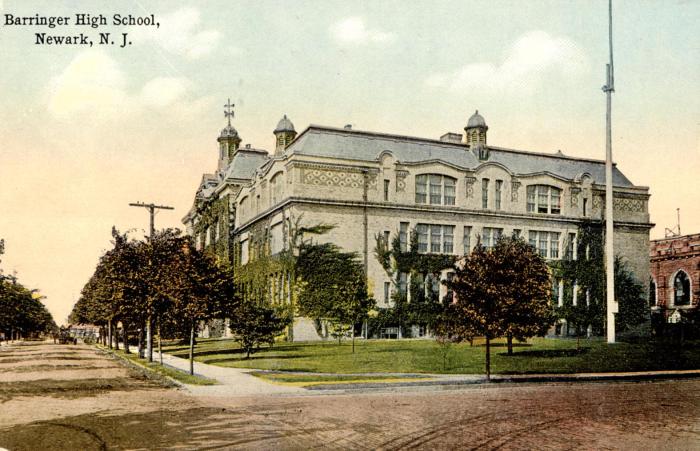
Margaret Coult was the long-time head of Barringer High School’s English department. Louis Ginsberg was one of thousands of Newarkers introduced to poetry through her teaching.
Another of Coult’s students, William Lewin taught English at Central High School when this tribute to Coult appeared in the Newark Evening News of June 26, 1930, a few days after her death.
Would you see hard work with success encrowned? With a thoughtful eye calmly look around; Here, the busy brain and the horny hand Bid their wondrous wares in a pageant stand, And the maker’s thoughts higher still aspire When the women smile and the men admire— Work is ne’er too mean to be deftly done,— ’Tis a small reward that is lightly won.
In the blackest muck snowy lillies bloom, And the sunrise springs from the darkest gloom; In the grimy coal lurks the power of steam, In the shapeless stone sleeps the sculptor’s dream, From the dusty loom fairest fabrics come, Fairy fancies flit through the workshop’s hum, In the plater’s bath silv’ry sheen’s begot, And the picture’s gloss in the varnish pot.
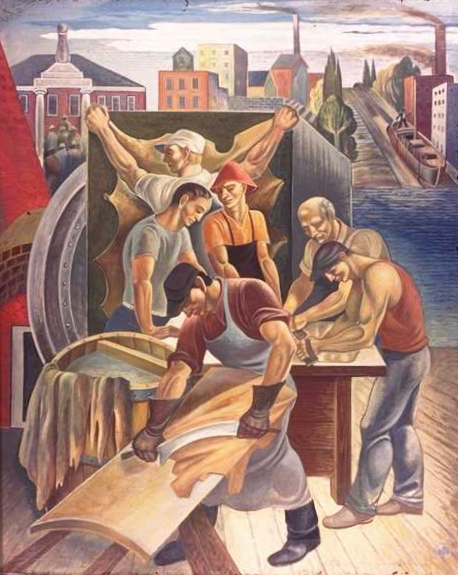
Labor loves its work when it works for love, From the Tanner’s vat comes the bridal glove; From the furnace flame comes the shining steel, And the gleaming gold from the rouging wheel; In the throes of toil perfect art is wrought, Through the mire of ink flash the gems of thought. Breath depends on bread formed of dust and leaven; In the mint of Earth saints are coined for Heaven.
From the dust of earth God made humankind, With the dust of earth Jesus cured the blind; From the blended dust of the earthly mine Men make magic work that’s almost divine. Man, in doing work finds his true delight, Labor speeds the day—toil brings rest at night; When the world was formed out of darkness bleak Great Jehovah wrought one eventful week.
For seven and a half weeks in the late summer and early fall of 1872, the Newark Industrial Exhibition showcased a bewildering array of products from astronomical clocks to saddlers’ tools, baseball bats to hat blocks, washing soap to wax fruit, tinware to underwear, all of it Newark-made. The first such exhibition held in this country, the event demonstrated not only Newark’s unparalleled manufacturing prowess but, in the words of former mayor Theodore Runyon, an “appreciation of the value and dignity of labor.”
The exhibition inspired Frederick Pilch to compose these lines, which were included in his Homespun Verses published in Newark in 1882.
287 was the long road to the newspaper plant my black-handed father would ride beneath the weight of a night sky. A father who works the night shift knows that weight, how it accumulates from within when his mistakes and debt begin to press on his children and wife. And so went his life—
If the stars spelled something real, they might spell the equation that my father never mastered— the news just ran through his hands and what slid there left the black residue of the world’s doings, pressed knowledge that read like misaligned tea leaves in his hardening palms, and in his life line and heart line and other lines that would normally speak a fortune, the night just accumulated itself— a little sky he would spread over us when the world redelivered him in the morning.
Newspaper publisher Samuel Irving Newhouse Sr. merged the Newark Ledger and Newark Star-Eagle in 1939, begetting the Newark Star-Ledger. Newark’s only daily newspaper since 1972, the Star-Ledger opened a suburban printing plant in 1980, and most of its operations are now conducted outside the city.
These lines appeared in the February 1999 issue of Poetry Magazine and in the author’s 2002 compilation Gravedigger’s Birthday.
I dreamed a dream the other night That left all others “out of sight;” Around the Kinney building surged A mob of wild-eyed men, who verged On panic, if a panic grow From masses struggling to and fro.
The mob was decorous if wild, As cultured gentlemen, beguiled By visions of good things, though faint, Would keep their hunger in restraint, Although, when appetites are keen, And limbs are shrunk, and ribs are lean, A well-filled board, in time of need, Will tempt an anchorite to feed.
These men, who thus besieged the Kinney, (All far from fat, and mostly skinny), Though eager as a hound in leash, Were strangely reticent of speech. With well-groomed men they would not pass For fashion-plates, for they, alas! Were chiefly garbed in sombre black, Of cut and style a decade back; Their “pants” (those of a later pattern) Shone like the sun (the parts they sat on), While rusty coats and hats betrayed The pinching of the wearers’ trade.
One thing I’ll say, and oft repeat, These men, in dress so incomplete, For classic nobs could not be beat Within a league of Market Street. Though seedy most, yet here and there Was one who looked quite debonair; “O-ho!” I cried to one of these, Who sauntered ’round, quite at his ease; “Pray tell me,” (for my sense grew hazy) “Have all these gentlemen gone crazy?”
“O, no,” he said: “Each one’s a poet; (Though all their verses do not show it.) They’re here because a dozen prizes In brand-new bills of different sizes, —One thousand plunks in all, I hear, Though it does sound a little queer— Are offered to the poets who Can put in odes the best review Of Newark’s glorious career For this, her Anniversary year. There’ll be a ton of rhymes, at least, For gods and men a bounteous feast.”
“One thousand—what!” I shouted: “Whew! You’re guying me; it can’t be true! How can some humble poets hope To get away with so much dope?”
He said (and confidential grew): “It is the truth I’m telling you; But bards are few of either sex Who ever see a double X. Do’st know why poets fare so ill, While plodding tradesmen get their fill?”
I answered: “No; tell me.” He said: “’Tis competition with the dead. The heroes of the shop and plow Have only rivals living now To test their wits, while every man Who wrote in verse since time began, Is just as much alive to-day As when he turned his toes up (say) Some forty centuries away! You surely know it is not so, sir, With your shoemaker and your grocer! Had Homer dealt in ducks and geese, His fame long since had found surcease. Could eggs of Virgil’s day compete With fresh-laid eggs on Commerce Street? Yet fresh-laid poets of today Find ancient bards blockade their way!”
Just then the crowd thinned out; a few Received their checks; the rest withdrew To brush their threadbare coats anew.
A sunbeam through my window broke And touched my eyes, and I awoke.
The Newark poetry competition of 1916 awarded prizes to only thirteen of the more than 900 poems submitted. The governing Committee of One Hundred did not, in fact, distribute checks outside its Kinney Building headquarters, but mailed them to the (female, as well as male) winning contributors.
“The Bard’s Complaint” appeared in The Newarker of September-October 1916.
In this glorious land of peace and plenty, There are cities rich in fame. But o’er all this land there is none so grand As this “Wonder City” I shall name. There they make almost all things you can mention, Over all this world its products you will meet; In the Garden State it’s that city great, That was founded by Robert Treat.
2
How we all love the sight of Military Or a stroll through Branch Brook Park, How we love to gaze at the bright light’s rays Such as Broad and Market after dark. We are proud of the statue of Abe Lincoln As he sits upon his throne in Court House Square. They all sing our toast clear from coast to coast For they all know that Newark’s there.
CHORUS
Newark you’re a city of perfection, Newark for you thousands hold affection. Good folks are a-journeying, they come from far and wide, Come to celebrate the year to which we point with pride, For twelve score years and ten you’ve led them all, To you they bow: Newark you’re the pride of this great nation, Others look at you in admiration, Even New York with its millions is jealously awed, Admits she hasn’t any traffic like Market and Broad. This world watches ev’ry thing you do Because you’ve shown that Newark knows how.
J. Fred Smith published his “Souvenir Song of Newark’s 250th Anniversary Celebration,” with music by Louise M. Robrecht and arrangement by J. S. Glickman, in April 1916.
The bye-street, the shy street, The street where cobbles gleam, Is quaint and narrow like a lane That drowses in a dream.
The staid trees, the shade trees Are prim old maids that sway; They rustle laces and their gowns And bustle all the day.
Yon garden wall that crumbles Upon the garden grass,— Who knows what lovers it has heard Whispering there and pass?
The bye-street, the shy street That dozes in the shade, It never hears the Traffic roar, Nor hears the tramp of Trade!
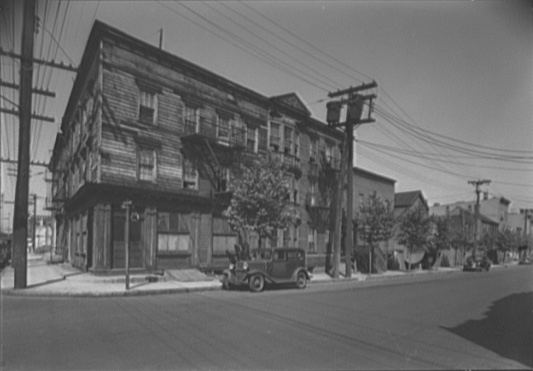
Louis and Naomi Ginsberg lived in an apartment at 163 Quitman Street when their son Allen, the future Beat poet, was born. According to Allen’s recollections in “Don’t Grow Old,” the family later moved to a house on Boyd Street.
“The Side-Street” was included in Louis Ginsberg’s 1920 collection The Attic of the Past and Other Lyrics.




 newarkpoems