Hail, Newark! Hail! Two hundred years plus fifty Is to you but growing time! And you have grown!!! How you have grown Is wonderfully shown In what you are to-day, Not counting what you may Become if but a mite Of all your promised greatness Is fulfilled As it is billed To do For you! Hail, Newark! Hail!
New Jersey’s biggest and her best, Her fairest and her liveliest, Like wine and women, You improve with age, And all the ways and means Of velvet and of jeans, Of brain and brawn engage To make you greater still, Until, Beyond the pale Of earthly progress, On the spirit gale Is borne the glory cheer: Hail, Newark! Hail!!!!
Captain Jinks of the Horse Marines (shown above), a life-sized painted wood figure attributed to Thomas J. White, entered the collections of the Newark Museum in 1924. For decades it stood outside the Jabez Fearey cigar store on Market Street.
“Colonel Bill” Lampton (“Colonel” was an honorary title bestowed by the governor of Kentucky) published light pieces and satirical verses in various newspapers and magazines. During the 250th anniversary year his contributions graced the pages of The Newarker, whose February 1916 edition featured this bit of “humoresque versification.”
There’s a project under way, Every minute of the day, Brainy engineers, Working hard for years, Thanks to their ideas, We’re finishing Newark Bay, That’s just why I say:
CHORUS
Out of Newark Bay, Soon will come the day, Captains will escort, Ships of every sort, To this wonderful port, When everything’s complete—just watch us. Dredges pumping clay, From the bottom night and day, Pictures right before my eyes, A great Commercial centre lies, Out on Newark Bay.
2
Ten score years ago and more, Men had dreams of what’s in store, For the pioneers, Things looked dark for years, Now a light appears, The terminal’s under way, Hip, Hip, Hip Hooray.
CHORUS
Out on Newark Bay, N. J.—U. S. A. At some near-by date, We’ll perpetuate, Our great wonderful State, We’ll put her down in history—just watch us. We’ll be known some day, In a Universal way, Imports, Exports, large and small, Soon we shall receive them all, Out on Newark Bay.
In 1914, under the direction of the Newark Board of Street and Water Commissioners, workers began reclamation of 4,000 acres of tidal wetlands, excavation of a 7,000-foot-long ship channel and construction of docking and handling facilities that would grow into the modern Port Newark.
To increase public interest in the development the mayor proclaimed October 20, 1915, “Port Newark Terminal Day,” and it was likely for this occasion that popular songwriter Edgar Leslie penned the lyrics above. They are preserved on a fragment of a printed program in the collections of the Newark Public Library’s Charles F. Cummings New Jersey Information Center.
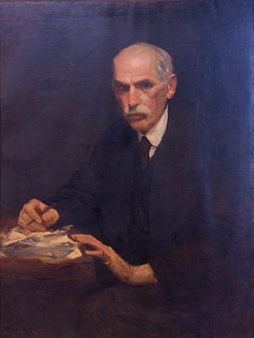
That is his portrait,—high bequest To our Museum’s hall. The artist painted at his best The one whose features well attest What mind and heart install.
There is no genius such as his Midst Newark’s throngs of men. To him be praise for what he is, And for his gracious ministries Past threescore years and ten.
His name and fame are heralded Where lore has reverence. Courageous followers daily tread Ascension paths his faith has led Soul’s triumph over sense.
He holds the keys of Learning’s doors To Wisdom’s House of Light. He gathers Culture’s golden stores, Interpreting the metaphors A city’s dreams incite.
His vision lured the princely gift Of a great merchant’s heart. Fine natures, they together lift The veils from Beauty, turn the drift Of wealth to calls of Art.
What streams of inspiration flow Out of his life’s survey! ’Neath healing shades they gently go, While time can never overthrow The hopes along their way.
All hail to Newark’s honored Sage This five and twentieth year! For him be long and mellowing age, With vistas of earth’s heritage That comes from his career.
LIBERATOR
by Gerald Raftery
He hurled no ultimatum at the state Nor led a revolution out to cry An empty creed against the empty sky. Nor ever did he play upon the hate Of poor for rich, of ignorant for great. And since his slow revolt was fine and high For him no banners dip along the sky, No cannons roar, no millions venerate.
His deed was not a sudden, blaring thing; It was a lifework, patient, unacclaimed. And now before the searching mind of youth The serried thinkers of the ages fling Their gold. This man made knowledge free, unchained; He loosed the slow, invading tide of truth.
To John Cotton Dana, Newark’s great champion of democratic culture, the worth of poetry and the other arts lay in one’s own experience of them. The pioneering director of the city’s library and museum considered popular songs and jingles “good poetry to the thousands who read and love them.” Dana insisted on the presence of poetry “in life itself, in homely everyday relations, in passing sentiments,” whether or not it found expression in the written word. (The Newarker, July 1912)
Lyman Whitney Allen composed his tribute on seeing Douglas Volk’s portrait exhibited in the newly opened home of the Newark Museum. The museum building, paid for by businessman and philanthropist Louis Bamberger (“the princely gift / of a great merchant’s heart”), was dedicated in 1926. In the same year Dana turned 70—on August 19—and marked 25 years of service to the artistic and cultural life of his adopted city. Since 2009 Volk’s painting has been displayed in the Dana Room of the Dana Library, on the Newark campus of Rutgers University.
Allen’s poem was printed in the Newark Sunday Call of March 6, 1927. Gerald Raftery’s, one of many homages paid Dana after his death, appeared in the New York World on September 16, 1929, and in the Newark Evening News three days later.
There is much talk of coming from passing along going toward from a river. Comments put into sparkling form whose luster is not forgotten.
It is good for a child to grow up in a city by a river where concrete can be seen to merge into fluid the static into the ever-flowing.
And a river can give assurance of the power of beauty to surmount defilement and that is important to a child growing up in a city.
This poem appeared in the Christian Science Monitor on August 14, 1975, and was included in Tsuda’s collection Urban River, published in Newark in 1976.
On each side of the Passaic stand The finest factories in the land; And looming up so tall and grand— The stately river thereby spanned— A railroad bridge. Back and forth the steam-car goes, Now and then a whistle blows, Underneath the water flows Down from Orange ridge.
Malaria comes and makes us shiver, Chills and fever make us quiver, Brought by winds that blow forever From the marshes by the river— Flowing down to Newark bay. Spacious streets and handsome parks, Lit by bright electric sparks, Under which the watchman harks To the drunken fray.
On one side of Broad street stands A market with the finest brands. Its stalls display both beef and lambs And choicest fruits from sunny lands, And foreign States. Up and down the people go, Buying cabbages and so Forth—what else we do not know— At lowest rates.
By the factories’ smoke veiled, Laden down with many a bale, Slide the great canal boats, trailed By slow donkeys, which, unhailed, Leave the great sand-bar. In the shops the people gaze, Beauties there their eyes do daze As they look within the maze Of Hahne’s great bazaar.
Many thousand little boys, Who delight in making noise When unconsciously we poise, ’Twixt stern reality and the joys Of sweet slumber, Raise their voices shrill and clear, Fill our startled hearts with fear, Thinking there are dangers near Without number.
Newark, Sept. 3, 1886
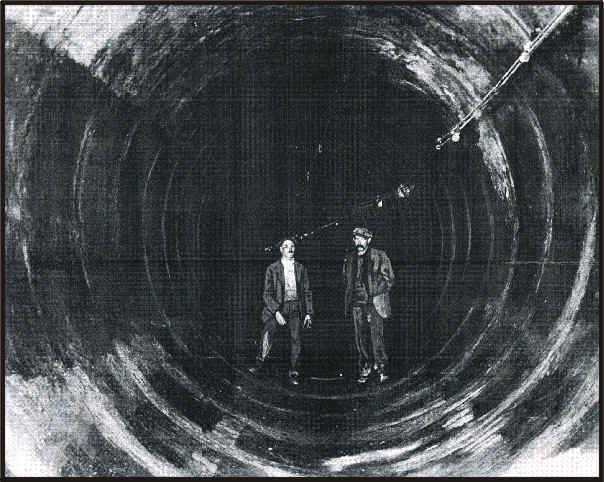
Newark’s poor drainage and inadequate sewerage contributed to deadly recurrences of malaria, typhus and cholera. Towards the end of the nineteenth century the city finally confronted these deficiencies and, from only 49 miles of sewers in 1883, expanded the network to 310 miles by 1910. Portions of this system still operate today. The Newark Meadows, condemned as breeding grounds for fever-inducing mosquitoes, were drained and developed into the seaport and airport in the early decades of the twentieth century.
A clipping from the Newark Journal, which published these verses by “a precocious young miss of thirteen summers,” has a handwritten note identifying them as the work of Miss Frances Depue of Newark. The clipping is found in the scrapbook collections of the New Jersey Historical Society.
I am lost in hot fits of myself trying to get out. Lost because I am kinder to myself than I need Softer w/ others than is good for them.
Taller than most/ Stronger What is it about me that frightens me loses me tosses me helplessly in the air.
Oh love Songs dont leave w/o me that you are the weakness of my simplicity Are feeling & want All need & romance I wd do anything to be loved & this is a stupid mistake.
“Air” was included in Black Magic, a collection of Amiri Baraka’s poems written between 1961 and 1967.
Hail, holy night with all thy quietude And stars. Calmness and gentle rest Cometh with thee, and thoughts higher Than Earth’s low confines. I would Gaze upon the spangles of thy robe, Pulseless and solemn night, And wander in my heart to those far climes, Beyond creation and corruption. I would forget mortality, forget The weariness and strife, sickness And toil of life, and mount afar, Enjoying brief, yet blissful respite From pervading memories of faded joys, Blank hopes, and all the countless Sicknesses of doomed humanity.
Take me, my soul, With wing untired and free, Far, far beyond those angel watches, Even higher than the brilliant pavement Of the sky. Upward mount, nor pause To fold thy pinions, till, heaven’s portal gained, I rest secure. There I would pause awhile And breathe celestial air; there I would List, and catch the notes of those Who long have left our sorrow-haunted spot, To dwell forever near the Throne of God.
As thus I muse, My soul will gather strength To wear a few short years, this weary lot, To bless, nor question it, the wise decree Which places me amid a world of blight, Crushed hearts and desolated homes.
Star-studded firmament, all hail! Beauty, sublimity and solemn light, All hail! And sable, dun-clad night With thy redeeming vestment of fair stars, And all thy quietude, and spells unutterable– Hail! My soul awakes in thy dominion, And rejoices in thy reign. Feels less Her fetters, upward rises, and peers Through the far-stretching canopy Of heaven, strains her keen vision– Catches a glimpse of uncreated day.
Newark, April 3, 1840.
NIGHT MUSINGS
Some fancy, that the Dead No more revisit earth, As birds return not to the bed, That cradled them at birth.
Forbid to look behind, They leave the shores of time, A melancholy band, to find, Like Lot, an unknown clime.
If there’s a gulf between The future world and this, A Bridge of Sighs must intervene, And join them both in bliss.
Heaven bends its canopy T’ embrace the world below; The tears and smiles of earth and sky Blend in one radiant Bow.
Our spirits sometimes flow In an unwonted tide; From souls in Heaven those currents go, By elysian springs supplied.
At midnight’s solemn chime Descend the Spirit Dead, As once they look’d to me in time Ere health and youth had fled.
And chief among them stands One ever-lov’d, and wept, Who nightly comes from shadowy lands, Her dying promise kept.
O night! what skies, what scenes Your portal dark unfolds; Which blazing day blots out, or screens, And only God beholds!
Within the ocean-shell Is heard a murmur low, That seems of mermaid caves to tell, Where groves of coral grow.
Even so, departed friends May feel a lingering love For earthly homes, which memory blends With palaces above.
Has earth such happiness Among her drossy joys, As souls, communing thus, possess, Which time, nor death, destroys?
Newark, Feb. 1845.
Signed “Rosette” and “S. J. G.” respectively, these poems appeared in the Newark Daily Advertiser of April 4, 1840, and February 14, 1845.
Who, curious, undertakes all things to span, By dint of labor all his own, nor can A limit to his mental pow’rs admit, A poor judge makes—a valuer unfit Of self and nature; for the God o’er all Would have us wonder much, with knowledge small, And touch alone what in our way is set. This primal error leads to greater yet, For he who lack of knowledge will deny, Himself with fallacy must satisfy. The mind that’s most at ease, will err the least, Content on knowledge smoothly earned to feast; Nor will it search for that which searching flies. Not knowing some things, ofttimes is most wise.
Frederick W. Ricord was a man of letters and historian, a linguist and educator, and a two-term mayor of Newark. As librarian and secretary of the board of education, he produced three volumes on Roman history for schools.
“Learned Ignorance,” one of Ricord’s many verse translations, appeared with his rendering of Terence’s Self-tormentor in 1885. The original by Grotius follows:
Qui curiosus postulat totum suae Patere menti, ferre qui non sufficit Mediocritatis conscientiam suae, Iudex iniquus, aestimator est malus Suique naturaeque: nam rerum parens, Libanda tantum quae venit mortalibus, Nos scire pauca, multa mirari iubet. Hic primus error auctor est peioribus. Nam qui fateri nil potest incognitum, Falso necesse est placet ignorantiam; Umbrasque inanes captet inter nubila Imaginosae adulter Ixion Deae. Magis quiescet animus, errabit minus, Contentus eruditione parabili, Nec quaeret illam, siqua quaerentem fugit. Nescire quaedam, magna pars Sapientiae est.
my heart at thy sweet voice –Saint Saëns’ Samson et Delilah
The girl flushes the gold seas and her eyes lift with the temperature of the day become two moons…
Her hair is an album of the despoiled countryside I wander sounds of love’s fallen arquebuses devesting themselves
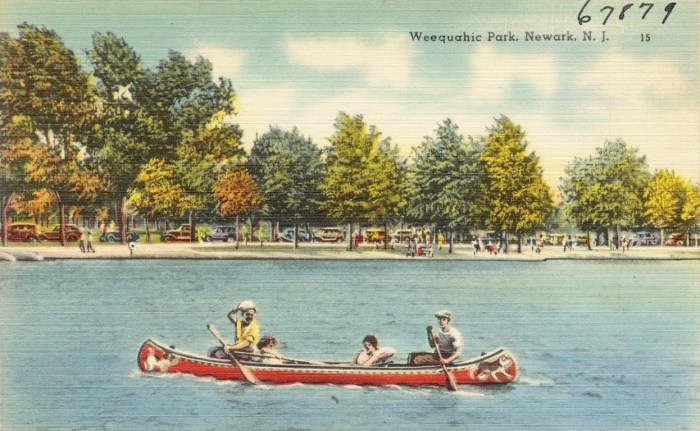
Camille Sabie (second from left in the picture) was a graduate of East Side High School, pursuing a degree in education at Newark State Normal School when she was photographed training in Weequahic Park for the first Women’s World Games in Paris. At the August 1922 competition Sabie set a world record and won the gold medal in the 100-yard hurdles. She also took the gold medal in the standing long jump and the bronze medal in the running long jump. Women’s track and field events were added to the Olympic Games in 1928.
Sotère Torregian’s multiethnic upbringing in Newark led to experiments with internationalist and surrealist poetry. The piece above comes from his 1970 collection The wounded mattress.
In the long days pleasant gloaming, ‘Twixt the sun and stars, When the soul would fain go roaming Free from mortal bars; Gentle night winds stir the roses, As the door of daylight closes In the Western sky; And the shades of dusk fall thickly, As oblivion gathers quickly Over men who die; Tunefully the streamlet’s tinkle In the leafy grove– Tallies with the rhythmic twinkle Of the orbs above.
JULY
Distant drowsy bells are telling Midnight on the air, Denizens of field and dwelling Slumber everywhere; Troops of shadows flee to cover, As the smiling moon peeps over Each umbrageous hill; And amid its lustrous glimmer Dusky woodland aisles grow dimmer, And more silent still; Rills and rivers smile unwrinkled By the slightest breeze, While the foliage droops unsprinkled On the dusty trees.
AUGUST
Crickets chirp and birds are singing At the break of day, While the lavish sun is flinging Streams of tints away; Busy farmers, brown and burly, Haste to labor, bright and early, Ere the day be clear; Making hillside echoes chatter With the loudly rattling clatter Of the reaping gear; While the gleeful children ramble ‘Mid the orchards cool, Or with laughter splash and gamble In some quiet pool.





 newarkpoems