a dream

by Elizabeth Clementine Kinney

Image: Denise Ippolito

‘Twas summer, and the spot a cool retreat–
Where curious eyes came not, nor footstep rude
Disturbed the lovers’ chosen solitude:
Beneath an oak there was a mossy seat,
Where we reclined, while birds above us wooed
Their mates in songs voluptuously sweet.
A limpid brook went murmuring by our feet,
And all conspired to urge the tender mood.
Methought I touched the streamlet with a flower,
When from its bosom sprang a fountain clear,
Falling again in the translucent shower,
Which made more green each blade of grass appear:
“This stream’s thy heart,” I said; “Love’s touch alone
Can change it to the fount which maketh green my own.”

Part of a circle of expatriate artists and writers that included fellow poets Robert and Elizabeth Barrett Browning, Kinney penned verses and essays from Italy for the Newark Daily Advertiser, of which her husband was the founding publisher. She returned to Newark after the Civil War.

“A Dream” is from the volume Poems, published in 1867.

to an old house

by George Bancroft Duren

Image: Vincent Jannelli via American Gallery

Dawn breaks with golden splendor on your roof:
Its molten sunbeams drip along the eaves,
Lighting the windows with a morning smile–
Just as they used to.

And starry night with hands invisible
Blots out the gold and blinds the windows’ eyes,
And shadows quicken on your lacquered roof–
Just as they used to.

Daybreak and dusk: they come and go the same.
And yet there is a difference and a pain:
I am not there to greet each sun and moon–
Nor shall I be again.

George Bancroft Duren was an editor of the Newark Evening News where several of his poems first appeared. This one is taken from his collection Earthbound, published in 1926.

summer afternoon

by Louis Ginsberg

Image: Newark Public Library via The Star-Ledger

The sky pours gold, raining in a shower
        Fluid sunlight down to flood each street,
Deluging all the world in the hot noon hour,
        Till the teeming city simmers with the heat!

Sunlight spills along the allies and the byways;
        All the air is crowded with scents upon the breeze;
Sunlight inundates the busy marts and highways;
        While pale gold light is shaken from the trees!

Radiant with gold are passing girlish faces–
        Radiant gold of sunlight which drenches and clings!
Streets drink brightness and blaze to flaring places;
        And round a hurdy-gurdy, children dance rings.

Popular poet and Newark native Louis Ginsberg published this in his 1920 collection The Attic of the Past and Other Lyrics.

fountain moved

by E. Alma Flagg

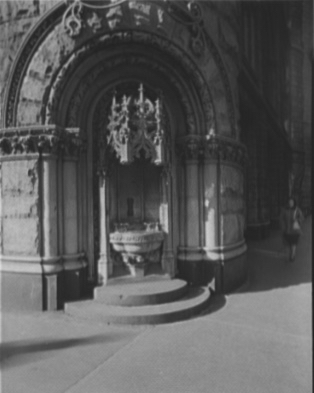
Image: Library of Congress

Years of my youth,
Long walks to the library,
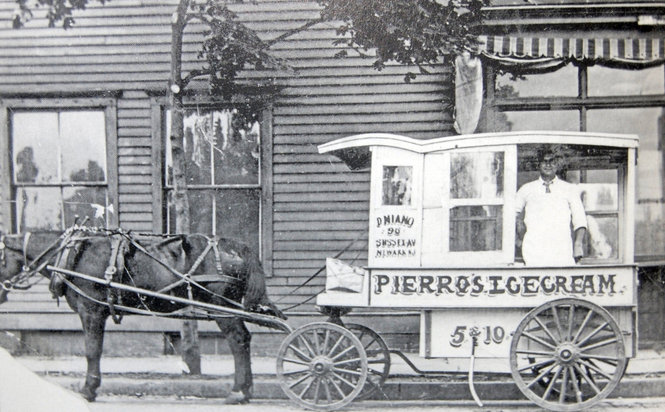
Short stops in the five-and-ten.
Massive gray building,
Busy street corner,
Greatest street ever.
There was the fountain,
Endless clear water
For all thirsty travelers…
Cool, soothing water,
Treating my being
With refreshment through and through…
New buildings there now,
Old ones demolished–
Feet, take this body
To the Museum garden.
There is our fountain!

In 1903 sculptor Samuel Thornton fashioned a limestone fountain to adorn the headquarters of the Prudential Insurance Company at Broad and Bank Streets. In keeping with the overall design of architect George B. Post, Thornton employed forms of French Gothic architecture. When Prudential demolished this building in the 1950s to make way for a modern office tower, the landmark fountain was donated to the Newark Museum. It may be seen today in a corner of the Museum’s garden.

Alma Flagg’s poem was published in Feelings, Lines and Colors (1980).

to a city sending him advertisements

by Ezra Pound

IMG_4232

But will you do all these things?
                You, with your promises,
        You, with your claims to life,
Will you see fine things perish?
Will you always take sides with the heavy;
Will you, having got the songs you ask for,
        Choose only the worst, the coarsest?
Will you choose flattering tongues?

        Sforza . . . Baglione!
Tyrants, were flattered by one renaissance,
        And will your Demos,
Trying to match the rest, do as the rest,
The hurrying other cities,
Careless of all that’s quiet,
Seeing the flare, the glitter only?

Will you let quiet men live and contrive* among you,
        Making, this one, a fane,
        This one, a building;
Or this bedevilled, casual, sluggish fellow
Do, once in a life, the single perfect poem,
        And let him go unstoned?

Are you alone? Others make talk and chatter about their promises,
Others have fooled me when I sought the soul.
And your white slender neighbor,
                a queen of cities,
A queen ignorant, can you outstrip her;
Can you be you, say,
As Pavia’s Pavia
And not Milan swelling and being modern despite her enormous treasure?

If each Italian city is herself,
        Each with a form, light, character,
To love and hate one, and be loved and hated, never a blank, a wall, a nullity;
Can you, Newark, be thus, setting a fashion
But little known in our land? The rhetoricians
Will tell you as much. Can you achieve it?
You ask for immortality, you offer a price for it, a price, a prize, an* honour?

You ask a life, a life’s skill,
                        bent to the shackle,
                        bent to implant a soul
                in your thick* commerce?
                                Or the God’s foot
                struck on your shoulder effortless,
                being invoked, properly called, invited?
I throw down his ten words,
                        and we are immortal?

In all your hundreds of thousands who will know this;
Who will see the God’s foot, who catch the glitter,
The silvery heel of Apollo; who know the oblation
Accepted, heard in the lasting realm?

If your professors, mayors, judges . . . ? Reader, we think not . . .
Some more loud-mouthed fellow, slamming a bigger drum,
Some fellow rhyming and roaring,
        Some more obsequious back,
Will receive their purple, be the town’s bard,
Be ten days hailed as immortal,
        But you will die or live
        By the silvery heel of Apollo.

Ezra Pound was living in England in 1916 when he received a notice about the Newark poetry competition marking the city’s 250th anniversary; this was his entry. The submission did not sit well with some members of the organizing committee, who called it “a poem of violence directed at the head, heart, and hands of Newark.” Whatever the intent, this was not the first time Pound used his pen to slight the city: a year earlier he wrote in the journal Poetry that increased investment in the arts would raise property values “even in Newark, New Jersey,” that is, “if Newark were capable of producing art, literature or the drama.”

In Pound’s verses the judges detected some merit–perhaps a challenge, perhaps even a vein of sympathy–and awarded them one of the ten lesser prizes of $50. The work went with the other winners into The Newark Anniversary Poems, published in 1917. Nor was this quite the end of Newark’s dealings with Pound. Homer Pound, the poet’s father, arranged with the Newark Sunday Call for a series of articles by Ezra on literary topics. Only one, about novelist Henry James, ever appeared.

A note on the text: The poem is given above substantially as printed in 1917, but we have altered three words on the basis of manuscript images supplied by courtesy of Yale University. These are indicated by asterisks.

newark moon: two poems

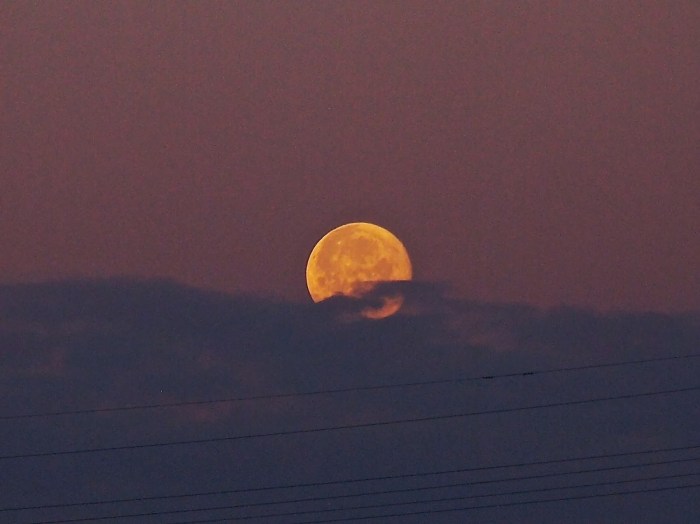
Image: Dr. Dick's Report
Image: Richard Wilkins, Jr.

EPIC WAS THE VOYAGE

by Larry Pendleton

Ho! The Sea of Tranquility
Where Man did not hold sway
Until two daring Astronauts
Walked on the moon that day …

Nations gasped and gaped in awe
The impossible had been done
Three valiant Voyagers roared thru space
Beneath the scorching sun …

Their Lunar module touched-down on moon
The Solar Winds moaned low
Silence filled Time’s Great Halls
As they muttered “it is so” …

It was an Epic Voyage
All mankind thrilled to see
Puny Man a giant in deed
From moon to earthbound sea …

We hail our mighty Astronauts
Our voices raised on high
Almighty God consented
And man vanquished the skies …

“Quo Fata Ferunt”


MIRE! MIRE! LA LUNA!

by Margaret Tsuda

The moon
full/radiant/fair
unshadowed by earth
hung just beyond
the reach of fingertips.
But
in the concrete dusk
of the city
only at street crossings
could the splendid sphere be seen.

At one corner
a clump of urchins
tumbled out of a doorway.
Rough and a bit ragged,
I thought as
I passed among them.

Then, behind me
rose a cry
loud/shrill/urgent,
“Mire! Mire! La luna!”

How many other
child-throats
in how many other tongues
gave voice that night,
“Look! Look! The moon!”
as planet earth and satellite
turned together
in their soundless spatial
harmony?

Above all speech
all difference of language
the moon serenely
pours forth
luminescent beauty
equally
over all who look
toward light!

Larry Pendleton was an employee of the Newark Post Office District and a journalist for the New Jersey Afro American. His tribute to the crew of Apollo 11 was printed in the September 8, 1969, Congressional Record where he was identified as Newark’s poet laureate.

Margaret Tsuda’s poem was published in The Christian Science Monitor of March 19, 1973, and in her collection Urban River (1976).

ode on the dedication of fairmount cemetery

by Henry William Herbert

Image: Old Newark
Image: Old Newark

This is God’s Acre–meted years ago,
While yet they battled with the tawny foe,
And laid the patriarchs of the forest low,
By those who first–where bright the waters gleam
Of reedy rimmed Passaic’s sylvan stream,
Or ere they broke the glebe, or turned the sod–
Planned in the wilderness a Church to God,
And set this mount apart, then forest-clad
And gay with leafy garniture, and glad
With countless blossoms.

                                        We, who fill the places
Whence long have passed their once familiar faces,
Though years have flown since they their work have done
And sleep, no more to greet the awakening sun,
What, in their poorness, they left half undone,
Would do of our abundance, which hath grown
Great from their small beginnings, and outflown
With giant wings, belike, the topmost bent
Of their aspirings. For if He have lent,
Who will not be forgot, nor doth forget
The talents He at interest hath set,
We would not be found unavailing quite,
Thankless and profitless, when comes the night,
And this world all departs with the departing light.

        This is God’s Acre!–So the Saxon phrase
Hallowed the place of graves, in those old days
When poetry was not a thing apart,
But breathing and alive in every heart.
God’s Acre–in it must the seed be strown,
The mourner’s seed, in dark corruption sown,
Which incorrupt shall grow, of mortal made
Immortal and Eterne. In it must fade
All sweetest flowers of earth, and in it lie
The germs of all, that ere it live must die–
The wheat, the tare, the fumitory rank,
The hellebore that taints the innocent bank
Of brightest blossoms. To it must go down
Alike the captive’s chain, the kingly crown,
The gracious odor of the good man’s worth,
The pomp heraldic of the great man’s birth,
The hero’s glory, that new worlds hath won,
The miser’s thrift, that hath himself undone,
The humble merit that did good by stealth
And nought assuming, gained eternal wealth.
The love, that loved not wisely, but too well,
The haughty strength by too much pride that fell,
And frailty’s penitence, and sin’s despair,
Wisdom, and intellect, and genius rare,
The bloom of beauty, valor of the brave,
Levelled, alike, and equal in the grave.

        God’s Acre–From it must the harvest grow
Ripe unto judgment, when the trump shall blow,
Startling the sleeper of ten thousand ages,
Opening the seals of the Apocalyptic pages,
Shrivelling the empyrean like a scroll,
Rending the solid globe from pole to pole,
What time, “the actions only of the just
Shall blossom into glory from the dust.”

        Let them sleep on ’till then, life’s fever o’er,
To work, to fold the hands, to weep no more,
Until awakened on the farther shore
Of Time’s spent ocean. Let no hand profane
Disturb the landmarks of their dread domain,
The kingdom of the awful dead–whom Death
Has hallowed, and secluded from all breath
Of praise or censure–which we consecrate
This day forever to their solemn state,
And sanctify to Him whose ends sublime
Are of Eternity and not of Time.
And may His eye, which ceaseless watch is keeping
O’er all, who live, and all beneath us sleeping,
So look upon us, while we linger here
’Mid scenes, though mournful, still to memory dear,
That when the work and weariness be o’er,
And the Dark Angel, halting at our door,
Summon us homeward, we may go to rest
With perfect hope and strong conviction blest,
And find the Peace, which none may understand,
And Love eternal in His Promised Land!

Through the late nineteenth century one could enter a monumental gate on Broad Street (seen in the photograph) and visit the final resting place of Newark’s first settlers. The Old Burying Ground was slowly erased through neglect and the encroachments of the burgeoning city. The remaining bones and tombstones were transferred to a crypt in Fairmount Cemetery in 1889.

English writer-in-exile Henry William Herbert composed the above verses for the opening of Fairmount Cemetery in 1855. In the melancholy isolation of The Cedars, a rustic dwelling he built overlooking the Passaic River, Herbert wrote popular works on horsemanship, hunting and other sports using the pen name Frank Forester. Eighteen years after his death by suicide, the Newark Herbert Association provided a marker for his grave in Mount Pleasant Cemetery, just south of where The Cedars once stood.

sappho is alive and well

by Hazel Crawley

Image: Queer Newark Oral History Project

Yes, Sappho is alive and well;
Within my life’s blood does she dwell.
My short-lived joys, my long-lived pain,
Command her into being again.

Despite long spans of dried-out Hell,
Despite my mask, despite my shell,
Despite bans, Witch Hunts, family …
She thrives … and she abides in me.

No other format gives me sway;
Only her candle lights my way.
Let canons, tomes, toll our death knell …
I tell you, ‘We’re alive and well.’

Newark’s official gay pride celebrations date back to 2005. The rainbow flag was raised in front of City Hall in 2007 for the first time, a ceremony repeated each year in July.

Hazel Crawley’s poem appears in her 1975 collection Erratica.

little brown jug

by Amiri Baraka (LeRoi Jones)

Version 2

Who are you?
A lost brother.
A singer. A song
I lost, almost, sat up
one night, itched
till it came
to me, cried
one night, happy
that it played
through me.

Little Brown Jug. Nigger Brother.
Dust singer in
the shadow of old
fences. Companion, of melody
rhythm
turned around heart runs
climbed & jumped screaming
WE ARE GODS, as we
sailed years through the firmament
landing beside a
garage, Dear brother, song
slides the streets, circles the cold,
sweats on summer fruit, Oh I
love my black energy &
lost brother father serenade
me, as world-solo, the spirits
bubble, loft, & say
where you are. I suffer
to hear you so tough
& know all the spooks
who need to.

In the 1964 essay “Hunting is Not Those Heads on the Wall,” Amiri Baraka (as LeRoi Jones) famously wrote: “Art is one of many products of thought. An impressive one, perhaps the most impressive one, but to revere art, and have no understanding of the process that forces it into existence, is finally not even to understand what art is.”

“Little Brown Jug” is from Black Art, published in 1966.

newark black: 1940-1954

by C. K. Williams

Vailsburg (Newark)

Black coal with a thunderous shush
plunging into the clearly evil-inhabited coal bin.
The black furnace into whose maw
you could feed paper to watch it curl to black char.

The hats women wore with black, mysterious veils,
even your mother. The “mascara” she’d apply
more meticulously than she did anything else.
With her black lashes she was almost somebody else.

The incomprehensible marks on blackboards at school
you conquered without knowing quite how.
The black ink in the inkwell. The metal pens
with blots that diabolically slid from their nibs.

Black slush, after the blizzard had passed
and the diesel buses and trucks were fuming again,
but you still remembered how blackly lovely
the branches of trees looked in new snow.

The gunk on the chain of your bike.
The black stuff always under your nails.
Where did it come from, how to get it out?
Even between your toes sometimes there was black.

The filthy tires hung on hooks in the garage-store
we had to pass through to get to our shul.
Black Book of Europe, first proof of the war on Jews—
illicit volume, as forbidden to Jewish children as porn.

Black people the states in the South began to send up,
keeping what they needed for cheap labor and maids
and exporting the rest: a stream of discarded humans,
with the manufacturing plants just then closing down.

The photo of black children in the ‘20s, frolicking
on the bench of the Lincoln statue by the courthouse.
I took the bus once to go sit in its lap, his lap:
how kind he looked, how surprisingly hard his bronze lap.

The other statue, Captive’s Choice, in a park:
the girl kidnapped by Indians who forgets she’s white,
then, “saved,” gives up Indian husband and children.
Who decided it should have been that, and there?

The first black kids in our school, fine with me,
because Clarence Murphy, sixteen in fourth grade,
stopped beating me up because I’d killed Christ
and raged instead with even more venom at them.

I was afraid of Clarence but not of black people,
except that day on the bus: the sweat-stench of men
who’d worked hard and not had time yet to change.
Though I already knew it was shameful, I fled.

“Blackballs” to keep Jews, Italians, and Irish,
then naturally blacks, out of the country clubs
in Maplewood and Montclair. The unfunny jokes
about signs on their gates: No Dogs, Niggers, or Jews.

Our gangster hero, Longie Zwillman, who had a black car;
so did our mayors—bought off, we were told by “interests.”
Irish, Italian, finally at last a black mayor:
all the bought-off ones with their Cadillacs of corruption.

Thick soot on the bricks of the mills by the tracks,
smoke billowing, then extinguished forever.
Rivers with rainbows of oil on their surface,
their beds eternally black venomous chemical sludge.

Miles of black turnpike and parkway pavement
scrolled out onto the soil of the no-longer farms.
You could speed now from one place to another
and not see the slums, the factories in broken-eyed ruin.

Everywhere ruin—did nobody see it arriving?
Urban flight, urban decay, shopping centers and malls,
the department stores downtown shuttered,
then small businesses, theaters, and the rest.

The finally unrecognizable city, done in by us all.
Only the ever benevolent Lincoln, unblackened
by time or pollution, emblem of promise and hope,
patiently waited, patiently waits.

Image: Bongiorno Productions via Newark Museum

C. K. Williams offered this remembrance of his Newark boyhood for the 2011 anthology New Jersey Noir edited by Joyce Carol Oates. He reissued it as “Newark Noir” in his own Writers Writing Dying (2014).